Prikazani su postovi s oznakom Sabbats. Prikaži sve postove

2.8.16

Awakening Our Inner Strength at Lughnasadh


Provoked by my yesterday's tarot reading, I decided to write this post since one card simply imposed itself on my as the key card. The card in question is the Woodward card from the Wildwood Tarot set. It is the eleventh card of the Major Arcana and, as such, is connected to the Strength card of the much more common, one one even say "classical" Rider-Waite Tarot (although Strength can be the eighth or eleventh card of the Major Arcana depending on the edition).


Parallels between these cards are clearly visible since the iconographic basis of the Strength card is a woman controlling a lion, but with her mental composure rather than through sheer physical strength. Her male equivalent in the Wildwood Tarot equally calmly reigns over his territory and the animals around him (which is made obvious by the lynx lying at his feet and the mountain lion head he wears as a symbol of his hunting success, prowess and strength).
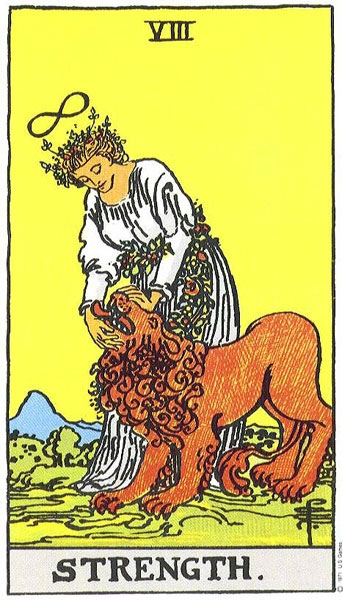
Yesterday, I actually did a reading especially for Lughnasadh to see what this Sabbat brings me, or rather what awaits me in the following months. I picked out the Woodward as the final and definitive card of the reading, which had quite a strong impact on me. To make things even more interesting, the authors of the Wildwood Tarot made a Wheel of the Year on which they placed all of the Major Arcana cards so that their meaning correspond to a particular part of the yearly cycle. And guess which point of the Wheel of the Year the Woodward is on? Precisely on Lughnasadh/Lammas.

One of the connections between this card and the Sabbat is the hill you can see in the background. It's known as Silbury Hill and is located just south of Avebury, England. It is the largest man-made mound found to this day. Archaeologists have found that its creation began at about 2 660 BCE, most likely at the beginning of August (i.e. after the first harvest). Some interpretations of the mound claim that it was a symbol of this time of the end of the first harvest since the hill was visible on the horizon from Avebury only after all the wheat from the surrounding fields had been harvested (as the wheat was too tall and obstructed the view).


Be that as it may, the message I got from this reading has to do with inner strength and balance which are necessary during this time of year. So, I would like to share my musings with you in hopes that I will encourage you into further conquests during the following months.

First, allow me to explain the make-up of the card. The central male figure represents the archetypal guardian; a strong man with all the markers of masculinity (a beard, mustache, war clothes, a weapon that is still bloody to make it even more pronounced) who governs over the surrounding territory. However, what is unusual in this depiction is that the man has not taken a stance of attention, or perhaps offense. Rather, he stands as if he is resting - he has lifted one leg on a sort of tump and is drinking wine from quite a fine cup which the authors of the set describe as the chalice of "giving, intoxication and compassion". Although Mabon is yet to come in September, wine plays an important role in this card as a symbol of sharing and celebration of the collected harvest at Lammas. However, what is most important in this card is the man's relaxed, even kingly posture due to which he simply radiates his inner strength.

The original symbolism of the Strength card warns us that we will achieve much more with patience, if we are balanced and filled with love than if we succumb to feelings of anger and hate.
We all come across obstacles in life. In the Wheel of the Year, the following winter months are that obstacle which could, in ancient times, only be crossed with persistence, balance, moderation (e.g. in the consumption of food during these months), careful planning of supplies and patient, diligent collecting of the fruits of one's labor in late summer and early autumn. This enabled people to sustain life during the winter months. Inner strength and persistence are what make us go on and not lose hope when we encounter every obstacle. I find the following description of this card from the authors of the Wildwood Tarot quite fitting at this moment:
"The Woodward, an ancient guardian of the Wildwood, symbolizes the inner power that comes from facing fear and understanding the nature of darkness. The inner strength that comes from this awareness gives the individual the emotional body language and the humility that says: 'I am not a victim. Treat me with respect. Do not mistake my passivity for wakness'." 

What usually happens is that people live in the belief that they are strong and that they can do anything, or perhaps that they cannot do anything and are too weak. But things become clear only when we are faced with a moment of crisis. Only then do we truly get to know our capabilities and true strength. However, crude strength cannot be our only focus. I must once again quote the authors of the Wildwood Tarot who really very poetically describe this card:

"The strength of the Woodward is both a balance and a dichotomy between te energy of the hunter or the guardian, and the grounded inspiration found within the ecstasy of drumming and war dancing. These energies honor the qualities that provide protection and inspiration." 
Whether we are dealing with a situation of crisis, facing the unavoidable truth, a private or professional problem, the Woodward tells us that we can survive it all with enough persistence and inner strength.

To return to the Wheel of the Year, imagine a farmer who works hard the whole year round planting and taking care of his wheat fields. And then comes the first harvest when he is expected to collect all of this wheat. He is exhausted from all the previous months of hard work and now he has to draw strength out of nowhere to finish the job. He has no choice; he has to do this despite the fact that he is at the end of his tether, that he is lacking patience and is wavering under the scorching summer sun. This harvest is what he and his family depend on for survival. To continue, he needs his inner strength.

Lughnasadh marks the beginning of the harvest when we collect the fruits of our labor. Sometimes these fruits manifest in the shape of rewards for all our effort and right decisions, but sometimes as the consequences of our wrong decision. However, we must know how to accept both and learn from experience.

With this, I wish you all a happy and blessed Lughnasadh! May your first harvest be plentiful!
Yours,
Witch's Cat

30.1.16

Winter as a Time of Clean(s)ing


In a few days (on February 1/2 traditionally, or astronomically on February 4) we will be celebrating Imbolc - the midpoint of winter. A few days ago, I went on an outing and treated myself to a day of relaxation during this very active period of my life. The outing itself just confirmed the general state which seemed to me that not only I, but many people around me were also in. The state I am talking about is that of hibernation, or better put winter passivity.


Watching nature, it is very easy to notice this same state in the dry ground, naked tree branches, the fog stretching out over the rivers and in our visible breath in the air. Winter is in itself a passive period what both humans and animals feel the need to sleep and when a kind of lethargy prevails. But that's completely natural. Although, Imbolc reminds us that we have to slowly awaken, motivate ourselves to get out of bed (be it actual or metaphorical) and get moving.

In the midst of this cold natural world in which we found ourselves where we could see only naked, fallen branches, cracked earth, fog, where the smell of dampness and moss dominated and only silence could be heard, there came to us a small robin - that wonderful, cute little bird that was our first hint of spring. And truly, once of the symbols of Imbolc is the red-breasted robin who, at this time of year when the snow starts to melt (even though there isn't much snow where I live), stops living on berries and starts searching for insects hidden in the soil. He brought to us a ray of flash of color in the middle of the gray winter landscape. In this sense, the robin is one of the many indicators of spring.

It's interesting that I went on this outing with the aim of releasing certain emotions, or rather discarding the redundant and welcoming the new. However, at the time, I had completely forgotten that this is also one of the traditions of Imbolc. That is to say, the lite motif of Imbolc is cleansing. It is necessary to cleanse oneself, one's surroundings and even physically clean up in order to get rid of the unnecessary burdens in life and get ready for the active part of the year that is to come. We often don't take account of how many things accumulate in us and around us; how much all of this suffocates us and fetters us in life. The causes of this can be various. Sometimes it's people who suck out our energy; who tire us out. Sometimes it's problems that are simply there, thanks to us or not. Sometimes it's emotions which prevent us from further spiritual and mental growth. Imbolc (or rather the period around it) and the Imbolc ritual itself are there precisely for this reprobation of everything that is wasting and suffocating us.

All of this is done with the aim of cleansing and getting ready for the oncoming period which begins with Ostara in March. From the agricultural viewpoint, some seeds are already planted at Imbolc (which is why seed blessings are often a part of the Imbolc ritual), albeit the actual sowing season begins at Ostara. For a spiritual/emotional aspect, it is a good idea to prepare the terrain for the "sowing" of new ideas. This means cleaning the terrain, "loosening the emotional earth" and nurturing our seeds (ideas, certain characteristics, individual personalities, emotions, self-confidence etc.). It's not enough to simply plant a seed for it to grow. Many preparations need to be done before hand, such as offering love to the seed and nourishing the earth in which it will be planted. I believe you can further extend this metaphor yourselves. Anyway, one of the traditions of Imbolc is (pre-) spring cleaning of both the home and the individual identity. However, this is usually done on the eve of Imbolc, which falls on January 31 this year.


Cleaning automatically makes room for novelty and therefore also prosperity and fertility. I would like to prompt you to treat yourselves and relieve yourselves of some burdens life brings for this Sabbat. Do some "deep cleaning" - clean your car and home thoroughly, mop your floors, vacuum your rugs, shake and air them out, don't forget to vacuum and dust those hidden corners that you tend to skip usually. Check your closets, shelves, drawers, your fridge and see if there's anything that needs to be thrown away (food that's past its expiration date, ripped clothes, worn out shoes, heaps of papers and old magazines, useless objects that you never use and so on). Don't hesitate. We all have the tendency to leave things aside on the basis of "you never know when this could be useful". If you don't keep something because you will really need it, then you are doing this out of some other, intrinsic need. Nobody other than you yourself can determine what this ulterior motive is.

When I start cleaning around the house, I really am thorough - I go over every shelf, every corner in every room and crazily start throwing away everything I don't need. Here are some principles I usually stick to when cleaning:
  • I form four heaps: "to sell", "to throw out", "for recycling" and "gifts/donations" (to a specific person, or a charity, library, home and so on). If the object at hand doesn't fall into any of these categories, then it means that I can keep it and that I either really need it or that I really don't want to get rid of it.
  • You don't need to throw away absolutely everything. You may want to keep a little trifle because it may be of strong sentimental value to you, but you also shouldn't overdo this. It's OK to keep a few photographs, or one or two trinkets, but not fifty. Sentimentality is one thing, but arrestment in the past is another. It's a good idea to throw away things for past relationships for the same reason.
  • I throw away things (so to speak; you can give them away/sell them etc.) that I haven't used in over a year and can't see myself using in the next six months.
  • I get rid of things that bring back bad memories and which I really don't care for.
  • Throw away things that have "expired" - rotten food/drinks gone bad, torn, broken, worn out things which are not worth fixing/cannot be fixed or reused in a different practical way.
  • Throw away unfinished things. If you started this particular project a long time ago and still haven't finished it and if you don't plan on doing so, you don't need to kid yourself (especially if you find yourself saying: "Wow, I forgot about this!").
  • When cleaning out your closet, throw away everything you can't wear anymore (because it's too big/too small/worn out/torn/uncleanable/looks bad on you etc.). If a pair of pants can be taken in a bit, take them to the seamstress to get fixed the same day, or the next at the latest. If they really can't be saved, then I just "throw them" away immediately. There's no need to keep things that are too small for us, that we have outgrown and that we may want to wear again in some distant future. These things keep us stuck in our past in which we were thinner, going through a phase and so on. There's not need to go back. It's better to look towards the future. Also, don't forget to throw away worn out, old underwear and odd socks.
  • If I don't see a use for it, I throw it out! I always get rid of things that I once got as a present/bought and never used (or used/wore once and weren't satisfied with) and for which I simply don't see a use anymore. They can be appliances, books, clothes/shoes, decorations etc.
  • Thoroughly go through papers! I always throw out old pieces of paper, newspapers, magazines, stacked up receipts, deposit slips and the like. This is an incredibly tiring task because you need to go through so many papers in detail. Papers, old notebooks, magazines and similar things end up in the recycling bin without too many questions being asked. However, receipts and similar more important documents need more detailed examination. I personally throw away receipts for things that I cannot return any longer, for things that are no longer under warranty and for those that I am satisfied with and don't plan on returning. After this, I throw about all the receipts/deposit slips etc. that are more than a year old. Once I have sorted these papers into two piles ("to throw out" and "to keep"), I neatly put away those which I need to keep in files, registrators or using some other filing system. I also develop an organizing system for these papers. Usually, I categorize them by the domain/obligation they are connected to, such as "bank", "school", "business", "bills" etc. and further file them by date.
  • Decorations, or useless kitsch? I like to throw away old decorations and other impractical objects that don't remind me of anything in particular and which I keep "just for the sake of keeping". These objects just end up collecting dust on your shelves and suffocate your home.
  • Don't forget your bathroom and medicine cabinets! I always have a detailed look at the cabinets and shelves in my bathroom and throw away all medicine that is past its expiration date (they really do present a health threat!).
  • Piled up cosmetics are always a problem. This is why I go through my cosmetics and throw away anything that cannot be used any more (because it's just gotten old, too hard, too watered down, past its expiration date etc.). By the way, when I say "cosmetics", I'm not only referring to lipstick, eye shadows etc., but also to creams and any other skin-related products you might have.
  • Check your jacket pockets and bag (or bags as the case may be for most women). Completely empty them out, vacuum them if necessary and throw away everything that has piled up in them and that you don't need anymore. You would be surprised at what you can find there; from money, to stray bits of paper, old tissues, forgotten cosmetics and so on.
  • Take care of your computer! Junk can pile up in the virtual world as well. Regularly cleaning your computer is always the best option (the same applies to real life), but theory is one thing and practice entirely another. When I clean my computer, I use the following programs: CCleaner, AVG antivirus and Defraggler. Research what these programs do; you'll be able to figure out which ones you will find useful. It's also a good idea to delete any duplicate documents or those that you really don't need anymore and make a backup on an external hard drive, or online (for example, using Google Drive or a similar application).
  • You can't forget about the big things such as cleaning your curtains (this is best done once or twice a year because your  home instantly smells and looks more airy), cleaning your windows (which is extremely tiring but equally necessary as cleaning curtains), cleaning your car (you can put aside some extra money for deep cleaning and vacuuming your car once a year), cleaning your pillow cases (yes, I'm talking about the ones on your couch!) and so on.
The small changes that I also like to make in this period simply because they make my home feel more clean are the following: changing the sponge, changing all the bed sheets, throwing away my old tooth brush, neatly folding plastic bags (we keep them all in a drawer because they always come in handy), changing the vacuum filter, throwing away all pens that don't work anymore (yes, this means you have to check them one by one), cleaning the keyboard (dust and grease get between the keys) and the list can go on indefinitely.

Of course, we cannot forget about ourselves at the end of the day. There's nothing better than a relaxing shower/bath after a strenuous day of cleaning, followed by a healthy, tasty meal and a restful night's sleep.

Surely, the above list is realistically much too long. It's good to do all of these things, but it's of course impossible to do it all in one day. The period of (pre-) spring cleaning can last a long time depending on how much needs to be cleaned any how much we ourselves are ready to clean at that particular time. This is why the process can begin on January 31 and can slowly be carried out until Ostara.

However, cleaning the external is the easiest part. Spiritual and emotional cleaning, which can be begun at the Imbolc ritual, takes much longer. Some of us may already know what they want to get rid of, while others may decide to seize the opportunity to gain insight into this. But, even when we become aware of what exactly we want to get rid of, it's sometimes not enough to just know the bare fact. Sometimes we have to go deeper and look into its roots. If we are dealing with emotions, patterns of behavior or bad habits, we may only get rid of the symptom by discarding this one "fact" (emotion/pattern/habit), but perhaps not its cause as well. This is when real individual growth and spiritual development begin.

With this post, I would like to prompt you to work on yourselves, to improve the quality of your lives and personalities and to explain in what ways the Pagan Sabbats can be practically incorporated into everyday life. In hopes that you will apply some of my suggestions, or perhaps question them and in doing so find a different path that will better suit you, I wish you all the best and send you my Imbolc blessings!

Yours truly,
Witch's Cat


20.12.15

Yule and the Cycle of Life


Yule, which is also known as the winter solstice, has two sides - one light and one dark. It is positioned at the crossroad between life and death because with it ends the dark period of the Pagan year, and the light period begins. Yule, among other things, signifies the lengthening of the day. However, the winter solstice also marks the darkest night of the whole year and reminds us of the difficulties of winter; the time of year when trees are bare, the earth cold, when the wind blows stronger than usual and rain and snow shower the earth. It seems as though the earth is asleep during this time of year.

Yule marks the beginning of winter and the coldest period of the year when endurance is needed to survive to the first inkling of spring which appears only at Imbolc (February 2). So this is a time when it is necessary to take a good look at the depths of one's soul and nurture one's inner flame, be it real or metaphorical, right until the coming of spring when the fear of winter tempests extinguishing our inner flames finally dies down.

Winter insures the survival of the fittest and a few days ago, right before Yule, I lost another family member. At Ostara my grandfather died, and this time my grandmother passed away. Her passing prompted me to once again think about the cycle of life and death in nature. She was weak and with the coming of colder days, she found it all the more difficult to live. Finally, her weakness prevailed and she died almost asleep.

Her eternal slumber marked the beginning of winter for me this year. It seems it will be more difficult than usual. Yule, just like Christmas, is a time when (my) family gathers, celebrates, bakes cakes together, laughs for the happy moments and cries for the sad ones and share gifts and love. This year, my family is one family member short. And this is not just any person. My grandmother was the one that practically brought Christmas every year with her little traditions. She will no longer be able to make her traditional gnocchi, or make everyone smile with her beautiful smile, or sneakily give out sweets.

But that's the cycle of life. The wheel of the year turns, and life inevitably follows it.

Above all, Yule celebrates the rebirth of the young God. However, the central figure from a Pagan point of view is the Goddess that gives birth to him. In the mythological sense, the Goddess is rejuvenated at Yule just as the God is reborn. She is transformed from her Crone aspect (which is predominant at the moment when I'm writing this) into a beautiful young Maiden and begins the new year in full bloom. Of course, birth is the central theme here. But birth does not exist without death. In Pagan mythology, but also in the mythology of numerous other cultures and faiths, a god has to die in order to be born once again. At some point (which is albeit less precisely defined in Paganism), the Goddess also has to die in order to move from her Crone aspect to her Maiden aspect.

I return to the dualistic nature of this holiday which has its gentle side (birth), but also its cruel side (death, coldness, winter).

During this time of year, cultures throughout the world celebrate mother goddesses and fertility goddesses such as Frigg, Holda, Bona Dea, Koliada and so on. However, they also celebrated darker goddesses such as the Celtic Cailleah, or the Slavic Baba Yaga. Both are often depicted as crones, and more often than not caricaturized to represent death and embody winter and darkness.

I believe I could focus a bit more on the figure of Baba Yaga in this context who is, in my humble opinion, an excellent embodiment of both aspects of this holiday. Depending on the tale and its source, she can be malevolent, or even very benevolent. Most stories about her suggest that she lives in a lonely cottage in the least accessible part of a forest. According to some, this cabin stood on chicken legs, while others claim that it was supported by a spinning wheel which emphasizes Baba Yaga's role as the spinner of the thread of life and death. As such, she has the power to give or take away life, both from the earth and from people. In mythology, her chthonic characteristics are often emphasized and it is believed that in the underworld, she is the one that decides which souls will go to a newborn child (which emphasizes her benevolent aspect and the motif of birth) and which ones will stay in the underworld (which emphasizes her malevolent aspect and the motif of death). She is believed to be the guardian of the fountain, which the water of Life and Death springs from. Her omnipresence and mysteriousness are emphasized by a tale which says that she does not ride throughout the night sky on a broomstick, which is a stereotypical image, but rather in a mortar. She propels herself using a pestle and she erases every trace of her passage in the sky and people's lives using a broom. The mortar and pestle in this case symbolize the creative and destructive forces because they are used to both grind grains (destructive) which are later used to prepare food, but also flax which is later used for spinning. Using her broom, she can create and nurture life, but she can also erase it from the face of the Earth with just one sweep. The bottom line of all this is that with every death comes a birth and that something has to be given/invested in order to get something else.

Baba Yaga is not exactly connected to Yule, but this association just seemed to impose itself to me this year. Year in, year out, I understand how all of these Pagan holidays I celebrate are actually very layered and complex and how one holiday does not represent just that one thing but rather a whole plexus of ideas. Each has its own unbelievably deep roots which can be studied for years. But this is wherein beauty lies.

This year, I think of Yule in a considerably different way and I don't see it as just another celebration of life, but also as an acknowledgement of death as an equally valuable part of life. Each year has to come to an end, and so does every life. Such is the natural cycle. This is why I will spend this period in quiet meditation on this topic. Nevertheless, I urge you to explore what this Sabbat means to you and celebrate it in accordance with this.

But not to finish on such a sad note, I want to wish you all a merry and blessed Yule. And to those of you who have decided to celebrate the winter solstice in its full glory (which, by the way, falls on December 22 this year), I wish it to be filled with happiness, love, celebration, feasts and holiday cheer.

Until next time.
Yours,
Witch's Cat

24.9.15

Mabon and Community


Mabon is a time of celebrating the abundance in our lives - we celebrate the rich harvest, emotional wealth, experiential wealth and social wealth. One of the messages that Mabon sends us is that you can have all the wealth of the world but it is all worthless if you have nobody to share it with. Because of this, feasts are a consistent practice which is particularly accentuated for this Sabbat. The entire yield that has been gathered up to this point is shared among the community which sowed them, cultivated them and finally harvested them. Those that have plenty give to those that have little. It is from this that the practice of donating and volunteering during this Sabbat stemmed.

But let's go back to community. This aspect of Mabon beckoned me this year for several reasons. More than ever, I have brought to consciousness that man is a social being and truly understood the importance of society and togetherness in it. But community is a complicated thing because relationships in it can be diverse. Community is not based solely on positive experiences and emotions; people can quarrel, not talk among each other but still be connected through their community. After all, togetherness strengthens if one is able to surmount and solve precisely these moments and emotions. Mabon reminds us of the importance of community; regardless of its size, it is always there for us. Our family, friends, partner(s), teachers and so on form us as people and are there for us through the good and the bad (albeit some more than others). Not everyone has to love one another inside a community, but what makes a community is that every link in the chain is necessary to keep the chain from breaking. That is to say, everyone in their own way contributes to the community's integrity.

The focus of my Mabon celebration was spending time with people I haven't seen for too much time and whom I missed dearly. The focus was on socialization, laughter, gaining pleasant experiences and memories with all of these people, which I did. However, in all of this, I didn't forget about the people that I see often. I reminded myself that I shouldn't take them for granted and contemplated our relationships; how they can be improved, what their good sides are, what their bad sides are, what they are based on. It is not always easy to find answers to these questions, but if you succeed, you can experience a sort of fulfillment.

I know that it is sometimes difficult to set aside time for the community taking into account our fast pace of life, but despite this, I hope that you managed to spend time with your loved ones during this Sabbat and enjoyed this time!

I wish you all a blessed Mabon! :)
Yours,
Witch's Cat

13.12.14

Yule - the Celebration of the Sun's Rebirth

(c) Anne Stokes - Spirit of Yule
(The Holly King)
Two kings fight for dominance - the Holly King and the Oak King. But this is not any usual battle as they do not have an army and they fight knowing that everything in nature is cyclical, as is their reign. They have been rivals since the beginning of time, yet they know that this is how it must be. The Oak King rules during the summer half of the year (from the winter solstice to the summer solstice) and the Holly King during the winter half (from the summer solstice to the winter solstice). Hence the Holly King is known to all as the dark king, he who rules during the waning half of the year, he who brings dark nights and who is followed by the fading of the Sun.

On the day of the battle - Yule, the winter solstice - the two kings are aware of their roles in the birth-death-rebirth cycle. It is now the Oak King's turn to once more govern over nature. The Holly King draws back, as does the darkness which cloaked the earth. The time comes for the Sun to regain its strength, for the lengthening of the days and the fertilization of the land. Yet, at the same time, this means the end of the resting and nesting period for people because there are no fruits without labor.

This year, Pagans celebrate the winter solstice (the first day of winter) a.k.a. Yule on December 21. For us, this day represents an important transition in the cycle of life. The winter solstice is marked by the longest night and the shortest day of the year. However, for Pagans, this is not a reason to grieve but rather for celebration because from this day on, the days become longer and the nights shorter...the Sun begins to regain its strength - it is reborn. It is precisely on this basis that many see Yule as the beginning of the new year. In Paganism, the Sun is personified by the God, just as the Moon is mirrored in the image of the Goddess. Thus the God, as the Sun, is reborn on this date. If it were not so, the natural cycle could not carry on.

For Lughnasadh, the God sacrificed himself, gave his body to Mother Earth and in this manner enabled the yield of crops. On Mabon, his vital energy quickly ebbs and he dies on Samhain. After this, the Goddess mourns him in the aspect of the Crone but both the Goddess and God are reborn at Yule. The Goddess undergoes a magical transformation from Crone to Maiden and gives birth to the God so they may continue to turn the Wheel of the Year together.

It is interesting that the very name of this festival, Yule, comes from the Nordic word iul/hjól which means "wheel". Based on this, we may understand Yule as the first spoke on the Wheel of the Year. As with any beginning, the first turn of this wheel is always the hardest and always lasts the longest. Thus nature in its entirety remains sedate during this time of year and in this resting phase prepares itself for the work that has to be done with the coming of spring. She warms herself up for the oncoming turns of the wheel.

(c) Anne Stokes - Oak King
Still, humans are a part of nature as well so they too take a part in all of this. This winter period of resting gives people the necessary time to reflect on their past, on themselves and their surroundings. Yule is also a wonderful time for thinking about the future and setting goals (which are also known as New Year's resolutions during this time of year). Cleansing, be it physical, emotional or spiritual, also doesn't hurt because nobody wants to enter the new year with a burden, a head full of doubts and a messy house.

The only mess you may have to put up with is a bunch of pine needles on the floor. And yes, even Pagans can decorate the Christmas tree during Christmas time. Actually, Christmas and Yule have much more in common that you might expect. An in depth comparison would require looking into the pasts of these two holidays which most definitely were intertwined, but I will only mention a few common traditions and basic ideas here. What Christians call the Christmas tree, Pagans call the Yule tree. Sometimes a Yule log is used in stead of a tree, but they both represent the same idea really - eternity. Evergreen trees such as pine, or sometimes just the stronger trees (for example oak from which the Yule log is most often made) as symbols of everlasting life because they at least seemingly ever die. The pine tree remains green throughout the entire year and in this represents the prevalence of life over death. The oak tree can live up to a few hundred years and is well known for its hardness and the durability of its roots. It's no wonder that these trees and all those similar to them are taken as symbols of eternal life! A number of other evergreen and seasonal plants and fruits can also be used for decorations - holly, mistletoe (and other berries), pine cones, acorns and so on. All of these materials are used to make wreaths, table decorations, decorations for the Christmas/Yule tree or the home in general.

Another tradition that is dear to everyone in this time of year regardless of their spiritual/religious beliefs is staying home with loved ones, enjoying the warmth of the home, nice food, warn tea, or mulled wine. The atmosphere becomes all the nicer when the time comes for exchanging presents. Although this practice has been reduced to something merely material nowadays, the ancient Romans had a habit of giving candles to one another for this occasion. In the beginnings of this solar festival, presents didn't even exist, but were introduced as a symbol of caring and love, but also protection. The candle is a symbol of light which is also given to somebody in the very act of giving the candle. In this context, light has multiple meanings - banishing evil forces and protection from them (which is similar to the symbolism of bells which are yet another appropriate symbol of the season) as well as solar symbolism (by lighting candles, one represents the growth of the Sun's strength which occurs in this time of year and, according to some beliefs, the Sun is actually stimulated by this act). Perhaps this season is a good time to recall that the main point of presents aren't the gifts themselves and their material value, but rather the intention that goes with them.

With all of this  - loved ones, warmth, food, drinks, presents and so on - good fun is guaranteed! After all, Yule is one of the eight Pagan Sabbats and is therefore a cause for celebration. This month, we celebrate the return of the Sun and say welcome. It is only fitting that you too begin to emanate light and warmth and, with it, fill your own lives and the lives of your loved ones.

I wish you all a joyous and blessed Yule!

(c) Rick Landry - Winter Solstice Sunrise

23.10.14

Samhain - Beyond This Reality

The days pass by and the Wheel of the Year turns, as it always does. Samhain is just around the corner. Maybe you, as I, have been preparing for it. Some are already making seasonal meals, others have been busy making decorations, while others have been reflecting on their lives and the lives of their ancestors. If you haven't started preparing yet, or if you need some additional inspiration, perhaps this post will be of some help.

Samhain (pronounced /sauin/) is one of the eight Pagan Sabbats, or annual celebrations. It is also the one that, among other things, marks the beginning of the New Year for Pagans. This is a time of grieving and celebration, however paradoxical that may sound. Namely, for Pagans, Samhain begins on Samhain Eve (the night of October 31) and the celebration continues until November 1. You may know this days as All Saints' Day during which it is quite normal to honor and remember our ancestors. Although this holiday is a Christian one, it shares many mysteries and aspects with the Pagan festival of Samhain. They even share a date (although this varied in history). Anyway, Samhain has another, not so dark side for Pagans which is focused on celebrating the New Year, new beginnings, on antics, feasts and other forms of amusement. But the story of how these traditions came to be has its roots in the distant past.

Most Neopagan traditions acknowledge a calendar which is called the Wheel of the Year. This wheel represents the cycle of birth, death and rebirth as well as the eternal interchange of seasons, deity aspects and the regeneration of nature. It is believed that the ancient Celts had the most influence on the formation of this calendar. It is important to not here that the Celts divided the year into two seasons - summer and winter. For them, summer began on Beltane (May 1) and winter began on Samhain (November 1). It was obvious to them, as it was to all cultures at the time, that the Sun gives life. Therefore, as the Sun grows and the days become longer, new life comes to existence. The Sun grows and regains its strength during winter. It is because of this that Samhain is taken as the date for the "birth" of the year. For then one, it would continue to grow, come to its peak at Beltane and then slowly start to decline and, figuratively speaking, die. 

The ancient Celts also believed that each of these two seasons lasted 180 days. The remaining 5 days of the year (April 30, Beltane, Samhain. November 1 and November 2) did not belong to either this or that side of the calendar; they were somewhere "between" the two realities (this visible one that we live in and the other invisible reality). Because of this, we say that the "veil between the worlds" is as thin as it can be on these days, or rather these two Sabbats. According to this, Samhain does not belong to this reality and does not have to conform to its standards and rules. And so this festival came to be the ideal time for antics, mischief and disorder of any kind (this is also where the popular tradition of trick-or-treating comes from; children go from house to house on Halloween and ask for treats; if they don't get them then they perform tricks). Spiritual, as well as mundane barriers were also broken on this day. This is why Pagans believe that the thin veil between worlds enables entities (and also spirits) from the other, invisible reality to pass into this reality. Divination, communication with one's ancestors and other entities make a lot more sense if we take into consideration the almost non-existent border between the two worlds.

Awareness of spirits inevitably reminds us of our ancestors. The other reality, which some refer to as the afterlife, also undeniably brings to mind what awaits us after this life. Therefore, although Samhain has its happy side, it also has a certain mystical, darker side which Pagans equally accept. 

From the Pagan perspective, death isn't necessarily bad, although it is upsetting for everyone. For us, death is just another step in the birth-death-rebirth cycle. This is also reflected in Pagan mythology. Namely, on Mabon (the Sabbat which is celebrated on September 22/23 i.e. the autumn equinox), the God dies and the Goddess grieves for him in her aspect of the Crone. For Samhain, the dark night and time of chaos, the God goes through a process of regeneration and the Goddess takes the form of the Dark Goddess which embodies chaos and the dark aspects of the female polarity. But right after this, she undergoes another metamorphosis in which she again takes the form of the Maiden which gives birth to the God at Yule (the Sabbat which is celebrated on December 21/22/23 i.e. the winter solstice). With this, the cycle of regeneration is complete.

Nature, as a key element of the Pagan faith, finds its place at the center of this Sabbat also. Death also exists in nature, but within it resides new life. Let me elaborate; Samhain announces the oncoming winter for which many preparations used to be needed. Cattle were taken into stables for shelter, the crops were gathered and everything was stored for the cold months ahead. People had to survive the harsh winter and feeding a large number of cattle was an unnecessary complication. This is why it was normal (and still is in some rural areas) to slaughter a certain number of livestock just before Samhain; usually it was the weakest animals that were slaughtered because they would most likely die during the winter anyway. This was necessary in order for people to have meat, fat and fur and, ultimately, survive. It is unnecessary to mention that Pagans show gratitude for this in their rituals.

Samhain is also known as the third harvest. The first harvest, Lughnasadh (August 1) is marked by the gathering of grains. The second harvest, Mabon, is the time for gathering fruit, vegetables, berries and nuts. As the third harvest, Samhain is the deadline for gathering any leftover fruits of the earth. So the crops have been gathered, meat and other food and drink have been stored and are now ready for consumption. This can lead only to one thing - feasts! If is completely logical that people will want to celebrate their effort and labor during the previous months and allow themselves a period of rest.

I hope that the paradox of life and death and the parallel celebration and grieving are somewhat clearer after my explanations. But it is necessary to summarize the focal points of this fest day in order for this whole story to be complete. So, what is the focus of this Sabbat? Surely, on death, but also on the soon-to-come rebirth, gratitude, donation/sharing, ancestors, the other reality and through it on our Shadow (everything that we keep in the deepest parts of our consciousness, or rather all the things which we are not aware of, or that we refuse to be aware of - our fears, wishes, desires, flaws and sometimes even virtues etc.). 

Each Pagan will celebrate Samhain in a different way and put more emphasis on a different aspect. It all depends on what you find necessary at that given time. If you feel that you don't have to look into death, the unconscious mind, communicate with your ancestors in any way or explore the darker side of this Sabbat in general, then feel free to just enjoy the feasts, share what you have with your loved ones and enjoy the New Year's atmosphere. Some Pagans try to be aware of and recognize both aspects of this festival. Perhaps this approach will suit you better. In any case, find a system that makes sense to you, that you like and that is preferably also useful.

If you don't have any ideas on how to honor this Sabbat outside of the ritual circle, here are a few ideas. Surely some of the following traditions are familiar to you, at least from American movies. These include wearing masks and making Jack-o'-lanterns from pumpkins. Both customs have ancient roots which you can try to revive on this day. Namely, people used to wear masks resembling all sorts of beings, but not in order to scare anyone,  but instead to fit into the spirit world. They believed that by doing so, they were less likely to become a victim of a malevolent spirit and also less likely to run into the spirit of a deceased person with which they have unresolved issues, unpaid debts and other disputes. Since the Samhain celebration begins on Samhain night, some sort of lighting is necessary. Lanterns used to be made of seasonal plants such as pumpkins or gourds which were perforated to let the light out. Human imagination went a step further and cut these holes to resemble faces (some believe that these lanterns then began to symbolize the spirits of the deceased which lead us through the night). As Samhain was originally a night of chaos and mischief, you can always allow yourself a bit of fun and joke at the expense of yourself or others. Feasts are always welcome and even more so if they serve the function of getting a family together. In this case, family should also include our ancestors, regardless of when they have left this earth. Some people take their deceased loved ones so much into account that they even leave a spare place for them at the dinner table. This practice is called the Dumb Supper (because speaking used to be forbidden while it lasted). Oftentimes, the deceased were also given a plate and full meals and candles were left on doorsteps/windowsills to show spirits that they are welcome into the home. If you are the creative type, try to make your very own gourd/pumpkin lantern (oranges are a satisfactory substitute), or another type of decoration, such as a garland for your home. Use your imagination and the fruits of the earth you see around you in this time of year. Apples, nuts, gourds, pumpkins, pomegranates...you can use all of these for both aesthetic and practical purposes. Surround yourself with brown, orange and red tones and you can even use this time to rid yourself of any prejudices toward the color black. If you want to combine "business with pleasure", then try fixing up a nice nutritious, seasonal meal for your loved ones. Many Pagans use this day for divination and contacting their ancestors. Some explore themselves in depth and, through introspection, try to get to know themselves, their past and their needs better as well as face their fears (especially fears and misconceptions regarding death). Divination can also be of great assistance in this process.

Ultimately, the New Year is a symbol of new beginnings. Get rid of your fears, prejudices and complexes, get to know yourself and your loved ones better, renew relationships, overcome old arguments and celebrate the abundance in your life no matter what form it may be in. Just be aware that this abundance does exist and that rebirth and new life come after death. Make the most of this opportunity and get ready for it.

Blessed be and a happy Samhain to you all!
Yours,
Witch's Cat

22.7.13

Lughnasadh (July 31)

The name of this Sabbat has several meanings depending on how it is written and where you are. If it is spelled Lúnasa, then this refers to the Irish Gaelic word for the month of August. If written Lunasda/Lunasdal, it is the Scottish Gaelic name for the holiday of Lammas which has today become equated with Lughnasadh even though Lammas falls on the first day of August, while Lughnasadh is celebrated on the last day of July. In addition to this, Lammas is the Christianized version of this Sabbat. In Wicca, both names are accepted but the name "Lughnasadh" remains more pagan in its nature since, in translation, it means "the commemoration of Lugh".

Since we've already mentioned Lugh, it would be fair to explain who he is. His name is connected to the Latin word lux (light). It is obvious that this is a light/fire deity. He is usually identified with another fire deity called Baal/Balor who I mentioned in my previous post on Beltane. But it can be said for Lugh that he is a later and more profound version of this god. In Irish mythology, Balor was one of the main gods until Lugh showed up as the leader of the Tuatha Dé Danann and defeated him. This is typical of any mythology in a period of change in the mentality of a nation (due to war, falling under another's rule etc.). A new, "enhanced" version of a god simply appears in mythology and defeats, blinds or in any other way gets rid of the previous deity. Of course, the new god has to be legitimized and this is usually done by proclaiming him the son of the former one. But, in the case of goddesses, they replace a previous deity by entering the family via marriage. In this situation, it is usually thought that Balor was Lugh's grandfather and not his father. According to some, Lugh was Dana's lover who made love to her on this day thus making a connection between Beltane and Lughnasadh. But if we were to take the previous myth to be correct, then this would make Dana Lugh's grandmother since she was also Balor's wife. Looking at the second myth, it is worth noting that it is common for the lover god to begin his decline towards death on the mating day since this day marks the peak of his power. Because of this, Lugh's death is also marked on Lughnasadh.

It is important to remember that the Goddess is already pregnant in this time of year. In Wicca, this is the last time the God makes love to the Goddess, which is a symbol of the final fertilization of the ground to help it give as many fruits as possible in the remaining few months before winter. His strength withers from this point on and he knows that death awaits him, but he sacrifices himself in a way, so the natural cycles may continue undisturbed.

Lugh is connected with the first harvest, that is the grain harvest. There are three harvest festivals altogether in Wicca: Lughnasadh, Mabon (September 21) and Samhain (October 31). According to Irish mythology, Lugh spared the life of one of the leaders of the enemy army so, in return, he gave Lugh the secrets to plowing, sowing and harvesting. Another harvest association would be the Anglo-Saxon name for this holiday - Lughomass. Literally translated, this would be "loaf mass" but they were usually conducted in honor of Lugh.

Remember that I mentioned a connection between Beltane and Lughnasadh a while ago. When it comes to sexuality, this holiday is the autumn equivalent of Beltane. Proof of this is all the love-making that used to go on in the forests, or in this case the cornfields. There was also an equivalent of the Beltane greenwood marriages which were held in a place called Teltown on Lughnasadh. In my previous post on Ostara, I mentioned the sacrificial mating theme which occurs both on Beltane and Lughnasadh too (for further explanations, follow the link).

When the people of the British Isles were Christianized, the holiday of Lughnasadh became Lammas. Some translated this into "loaf mass" and this would be much more Christian since a mass really did occur to which everyone would bring a loaf of bread made form the first grain harvests. Lugh soon became St. Michael who later became and archangel and is connected with light (just as Lugh is). Festivals connected with this holiday, at least in Great Britain, used to be restricted only to the Sunday before and after the first day of August. This wasn't only because Sunday became the holy day when Christianity came, but also because it was the day of rest from Christianization onward. This enabled more people to gather for the celebration. These celebrations were usually held on elevated ground which was usually isolated. It just so happens that many of these places used to be pagan sacred grounds (often dedicated to Lugh).

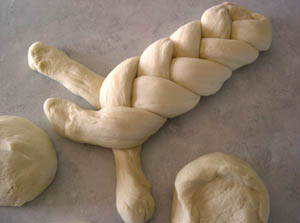
Typical colors for this festival include golden-yellow, orange and brown which are all very appropriate since this is the time for gathering the grain for bread. It is traditional to place a small, preferably soft, loaf of bread on the altar. The High Priestess will usually wear a crown made of holly with entwined fruits of the harvest. Reefs made of the fruits of the season and entwined poppy are also common. The altar can be decorated with poppies, blueberries and seasonal fruits. The cauldron is placed in the east (usually filled with wheat stalks) because that cardinal point is the symbol of rebirth. Other traditions include baking bread and bread plaits as well as making corn dollies.

A plant which is often connected with Lughnasadh is the blueberry since it used to be the symbol of the fertility of the land and also of a successful ritual. Fertility and the earth's yield was of great importance. We already mentioned that this was the time of the first harvest, but this is also the period just before the beginning of autumn. The weather is getting colder and you can feel winter coming. This makes it the perfect time to gather everything possible because what you gathered would keep you alive throughout the winter. Rituals were there to encourage the land to give equally as much (or more) next year but also to show thanks for the food on the table. If you remember the previously mentioned Balor's defeat by Lugh, you can conclude that, because of this, rituals often included reenactments of certain deaths and rebirths of gods or perhaps the many stories in which one god was defeated by another.

Sabbat: Lughnasadh / Lammas
Pronunciation:
/'loo-nə-sə/, /'la-məs/
Date: July 31/August 1
Other names: The first harvest, grain harvest,
bread harvest, Lammas, the festival
of the first fruit
Phase of the God: Withering strength (Holly King)
Phase of the
Goddess:
Mother (she feels the child in her
which will succeed the God on Yule)
Symbolism: Emphasizing the importance of the
harvest, encouraging the fertility of
the land for next year, giving thanks
for the food you have
Traditions:
Eating bread, making corn dollies (of
the God/Goddess), filling the cauldron
with wheat, making reeds from seasonal
plants and fruits
Symbols and
colors:
Yellow-golden, orange, red, green,
brown, corn dollies, bread
Traditional food: Bread, apples, blackberries, cornbread,
Lammas loaf and spiced apple cider,
herb fritters...
Until I fill up my witch's cookbook, you
can try to find a nice recipe on one of the
following web sites:
My Moonlit Path
Angelfire
The Druid's Egg
Traditional
incens:
Rose

I wish you all a happy Lughnasadh a few days in advance as well as a merry old time and a very tasty feast so you can celebrate all the hard work you did throughout the year in order to earn the food on the table or perhaps the labor you did in the fields yourselves to achieve this. 


Until next time. Yours,
Witch's Cat

16.6.13

Litha (June 21)

Litha is an old Roman word which Wicca adopted and now uses to refer to the summer solstice which usually falls on June 20/21. This year, we will witness the peak of the year on June 21. I say "peak" because this is the time of year when the Sun is strongest and brightest, but also when the days are longest. It seems logical that this will be celebrated because who doesn't like the Sun? By doing rituals for Litha, we try to prolong the summer and keep the land fertile since it will become barren when winter comes.

The Sun is important as a symbol of the God so I would like to mention, in connection to this, the two aspects of the God, which you may have come across in my other posts - the Holly King and the Oak King. The Oak King reigns during spring and summer, while the Holly King reigns during the autumn and winter months. The two solstices (summer and winter) are times of drastic change because, in mythology, the two Kings battle on these days and the one who wins reigns until the next solstice. According to some myths, the Holly King defeats the Oak King on the summer solstice thus gaining the right to reign until the winter solstice when the Oak King will wake up from his six-month-long slumber and defeat the Holly King. The rising of the Sun's power will follow the Oak King's victory and it will reach its peak on the summer solstice, which also marks the death of the Oak King.

In connection to this, many legends have survived and, by the way, they are all associated with sacrifice. The sacrifice is usually that of the Oak King in order to restore balance to nature (i.e. to let winter come). In some of them, the Oak King is burnt, in others her is blinded or even crucified on a T-shaped cross (Robert Graves compares this myth to the story of Samson who was also blinded after his power was taken from him). Graves also believes that John the Baptist (who was killed on June 24) was thought to be the equivalent of the Oak King. It was quite natural to name Jesus Christ as his successor after his death since John himself baptized Christ and who is thus his logical heir. 

Even though we have to keep in mind this battle theme of the summer solstice, we mustn't forget the Goddess. She is in her Mother aspect at this time of year. Since this Sabbat is dedicated to fire (the Sun), it is also dedicated to water as its opposite.

Now, I have to ask you not to confuse Beltane and Litha, which is what people often do. A small misunderstanding has happened over time so that some people now take Litha as the mythological day when the God and Goddess unite, even though this is actually what Beltane is all about. It is possible that the "main culprit" fro this misunderstanding was St. Patrick who transferred the Irish "bonfire night" from Beltane (May 1) to St. John's Eve (June 23/24). By doing this, he attempted to erase Ireland's Pagan past, but this was a very difficult thing to do since Beltane is the Irish name for the month of May. This makes it very hard to confuse people from Ireland, but he was able to trick those that weren't Irish. So don't be surprised if you find many common traditions for these two holidays.

Some common traditions are definitely lighting a fire (and bonfires), jumping over this fire (a more practical option is two light two fires/candles and pass between them), but also leading cattle through its ashes (or again between two fires but you can read more about that in my older post on Beltane). In some countries, it was even believed that the crops would grow only as high as you could jump over the fire! Others believed that scattering the ashes of the fire over the land would make it more fertile. There were many other traditions that can't as easily be connected with Beltane such as rolling downhill or burning a wheel (a symbol of the Sun).

It is obvious that the fire is of great importance to this Sabbat, so it is logical that this will be expressed in rituals. Fire is usually lit in a cauldron, but for this occasion, the cauldron is used for holding water with which the High Priestess will sprinkle all the coven members. It takes on the name "Cerridwen's cauldron" (named after the goddess Cerridwen) has over time and in mythology been knows as the cauldron of wisdom and poetic inspiration. In order for this problem to be solved, the element of fire can be represented by two candles.

Because of the warm weather during this season, this is one of the best Sabbats to hold skyclad (naked). This was even recommended for women who wanted to get pregnant (they would usually walk through their garden naked to share their fertility with their plants). Of course, this is not a new tradition. It was long believed that walking through a field naked would ensure a good harvest and fertile land. Traditions which were incorporated into this included riding a horsey/broom (phallic symbols), which soon became one of the main attributes of the stereotypical Witch. But don't get me wrong, this is not obligatory! You can work indoors or outdoors, naked or fully dressed...it's up to you :) I'm just stating the customs here.

Since this is, after all, a time when nature flourishes, it's worth noting that it's best if you take advantage of her fruits :) Appropriate aromas for your altar include lemon, myrtle, pine and rose and try to keep the colors as happy and natural as possible (for example the colors of the rainbow and dark green). This is also a great time to dry plants (to make teas and other products). For additional decoration, you can fill a cauldron with flowers or perhaps make a circle out of flowers (along with opening the circle with your athamé and/or the Elements).

For those of you that are ambitious, I recommend you read the section entitled "The Fire-Festivals of Europe" in the book entitled The Golden Bough by Frazer. There are many interesting things to read in there in general, but this chapter is directly connected to Litha and its traditions :D

Sabbat: Litha
Pronunciation: /liθa/ (simply put, /litha/)
Date: June 20-21
Other names: Midsummer, the summer solstice, Aerra
Litha
God phase: The Green God, at the peak of his strength,
the Holly King defeats the Oak King
Goddess phase: Mother (at the peak of her power, is
pregnant)
Symbolizes:
Energetic peak (both magical and solar),
maintaining and celebrating the Sun's 
strength and fertility
Traditions:
Jumping over fire/passing between two
fires, burning a wheel, drying herbs, rolling
downhill, walking naked through a garden/
field
Symbols &
colors:
Blue, green, yellow, colors of the rainbow,
dark green, mirrors for catching sunlight, 
wheels, a cauldron with flowers/a sword
Food: Since I don't have my own cookbook, I
recommend the following websites for
inspiration :D
And by all means, keep the food fresh and
cooling since it is summer, after all.
Raven and Crone recipes for Litha
My Moonlit Path - recipes pt. 1
My Moonlit Path - recipes pt. 2
And here are some of my recipes:
Lemon balls
Honey-lavender biscotti
Incense: Lemon, myrtle, pine, rose

I wish you all a merry Litha in advance and good luck with baking goodies, rolling beneath on fresh grass, basking in the Sun and, of course, with your ritual :D

Until next time. Yours,
Witch's Cat

11.5.13

Ostara (March 21)

This year, the Spring equinox, called Ostara in Wicca, falls on March 20, though its date varies from the 20th to the 23rd. Despite the fact that this day signifies the equality of day and night (the Sun and Moon), this is a time that emphasizes the Sun's rising strength which brings those longer Spring days that we all love.

 Some of you will know this period as Easter time when Jesus, the Son of God, the Sun of the world was reborn. In order for me to explain how Jesus and the Spring equinox are connected, I need to mention the meaning of the word Easter. It got its name in honor of the goddess Eostre whose name is probably another variable of the names Ishtar, Astarte and Aset (whose Egyptian counterpart is Isis). Eostre was the Anglo-Saxon goddess of fertility, and Ostara the Teutonic goddess of the Sun. You're probably clear on why such a strong emphasis was put on the Sun and fertility but let me explain anyway. In Spring, the Suns regains strength, flowers bloom and the animals begin to mate. I believe no further explanation is necessary. :)

Ostara is also associated with other things other than the aforementioned goddesses, for example with the concept of sacrificial mating through the myth about Cybele (the Phrygian Mother Goddess whose temple I am proud to have in my home town ^^) and her lover Attis. Despite what the concept alludes to, it doesn't imply a sacrifice during mating. But for me to explain this, I have to tell you a little story.

Namely, Zeus had the hots for Cybele but she rejected him. He, of course, didn't know the meaning of the word "no" so he decided to simply spill his seed on her while she was sleeping and in doing so have his way with her. Notice how the motif of mating is separate and don't be surprised when you come across this type of indirect type of intercourse because it is quite common in mythology. But back to the story. Cybele got pregnant and soon gave birth to Agdistis - a hermaphroditic demon who all the other gods feared. In one of their rushes of fear, they cut his penis off (here's the sacrifice motif) from which an almond tree sprouted. By the way, you will also often come across this sort of situation in which a sacrifice/death results in the birth of something else. Anyway, a new figure enters the story - Nana, who ate an almond from this tree and thus got pregnant. She gave birth to a wonderful baby boy who ended up in the hands of a caring shepherd couple who lived nearby (or rather Nana wanted to get rid of him since he didn't have a father, which was thought to be shameful). Now this boy grew up to be so handsome that Cybele herself fell in love with him (his grandmother, in case you don't feel bothered to do the math). This boy was called Attis and he was in love with another woman, but Cybele didn't really care much for that. She wanted him all to herself and became much too jealous. He of course wanted to protect his beloved and started hunting Cybele down all over the mountains but in the process went mad. So one day, while standing next to a pine, he decided to commit suicide. From his blood, the first violets sprung, but the pine took his soul and Cybele his body, which she resurrected with Zeus' help. Many rituals used to be done in honor of his resurrection, but that's too long a story for this post.  The main thing is that you now understand what "sacrificial mating" means. To revise, this is a theme in which the motifs of sacrifice and mating appear separately! 

You may be asking yourselves: "But what about the Easter bunny who brings eggs? How come he isn't mentioned?" or possible: "Why does the Easter bunny story even exist?". Well, I was just getting to that. The symbolism of the eggs is quite clear. This is a well-known iconological theme connected to rebirth and birth in general. This is the connection between eggs and Easter (just as Christ resurrects from his tomb into a new life, so do chicks from their eggs). Of course, chicks need warmth in order to grow so they can be strong enough to break the eggshell (this is why chickens always keep their eggs warm by sitting on them). The original egg myth included a snake egg, but as the Orphic cult grew stronger the snake slowly began to lose its symbolism and was replaced by the chicken since the symbol of this cult was a rooster (the bird of resurrection and waking). The first time the tradition of coloring the eggs appeared was in the time of the Druids who originally painted their eggs gold/yellow in honor of the Sun.

As for our Easter bunny, he deserves some special attention. He was closely related to the goddess Eostre (remember that she is the Goddess of fertility..and now remember the phrase "thumpermaiting", or the more vulgar phrase "to f**** like rabbits". Everything clear now?). Undoubtedly, the hare/rabbit is a sacred animal in many cultures of the world and this has left its trace in superstitious beliefs which state that a hare's foot brings good luck. I also have to mention the term Moon-Hare who even the famous Boudica (about whom there is a great documentary on Viasat History, by the way) had on her coat of arms. As an additional interesting fact I would like to share with you that the Celtic people believed that this Moon-Hare was responsible for the "dots" we see on the moon.

In order for me to bring this Sabbat a bit closer to you and so this post isn't just a collection of my ramblings, I would like to quote Douglas Hill who says:
"Drinking, dancing, feasting, noise-making and love-making have been the usual ways in which men have celebrated occasions of communal happiness...but ever since prehistoric times man has reserved special celebratory energies for the turning of the seasons and has reacted with perhaps the strongest surge of emotion to spring, the time when the earth is freed from the shackles of winter."
This passage caught my eye because it really does depict the spirit of this time of the year. Truly, this is a time which has to be celebrated. You have probably felt the depressing moods of February on your own skin, as well as the sudden improvement in mood that comes with the month of March. And not to mention the sudden changes in weather. This is the time of the year when all of this calms down a bit. Spring is coming, happiness is with us and we can finally bathe in the Sun, ride our bikes, go for long walks and put our Winter coats back in the closet.

Of course, this doesn't go for every country. In the Northern countries as well as Great Britain, Ostara wasn't always celebrated. Actually, in England, it was only celebrated by the pre-Celtic builders of the megaliths we now know, while the fertility and strength of the Sun was celebrated a bit later in the North (around Beltane, May 1), which is logical since their climate is completely different. We can see that people who lived before us adapted to their climate, so I think that we should do so too. What I mean is that I see no point in celebrating the Sun's growing strength if we see rain and snow around us, feel the cold wind on our faces and still have to wear our Winter coats and sweaters. Where I live, on the coast of the Mediterranean Sea, plants start to grow about this time while in the North, this will be just the right time fro sowing. So learn to be flexible :)

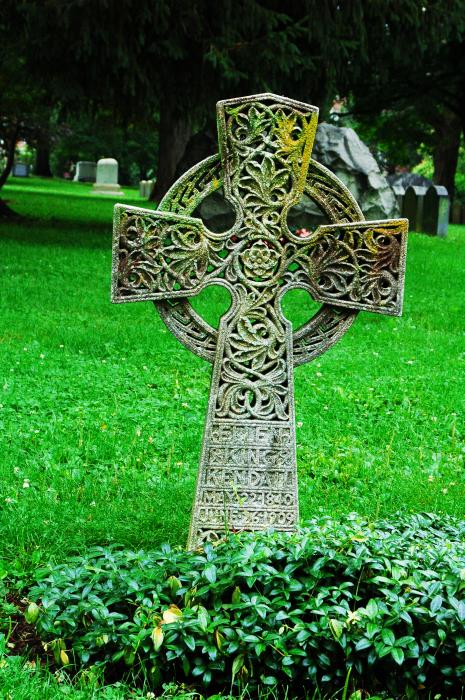
The symbolism fire has when it comes to Ostara is quite obvious, so it is recommended that you have at least some small sort of symbol of fire in your circle during your ritual (e.g. small wax candles if you can't light a small fire in your cauldron or outside). A common symbol you may see on altars is the fire wheel (this isn't a wheel made out of fire but a wheel-shaped object decorated with ornaments that symbolize a burning fire). A symbol very similar to this one (because it also has three parts) is the clover with its most common three-leafed construction. Ireland celebrated St. Patrick's Day by wearing a clover with pride since it has become their national emblem. Their is a story that tells us how St. Patrick used the three-leafed clover to explain how the Holy Trinity works, but for Pagans, these three leaves would represent the Triple Goddess. Of course, you are free to decide what this symbol will mean to you :) The four-leafed clover is thought to bring good luck because of its connection to the Sun wheel (which also has four parts) which was thought to have the power to banish evil spirits. I also have to mention that this Sun wheel became the archetypal symbol for balance and completeness. The number four is the number of balance, the symbol of the Earth (stability) and it will appear in many more ways, always in connection to integrity (in the Celtic cross, the magickal circle with its quarters, the Egyptian hieroglyph of niewt meaning "town", in the traditional Easter baked goods called Hot-cross buns etc.).

The Celtic cross (which
looks a lot like the sun
wheel)
You can decorate the room you're in with lots of flowers (if possible, yellow flowers such as primrose, daffodils, gorses etc.), and you will also find that many Witches use this occasion to bless their plant seeds for better growth. It is appropriate to have a small bowl of earth on the altar as well.

In regard to clothing and jewelry, everything should symbolize the Sun and springtime. According to this, appropriate metals to wear include gold, bronze, brass and various gilts. Whichever way you decide to go, the yellow color should dominate. :)

Don't forget that you're not only celebrating the Sun's strength but also fertility. This is why a phallic wand (such as the priapic wand) is often used in Wiccan rituals instead of the normal wand. It is important to celebrate, sing, dance and be merry! :D Enjoy the food you have (and I hope you will have plenty of it).

Sabbat: Ostara
Pronunciation: /os'tarah/
Date: May 21 usually (varies from the 20th-23rd)
Other names: The Spring equinox, Eostre, Easter, the Tree
festival
Phase of the God: Is growing up (the Green God)
(the Oak King)
Phase of the
Goddess:
The Maiden (time of initiation)
Symbolism: The beginning of Spring, celebrating light,
fertility and warmth which the Sun brings
Traditions:
Lighting a fire, jumping over embers, coloring
eggs, consecrating seeds, making bouquets of
Spring flowers
Symbols and
colors:
Golden/yellow, pastel colors (primarily purple,
but also pink, blue and green), a potted plant,
fire, a cauldron (with a candle in it), colored
eggs, the hare, necklaces of wildflowers, seeds
Traditional food: Hard-boiled eggs, hot-cross buns, fruit cakes
(with lemon or carrots most often), salads,
food with honey etc.
Ostara flax cookies
Traditional
incens:
Violet, jasmine, rose, sage, strawberry

Hot-cross buns
With this post, I wish you all a blessed Ostara :) with a bit of luck (and free time), I'll try out these famous Hot-cross buns (which are a traditional meal for Good Friday i.e. the Friday before Easter) and share the recipe with you :)

And for those of you that don't celebrate Ostara, happy Easter! 

Until next time. Yours,
Witch's Cat