This year, the Spring equinox, called Ostara in Wicca, falls on March 20, though its date varies from the 20th to the 23rd. Despite the fact that this day signifies the equality of day and night (the Sun and Moon), this is a time that emphasizes the Sun's rising strength which brings those longer Spring days that we all love.
Some of you will know this period as Easter time when Jesus, the Son of God, the Sun of the world was reborn. In order for me to explain how Jesus and the Spring equinox are connected, I need to mention the meaning of the word Easter. It got its name in honor of the goddess Eostre whose name is probably another variable of the names Ishtar, Astarte and Aset (whose Egyptian counterpart is Isis). Eostre was the Anglo-Saxon goddess of fertility, and Ostara the Teutonic goddess of the Sun. You're probably clear on why such a strong emphasis was put on the Sun and fertility but let me explain anyway. In Spring, the Suns regains strength, flowers bloom and the animals begin to mate. I believe no further explanation is necessary. :)
Ostara is also associated with other things other than the aforementioned goddesses, for example with the concept of sacrificial mating through the myth about Cybele (the Phrygian Mother Goddess whose temple I am proud to have in my home town ^^) and her lover Attis. Despite what the concept alludes to, it doesn't imply a sacrifice during mating. But for me to explain this, I have to tell you a little story.
Namely, Zeus had the hots for Cybele but she rejected him. He, of course, didn't know the meaning of the word "no" so he decided to simply spill his seed on her while she was sleeping and in doing so have his way with her. Notice how the motif of mating is separate and don't be surprised when you come across this type of indirect type of intercourse because it is quite common in mythology. But back to the story. Cybele got pregnant and soon gave birth to Agdistis - a hermaphroditic demon who all the other gods feared. In one of their rushes of fear, they cut his penis off (here's the sacrifice motif) from which an almond tree sprouted. By the way, you will also often come across this sort of situation in which a sacrifice/death results in the birth of something else. Anyway, a new figure enters the story - Nana, who ate an almond from this tree and thus got pregnant. She gave birth to a wonderful baby boy who ended up in the hands of a caring shepherd couple who lived nearby (or rather Nana wanted to get rid of him since he didn't have a father, which was thought to be shameful). Now this boy grew up to be so handsome that Cybele herself fell in love with him (his grandmother, in case you don't feel bothered to do the math). This boy was called Attis and he was in love with another woman, but Cybele didn't really care much for that. She wanted him all to herself and became much too jealous. He of course wanted to protect his beloved and started hunting Cybele down all over the mountains but in the process went mad. So one day, while standing next to a pine, he decided to commit suicide. From his blood, the first violets sprung, but the pine took his soul and Cybele his body, which she resurrected with Zeus' help. Many rituals used to be done in honor of his resurrection, but that's too long a story for this post. The main thing is that you now understand what "sacrificial mating" means. To revise, this is a theme in which the motifs of sacrifice and mating appear separately!

You may be asking yourselves: "But what about the Easter bunny who brings eggs? How come he isn't mentioned?" or possible: "Why does the Easter bunny story even exist?". Well, I was just getting to that. The symbolism of the eggs is quite clear. This is a well-known iconological theme connected to rebirth and birth in general. This is the connection between eggs and Easter (just as Christ resurrects from his tomb into a new life, so do chicks from their eggs). Of course, chicks need warmth in order to grow so they can be strong enough to break the eggshell (this is why chickens always keep their eggs warm by sitting on them). The original egg myth included a snake egg, but as the Orphic cult grew stronger the snake slowly began to lose its symbolism and was replaced by the chicken since the symbol of this cult was a rooster (the bird of resurrection and waking). The first time the tradition of coloring the eggs appeared was in the time of the Druids who originally painted their eggs gold/yellow in honor of the Sun.

As for our Easter bunny, he deserves some special attention. He was closely related to the goddess Eostre (remember that she is the Goddess of fertility..and now remember the phrase "thumpermaiting", or the more vulgar phrase "to f**** like rabbits". Everything clear now?). Undoubtedly, the hare/rabbit is a sacred animal in many cultures of the world and this has left its trace in superstitious beliefs which state that a hare's foot brings good luck. I also have to mention the term Moon-Hare who even the famous
Boudica (about whom there is a great documentary on Viasat History, by the way) had on her coat of arms. As an additional interesting fact I would like to share with you that the Celtic people believed that this Moon-Hare was responsible for the "dots" we see on the moon.
In order for me to bring this Sabbat a bit closer to you and so this post isn't just a collection of my ramblings, I would like to quote Douglas Hill who says:
"Drinking, dancing, feasting, noise-making and love-making have been the usual ways in which men have celebrated occasions of communal happiness...but ever since prehistoric times man has reserved special celebratory energies for the turning of the seasons and has reacted with perhaps the strongest surge of emotion to spring, the time when the earth is freed from the shackles of winter."
This passage caught my eye because it really does depict the spirit of this time of the year. Truly, this is a time which has to be celebrated. You have probably felt the depressing moods of February on your own skin, as well as the sudden improvement in mood that comes with the month of March. And not to mention the sudden changes in weather. This is the time of the year when all of this calms down a bit. Spring is coming, happiness is with us and we can finally bathe in the Sun, ride our bikes, go for long walks and put our Winter coats back in the closet.
Of course, this doesn't go for every country. In the Northern countries as well as Great Britain, Ostara wasn't always celebrated. Actually, in England, it was only celebrated by the pre-Celtic builders of the megaliths we now know, while the fertility and strength of the Sun was celebrated a bit later in the North (around Beltane, May 1), which is logical since their climate is completely different. We can see that people who lived before us adapted to their climate, so I think that we should do so too. What I mean is that I see no point in celebrating the Sun's growing strength if we see rain and snow around us, feel the cold wind on our faces and still have to wear our Winter coats and sweaters. Where I live, on the coast of the Mediterranean Sea, plants start to grow about this time while in the North, this will be just the right time fro sowing. So learn to be flexible :)

The symbolism fire has when it comes to Ostara is quite obvious, so it is recommended that you have at least some small sort of symbol of fire in your circle during your ritual (e.g. small wax candles if you can't light a small fire in your cauldron or outside). A common symbol you may see on altars is the fire wheel (this isn't a wheel made out of fire but a wheel-shaped object decorated with ornaments that symbolize a burning fire). A symbol very similar to this one (because it also has three parts) is the clover with its most common three-leafed construction. Ireland celebrated St. Patrick's Day by wearing a clover with pride since it has become their national emblem. Their is a story that tells us how St. Patrick used the three-leafed clover to explain how the Holy Trinity works, but for Pagans, these three leaves would represent the Triple Goddess. Of course, you are free to decide what this symbol will mean to you :) The four-leafed clover is thought to bring good luck because of its connection to the Sun wheel (which also has four parts) which was thought to have the power to banish evil spirits. I also have to mention that this Sun wheel became the archetypal symbol for balance and completeness. The number four is the number of balance, the symbol of the Earth (stability) and it will appear in many more ways, always in connection to integrity (in the Celtic cross, the magickal circle with its quarters, the Egyptian hieroglyph of
niewt meaning "town", in the traditional Easter baked goods called Hot-cross buns etc.).
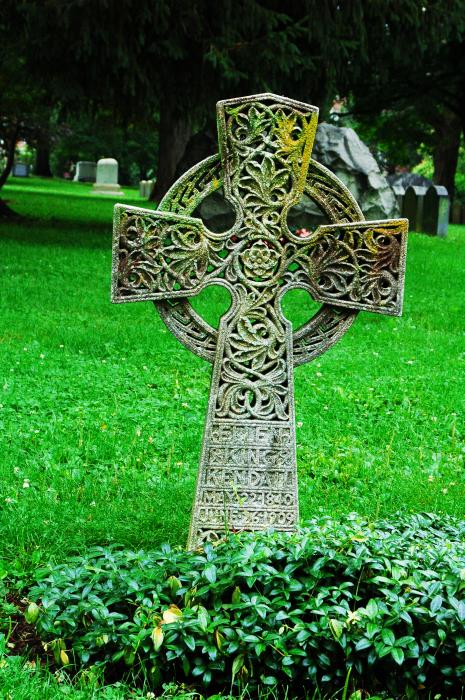 |
The Celtic cross (which
looks a lot like the sun
wheel) |
You can decorate the room you're in with lots of flowers (if possible, yellow flowers such as primrose, daffodils, gorses etc.), and you will also find that many Witches use this occasion to bless their plant seeds for better growth. It is appropriate to have a small bowl of earth on the altar as well.
In regard to clothing and jewelry, everything should symbolize the Sun and springtime. According to this, appropriate metals to wear include gold, bronze, brass and various gilts. Whichever way you decide to go, the yellow color should dominate. :)
Don't forget that you're not only celebrating the Sun's strength but also fertility. This is why a phallic wand (such as the priapic wand) is often used in Wiccan rituals instead of the normal wand. It is important to celebrate, sing, dance and be merry! :D Enjoy the food you have (and I hope you will have plenty of it).
| Sabbat: | Ostara |
| Pronunciation: | /os'tarah/ |
| Date: | May 21 usually (varies from the 20th-23rd) |
| Other names: | The Spring equinox, Eostre, Easter, the Tree
festival |
| Phase of the God: | Is growing up (the Green God)
(the Oak King) |
Phase of the
Goddess: | The Maiden (time of initiation) |
| Symbolism: | The beginning of Spring, celebrating light,
fertility and warmth which the Sun brings |
| Traditions: |
Lighting a fire, jumping over embers, coloring
eggs, consecrating seeds, making bouquets of
Spring flowers
|
Symbols and
colors: | Golden/yellow, pastel colors (primarily purple,
but also pink, blue and green), a potted plant,
fire, a cauldron (with a candle in it), colored
eggs, the hare, necklaces of wildflowers, seeds |
| Traditional food: | Hard-boiled eggs, hot-cross buns, fruit cakes
(with lemon or carrots most often), salads,
food with honey etc.
Ostara flax cookies |
Traditional
incens: | Violet, jasmine, rose, sage, strawberry |
 |
| Hot-cross buns |
With this post, I wish you all a blessed Ostara :) with a bit of luck (and free time), I'll try out these famous
Hot-cross buns (which are a traditional meal for Good Friday i.e. the Friday before Easter) and share the recipe with you :)
And for those of you that don't celebrate Ostara, happy Easter!


