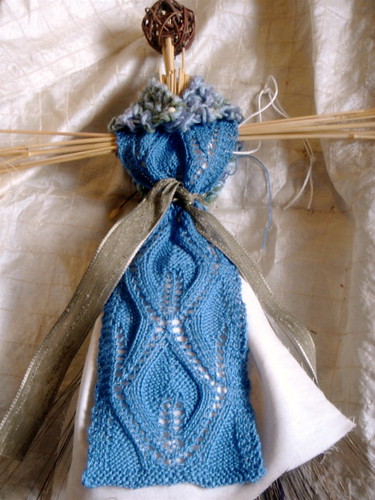
In a few days (on February 1/2 traditionally, or astronomically on February 4) we will be celebrating Imbolc - the midpoint of winter. A few days ago, I went on an outing and treated myself to a day of relaxation during this very active period of my life. The outing itself just confirmed the general state which seemed to me that not only I, but many people around me were also in. The state I am talking about is that of hibernation, or better put winter passivity.
Watching nature, it is very easy to notice this same state in the dry ground, naked tree branches, the fog stretching out over the rivers and in our visible breath in the air. Winter is in itself a passive period what both humans and animals feel the need to sleep and when a kind of lethargy prevails. But that's completely natural. Although, Imbolc reminds us that we have to slowly awaken, motivate ourselves to get out of bed (be it actual or metaphorical) and get moving.
In the midst of this cold natural world in which we found ourselves where we could see only naked, fallen branches, cracked earth, fog, where the smell of dampness and moss dominated and only silence could be heard, there came to us a small robin - that wonderful, cute little bird that was our first hint of spring. And truly, once of the symbols of Imbolc is the red-breasted robin who, at this time of year when the snow starts to melt (even though there isn't much snow where I live), stops living on berries and starts searching for insects hidden in the soil. He brought to us a ray of flash of color in the middle of the gray winter landscape. In this sense, the robin is one of the many indicators of spring.
It's interesting that I went on this outing with the aim of releasing certain emotions, or rather discarding the redundant and welcoming the new. However, at the time, I had completely forgotten that this is also one of the traditions of Imbolc. That is to say, the lite motif of Imbolc is cleansing. It is necessary to cleanse oneself, one's surroundings and even physically clean up in order to get rid of the unnecessary burdens in life and get ready for the active part of the year that is to come. We often don't take account of how many things accumulate in us and around us; how much all of this suffocates us and fetters us in life. The causes of this can be various. Sometimes it's people who suck out our energy; who tire us out. Sometimes it's problems that are simply there, thanks to us or not. Sometimes it's emotions which prevent us from further spiritual and mental growth. Imbolc (or rather the period around it) and the Imbolc ritual itself are there precisely for this reprobation of everything that is wasting and suffocating us.
All of this is done with the aim of cleansing and getting ready for the oncoming period which begins with Ostara in March. From the agricultural viewpoint, some seeds are already planted at Imbolc (which is why seed blessings are often a part of the Imbolc ritual), albeit the actual sowing season begins at Ostara. For a spiritual/emotional aspect, it is a good idea to prepare the terrain for the "sowing" of new ideas. This means cleaning the terrain, "loosening the emotional earth" and nurturing our seeds (ideas, certain characteristics, individual personalities, emotions, self-confidence etc.). It's not enough to simply plant a seed for it to grow. Many preparations need to be done before hand, such as offering love to the seed and nourishing the earth in which it will be planted. I believe you can further extend this metaphor yourselves. Anyway, one of the traditions of Imbolc is (pre-) spring cleaning of both the home and the individual identity. However, this is usually done on the eve of Imbolc, which falls on January 31 this year.

Cleaning automatically makes room for novelty and therefore also prosperity and fertility. I would like to prompt you to treat yourselves and relieve yourselves of some burdens life brings for this Sabbat. Do some "deep cleaning" - clean your car and home thoroughly, mop your floors, vacuum your rugs, shake and air them out, don't forget to vacuum and dust those hidden corners that you tend to skip usually. Check your closets, shelves, drawers, your fridge and see if there's anything that needs to be thrown away (food that's past its expiration date, ripped clothes, worn out shoes, heaps of papers and old magazines, useless objects that you never use and so on). Don't hesitate. We all have the tendency to leave things aside on the basis of "you never know when this could be useful". If you don't keep something because you will really need it, then you are doing this out of some other, intrinsic need. Nobody other than you yourself can determine what this ulterior motive is.
When I start cleaning around the house, I really am thorough - I go over every shelf, every corner in every room and crazily start throwing away everything I don't need. Here are some principles I usually stick to when cleaning:
- I form four heaps: "to sell", "to throw out", "for recycling" and "gifts/donations" (to a specific person, or a charity, library, home and so on). If the object at hand doesn't fall into any of these categories, then it means that I can keep it and that I either really need it or that I really don't want to get rid of it.
- You don't need to throw away absolutely everything. You may want to keep a little trifle because it may be of strong sentimental value to you, but you also shouldn't overdo this. It's OK to keep a few photographs, or one or two trinkets, but not fifty. Sentimentality is one thing, but arrestment in the past is another. It's a good idea to throw away things for past relationships for the same reason.
- I throw away things (so to speak; you can give them away/sell them etc.) that I haven't used in over a year and can't see myself using in the next six months.
- I get rid of things that bring back bad memories and which I really don't care for.
- Throw away things that have "expired" - rotten food/drinks gone bad, torn, broken, worn out things which are not worth fixing/cannot be fixed or reused in a different practical way.
- Throw away unfinished things. If you started this particular project a long time ago and still haven't finished it and if you don't plan on doing so, you don't need to kid yourself (especially if you find yourself saying: "Wow, I forgot about this!").
- When cleaning out your closet, throw away everything you can't wear anymore (because it's too big/too small/worn out/torn/uncleanable/looks bad on you etc.). If a pair of pants can be taken in a bit, take them to the seamstress to get fixed the same day, or the next at the latest. If they really can't be saved, then I just "throw them" away immediately. There's no need to keep things that are too small for us, that we have outgrown and that we may want to wear again in some distant future. These things keep us stuck in our past in which we were thinner, going through a phase and so on. There's not need to go back. It's better to look towards the future. Also, don't forget to throw away worn out, old underwear and odd socks.
- If I don't see a use for it, I throw it out! I always get rid of things that I once got as a present/bought and never used (or used/wore once and weren't satisfied with) and for which I simply don't see a use anymore. They can be appliances, books, clothes/shoes, decorations etc.
- Thoroughly go through papers! I always throw out old pieces of paper, newspapers, magazines, stacked up receipts, deposit slips and the like. This is an incredibly tiring task because you need to go through so many papers in detail. Papers, old notebooks, magazines and similar things end up in the recycling bin without too many questions being asked. However, receipts and similar more important documents need more detailed examination. I personally throw away receipts for things that I cannot return any longer, for things that are no longer under warranty and for those that I am satisfied with and don't plan on returning. After this, I throw about all the receipts/deposit slips etc. that are more than a year old. Once I have sorted these papers into two piles ("to throw out" and "to keep"), I neatly put away those which I need to keep in files, registrators or using some other filing system. I also develop an organizing system for these papers. Usually, I categorize them by the domain/obligation they are connected to, such as "bank", "school", "business", "bills" etc. and further file them by date.
- Decorations, or useless kitsch? I like to throw away old decorations and other impractical objects that don't remind me of anything in particular and which I keep "just for the sake of keeping". These objects just end up collecting dust on your shelves and suffocate your home.
- Don't forget your bathroom and medicine cabinets! I always have a detailed look at the cabinets and shelves in my bathroom and throw away all medicine that is past its expiration date (they really do present a health threat!).
- Piled up cosmetics are always a problem. This is why I go through my cosmetics and throw away anything that cannot be used any more (because it's just gotten old, too hard, too watered down, past its expiration date etc.). By the way, when I say "cosmetics", I'm not only referring to lipstick, eye shadows etc., but also to creams and any other skin-related products you might have.
- Check your jacket pockets and bag (or bags as the case may be for most women). Completely empty them out, vacuum them if necessary and throw away everything that has piled up in them and that you don't need anymore. You would be surprised at what you can find there; from money, to stray bits of paper, old tissues, forgotten cosmetics and so on.
- Take care of your computer! Junk can pile up in the virtual world as well. Regularly cleaning your computer is always the best option (the same applies to real life), but theory is one thing and practice entirely another. When I clean my computer, I use the following programs: CCleaner, AVG antivirus and Defraggler. Research what these programs do; you'll be able to figure out which ones you will find useful. It's also a good idea to delete any duplicate documents or those that you really don't need anymore and make a backup on an external hard drive, or online (for example, using Google Drive or a similar application).
- You can't forget about the big things such as cleaning your curtains (this is best done once or twice a year because your home instantly smells and looks more airy), cleaning your windows (which is extremely tiring but equally necessary as cleaning curtains), cleaning your car (you can put aside some extra money for deep cleaning and vacuuming your car once a year), cleaning your pillow cases (yes, I'm talking about the ones on your couch!) and so on.
The small changes that I also like to make in this period simply because they make my home feel more clean are the following: changing the sponge, changing all the bed sheets, throwing away my old tooth brush, neatly folding plastic bags (we keep them all in a drawer because they always come in handy), changing the vacuum filter, throwing away all pens that don't work anymore (yes, this means you have to check them one by one), cleaning the keyboard (dust and grease get between the keys) and the list can go on indefinitely.
Of course, we cannot forget about ourselves at the end of the day. There's nothing better than a relaxing shower/bath after a strenuous day of cleaning, followed by a healthy, tasty meal and a restful night's sleep.
Surely, the above list is realistically much too long. It's good to do all of these things, but it's of course impossible to do it all in one day. The period of (pre-) spring cleaning can last a long time depending on how much needs to be cleaned any how much we ourselves are ready to clean at that particular time. This is why the process can begin on January 31 and can slowly be carried out until Ostara.
However, cleaning the external is the easiest part. Spiritual and emotional cleaning, which can be begun at the Imbolc ritual, takes much longer. Some of us may already know what they want to get rid of, while others may decide to seize the opportunity to gain insight into this. But, even when we become aware of what exactly we want to get rid of, it's sometimes not enough to just know the bare fact. Sometimes we have to go deeper and look into its roots. If we are dealing with emotions, patterns of behavior or bad habits, we may only get rid of the symptom by discarding this one "fact" (emotion/pattern/habit), but perhaps not its cause as well. This is when real individual growth and spiritual development begin.
With this post, I would like to prompt you to work on yourselves, to improve the quality of your lives and personalities and to explain in what ways the Pagan Sabbats can be practically incorporated into everyday life. In hopes that you will apply some of my suggestions, or perhaps question them and in doing so find a different path that will better suit you, I wish you all the best and send you my Imbolc blessings!
Yours truly,
Witch's Cat