Prikazani su postovi s oznakom Ritual tools. Prikaži sve postove

10.1.14

Altar Arrangement

For the second week of the Pagan Blog Project, I decided to write about altars, their roles in Paganism and Wicca and primarily their arrangement as their very layout has deep symbolism and can define the type of ritual you are doing, as well as its atmosphere. 

There were many posts written on the topic of altars for the first week of the project, and all of them were original and wonderful in their own way. I admired the fact that most of them were quite personal. I did notice though that none of them focused on altar arrangement. This is thought by some to be a very textbook topic, but its one worth covering in my opinion. This post isn't going to be as personal as some of the other ones on the topic, but it will provide a substantial amount of applicable information for Pagan practitioners.

The reason why I chose to write a not-so-personal post on altars is because I remember them being something completely distant to me when I started practicing my faith. I was concerned with practical questions like: "What is the altar used for?", "What should I put on it?", "Do I even need an altar?" and so on. These dilemmas, which I now perceive to be small, are in fact very large for anyone new to Pagan practices. It is normal for the beginning of any path to be a little bit bumpy and for the practitioner to come across dilemmas such as these. Nevertheless, they can still cause a great deal of confusion which can easily be avoided with just a bit of practical information. It is exactly this kind of information that I will try to convey through the following text. :)

Before I begin, it's worth noting that I'm Wiccan, which means I incorporate Pagan symbolism into my altar arrangement. Other occult traditions and other religions/spiritual paths may have completely different layouts. This is completely acceptable. The main thing is that you understand what the altar is and how you can use it and that its arrangement is symbolic, logical and practical to you. After all, you are going to be the one using it. The arrangements which I will suggest are by no means the only possible ones, or the "right" ones. They are simply arrangements that have a deep symbolism for Pagan practices and that have become widely accepted due to this (as well as their practicality). You can modify the arrangements to suite your own needs, or even choose not to use them at all. But whatever you decide, I hope that you at least learn something new from this post. :) 

What Is an Altar?

The world "altar" is often connected to the Latin word altare which can be translated into "high altar/altar for sacrificing to the gods" or the Latin adjective altus meaning "high". This definition is widely-accepted, but less valid than the following one. A more accurate theory would be that it comes from the Latin verb adolere meaning "to burn" which relates to the notion of sacrifice in the previous definition as a sacrifice doesn't have to be a blood sacrifice (e.g. animals in ancient times) but rather a burnt plant of piece of food. 

It is often defined as a raised place on which sacrifices and gifts are offered in some religions. The Pagan concept of the altar differs slightly from the Christian concept. Of course they vary in decoration and the object placed on them, but an important thing to note is that Christian altars are simply "always there" (they are usually made of a certain stone which isn't moved, but always stays in the same place and is rarely left unadorned). Pagan altars are usually movable and are prepared for occasions (i.e. before a ritual). 

The altar is often placed in the middle of the sacred circle and is thus the focal point of the ritual. In this sense, the altar serves as a sort of repository for energy which can be channeled when the need be during the ritual. It is also serves as a bond between the physical and spiritual world (in many ways, but primarily because its very presence and energetic strength changes the mindset of the practitioner and makes them aware of being in a spiritual place). 

First of all, I have to repeat that the altar is usually placed in the center of the circle (although in rare occasions at the north, but that's not important now). In Pagan traditions, it usually faces north (which is connected to the element of earth and symbolizes a connection to the physical plane), while some prefer to face east (because the Sun rises on this side). This is a matter of personal preference and neither way is wrong, but you have to be aware of why you made this decision and what it symbolizes for you. By the way, when I say that the altar faces, for example, north, then that means that the practitioner should be facing north when they stand at the altar.

Apart from having great spiritual value, the altar also serves as a very practical ritual tool (if it can be called a tool) because most objects used during a ritual are kept on it and because all works, both religious and magical, are done at the altar. 

What Should An Altar Look like?

There really are no exact rules as to what an altar should look like in Paganism. There are many suggestions and good ideas, but none of this is obligatory and unquestionable. I would like to give you some recommendations, but feel free to disregard them if you feel that none of them are right for you.

Your altar can be anything from an old tree stump or rock somewhere in nature, a box covered with a cloth, a highly decorated table, an old chest or even the floor itself (although it is recommended for practical reasons that the altar be slightly higher than the ground; this makes it easier for you to pick up objects and also looks and feels more solemn). It can be store-bought, found and restored or hand-made. This all depends on your time, resources, finances and other factors. 

The material of which it should be made isn't specified, although wood is most traditional and metal is typically avoided because metal conducts energy and the altar doesn't serve this purpose (whereas a sword, knife or wand do serve this purpose and often are made of/include metal). Basically, the better a material conducts electricity, the better it will also conduct energy and the "worse" it will be for your altar material. Although the material is less important for religious rites where the energy is stored and channeled in a different manner. The altar material will have more influence of magical rites.

As I said, wood is the ideal choice, but you will also come across altars made of stone, brick, cardboard and so on. Of course, you won't have a stone altar if you intend to move it around a lot, and a cardboard altar is a great choice for those who need to camouflage it. If you choose to get a wooden altar, traditional choices would be oak and willow. Also, the use of glue to construct your altar is not recommended (although natural glues are ok). Metal fixtures are also best to be avoided. Again, these are all just suggestions. 

The shape of the altar is not all that important. It depends on what you prefer and what you find more practical. The most common altars are round (because Pagans work in a circle; so this is both practical because you circle around the altar and it fits into the space better, but also because of the symbolism of the shape itself and its connection to female/Goddess energies). Rectangular altars are also very common (they usually bear the symbolism of the four elements and are connected more with male/God energies). Of course, other top shapes are also acceptable; a polygon or a completely organic shape. Choose what you find best. 

There are no rules as to how many legs it should have (if any), bu it is very practical to leave some space underneath your altar for placing things that you may need during your ritual. In stead of this many Pagans choose altars that have drawers and keep secondary tools there. 

The height of the altar also depends on your preference. If you do your rituals sitting or kneeling down, then the altar should naturally be lower, but if you do them standing up then it is very impractical to keep bending or crouching down to get what you need. In this case, a higher altar would be a better choice.

When choosing the size of your altar, it's important that all the necessary ritual tools fit on it. I worked for a while with an altar about 30 x 30cm in size (it was basically a wooden box). I made a new altar a few years back which is much larger (about 1m x 50cm). If you decide to have a circular altar, then I recommend a diameter of at least 1 meter. Of course, if this is too large for you, then simply choose according to how much space you have/need.

Your altar can also be decorated, but it doesn't necessarily have to be. Many Pagans cover their altars with a cloth of an appropriate color (depending on the festival) because it looks very solemn but also protects the surface. Some choose to decorate it with greenery, but again, that's your choice.

In any case, the altar is used for keeping your ritual tools which can be arranged in many different ways depending on what you want to achieve, what you find aesthetically pleasing and what you find more practical.

Altar Arrangement

When I say "arrangement", I mean the arrangement of your ritual tools on the altar. Of course, not everyone has the same tools (this depends on the tradition, personal preference, financial situation, the individual's situation etc.). Some don't have any ritual tools at all (in which case there is no practical need for an altar), some have only a few, while others have every possible tool there is because they feel most comfortable having them there.

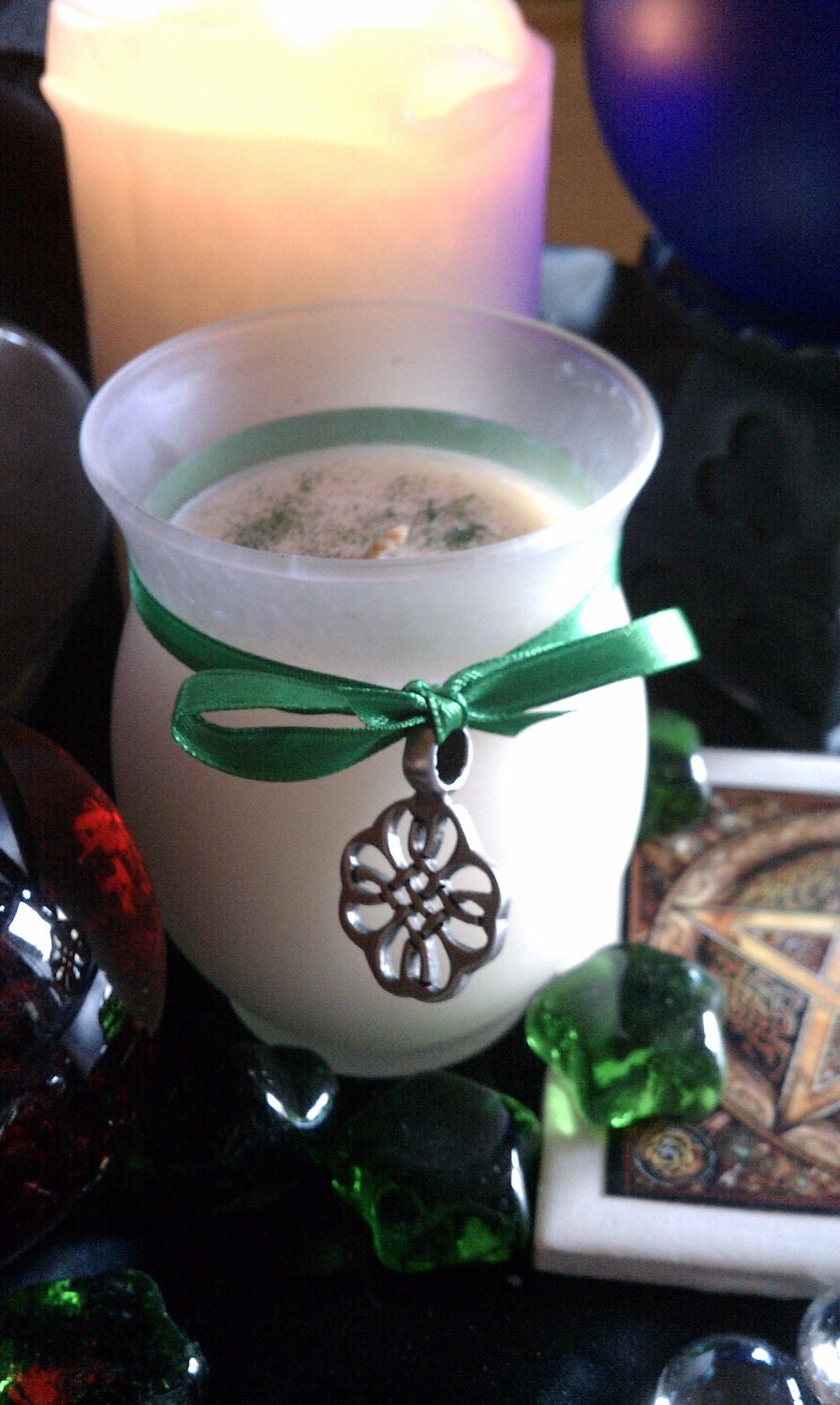
You will typically find some of these ritual tools on a Pagan altar: the representations of deities (God/Goddess figurines, other figurines/paintings/natural objects which symbolize the deity or even one/2 candles), an athame and/or wand, incense (and whatever goes along with it), food and drinks (and also a plate, goblet and libation dish to go with them), two bowls (one filled with salt, the other with water), a bell, a candle snuffer, a book of shadows or other book/papers from which the practitioner may read (if necessary), an altar candle (which isn't needed if you represent the deity/ies with candles) and so on.

Large object such as cauldrons, swords, brooms, staffs and additional items such as spare candles should be left beside or below the altar so as not to crowd it too much but also not to put too much weight on it. 

The altar is usually divided into "zones", each of which corresponds to something and which holds object corresponding to that same something. There are two ways of dividing your altar (I will use a rectangular altar as an example, but the same can be done on a circular altar):

1. Vertical partition

The altar is vertically divided into three sections:
  1. The left section - belongs to the Goddess and is connected to emotions. Objects connected to her and with "female" characteristics are placed here.
  2. The right section - belongs to the God and is connected to the rational. Objects connected to the God and the masculine (or otherwise thought of as "male") are placed here.
  3. The middle section - it is also called the working area and is used to place other objects which are used in magic or have a practical purpose (such as the Book of Shadows for reading and so on). Magical objects can include candles (if practicing candle magic), cords (for cord magic), poppets, divination tools, objects that are going to be consecrated and so on.

Note: the objects mentioned in these diagrams under "Goddess" and "God" (or in the diagonal diagram under a certain element) aren't necessarily the only objects corresponding to them. I will give you a full list of ritual tools and their "gender" later on to help you out with this. The tools which are listed are only examples (or really very essential tools).

The items can be placed about in various ways though a very practical way would be the one in the following diagram.


2. Diagonal partition

The diagonal partition divides the altar into four parts, each one corresponding to a certain element. This is more typical for rectangular altars but can also be used on circular ones. If you have a rectangular altar, it is typical for the corners of the altar to point at the cardinal points (so upper right corner pointing to east, lower right to the south and so on). This would result in a normal horizontal/vertical raster on the altar such as the one below.

Note: the four quadrants are colored appropriately. The yellow quadrant is for air, the red for fire, the green for earth and the blue for water.


If you decide to place your altar so that you face a certain way (e.g. north/east), then the partition will really be diagonal (as the name suggests). This kind of partition is more common because facing towards a certain cardinal point (e.g. north) is more common that, for example, facing north-east. 

This is what the altar would approximately look like:


Of course, there are other ways to divide your altar. One such example can be found in Raymond Buckland's book Wicca for One in which the author gives an example of how he would set the altar. This partition is mainly practical in nature because the candle(s) is/are placed at the back so that it isn't knocked down, all the bowls are gathered in one place and the objects most often used are placed at the front of the altar.


As I promised, here's a detailed list of altar tools with gender and element correspondences (although it is far from complete because some traditions and individuals add/remove/replace certain tools). Hopefully, it will help you distinguish which tools to put where according to the above mentioned altar arrangements. :)

Note: not all tools have a gender or element correspondence, so don't let this confuse you. Some of them don't require any explanations (e.g. the altar cloth), while other such as a snuffer are simply neutral in terms of gender and/or have no element correspondence so they can be placed anywhere on the altar. The neutral items will be symbolized by a Ø symbol. The forward slash symbol (/) simply means "or". For the "neutral" tools, decide for yourselves where you want to place them (if you decide to use them at all). Also, not all the tools are obligatory. You can find a less detailed list of tools in a previous post entitled "Ritual Tools". The ones that are commonly thought of as obligatory are underlined. This should clear things up a bit.

Ritual Tool
Gender
Element(s)
altar cloth
Ø
Ø
God representation
male
all
Goddess representation
female
all
candles
male
fire
candlestick
male
Ø
snuffer
Ø
Ø
incense
male
air
censer/thurible
male
Ø
incense charcoal
Ø
Ø
bowl with water
female
water
bowl with salt
female
earth
bell(s)
Ø
Ø/air
spoon (for the salt)
Ø
Ø
feather
male
air
libation dish
Ø
Ø
wand
male
air
athame
male
fire
chalice
female
water
plate/pentacle
female
earth
broom
both
Ø
cauldron
female
water
boleen
Ø
Ø
staff (usual or forked)
male
air
priapic wand
male
air/fire
scepter
male
air/fire
cords
Ø
Ø
sword
male
fire
scourge
male
fire

Of course, other tools can be included. Some of them which are used rarely can be placed beside the altar or under it (e.g. matches/a lighter, a compass, a water bottle, CD player if playing music etc.). 
Some of the tools are too large to be placed on the altar itself so you can place them by the altar on the side which corresponds to their gender/element. These items include: the broom, cauldron (although small ones do exist), staff, scepter, sword etc. So, for instance, the cauldron, which symbolizes the Goddess and the element of water, would be placed either to the left of the altar (in a vertical partition), or on the west side (in the diagonal partition). 
Like I have already said, this isn't a full list of ritual tools, but it should be enough for now. :)

What If I Can't Have an Altar?


Some of you may find yourself in an awkward situation where the people you are living with don't know about your faith and practices. In this case, having a visible altar somewhere in the house is a dead giveaway. This doesn't always have to be the case. You may simply not have the room or finances for an altar at the moment.

It will come as a relief to you that there are alternatives! :D
You can also use the following objects for you altars:
  • a box (of any material and size) turned upside down and covered with a cloth
  • the ground (preferably have a cloth underneath your tools, though)
  • a modified table/chair/bedside table/coffee table/chest of drawers and so on
Modifying an existing piece of furniture is a great idea because you don't have to spend any money on a separate piece of furniture for you altar and you will have extra room in your house. Besides, the fact that this table (or whatever it is) will be used regularly doesn't effect its religious function because it can always be cleansed and consecrated before each ritual. If this is a bit tiring, then you can always have an altar cloth which will be used only for religious purposes and use it to cover the table. This is also why I recommend placing the tools on the cloth in stead of directly on the cardboard box or the ground.

To illustrate my point, here are some pictures of modified altars (disregard the altar arrangement though because it's not the same as in this post).


I'm sure you'll be able to find many more examples on the Internet. :)
Anyway, I hope this post was of some use to you and that you enjoyed reading it! :D
Expect another Pagan Blog Project post next Friday. Yours,

Witch's Cat

24.4.13

Ritual Tools

Ritual tools are everything that you use while doing a ritual. Some of these objects you will probably recognize (e.g. the chalice, symbols of the Goddess and God and the famous broomstick), while some you may not. It's important to note that ritual tools aren't obligatory. On the contrary, some witches prefer not to use these tools at all because they just get in the way for them, though they may make things easier for some of you because you will have a physical object to handle and aid you in your actions. Of course, you don't have to have all the tools listed; you can just have the ones you find necessary. Nothing here is obligatory :)

Your decision may also depend on the tradition you follow, but if you are a Solitary, then you don't have to follow the tradition as strictly as you would in a coven. For example, in the Gardnerian tradition you will see the following tools: an athamé, a sword, a scourge, a staff, cords, a white-handled knife and a pentacle, while in the Saxon tradition you will see only a knife (called a seax), a sword and a spear.

I would recommend you try each of these tools before you completely discard them because some of them could really prove useful...especially when you're just starting with the practical part.

Also, try to keep everything you use in the circle as natural as possible i.e. avoid synthetic materials like plastic or polyester for clothes. 

I have already mentioned that, in the Craft, it is thought that something is stronger if you put more energy into it. Because of this, it's better if you make your tools yourself and spend your own time and energy on it instead of just ordering it online or from someone else who makes these types of things. If you aren't able to make some of these tools for yourself, try to at least add something to the bought product so you make it unique (make your own handle if the tool is held or decorate it with ribbons or crystals, though engravings are also quite popular). You can conclude that the tool is as strong as the quantity of energy you put into it.

Of course, you aren't expected to have everything at the very beginning. I personally don't have everything (some because I simply don't feel the need to have them, others because I just didn't manage to find a way or an opportunity to make them). There will be time, but for starters, there are a few tools you should have a few tools which are fairly easy to come across or make. But remember, alternatives always exist :)

Before using it, every tool has to be consecrated. By doing this, you will make the tool even stronger since you will put even more energy into it. I will discuss consecration techniques in a later post where I will also say a thing or two about the ritual form :)

I will now give you a list of ritual tools which are used in most Wiccan traditions. Some tools you don't have to have, like I said, but I will leave the decision-making to you. I will underline and bolden the tools which I find are necessary.
  • altar
  • athamé / wand
  • a cord / chalk / something else for marking
  • candles for the four quarters
  • candles for other purposes
  • an altar candle
  • symbols of the Goddess and God
  • dishes for water and salt (but don't forget the water and salt also)
  • incense and an incense holder
  • matches / a lighter
  • a pentacle
  • a chalice and plate / a bowl for food (Cakes and Wine)
  • ritual oil
  • a broomstick
  • a sword
  • a staff
  • a bell
  • a white-handled knife and a boline (for cutting herbs)
  • cords
  • ritual clothes and jewelry
  • decorations
  • other fitting objects for Sabbats and Esbats
And now I think it's time to talk about every tool separately :)

The Altar

My modest altar :) (above)
Only the word "altar" sounds very profound, but to tell you the truth, your altar doesn't have to be made of gold and covered with rubies. Tprio the contrary, your altar can be an ordinary log or whatever you deem to be fit...just keep in mind it has to be big enough to hold all of your tools (but not so they keep falling off).

Notice the picture of my altar on the right...I simply got an old chest and restored it. It is usually recommended that the altar should have any metal parts on it (because of their ability to conduct electricity...and some think this also applies to energy). The same goes for all other ritual tools except for the athamé and/or the wand (in fact, it's favorable for them to have some metal on them because they are used for sending/receiving energy). 

I recommended a log/stump because of its circular form. A lot of people will say that this looks much nicer than an old-fashioned rectangle (especially inside the ritual circle which is often marked with physical objects or markers of other kinds). Also, the circle has a special meaning in Wicca. But it's your choice.

The altar will be used to hold some (not all) of your ritual tools, like your altar candle(s), your censer/other kind of incense, bowls for salt and water, chalice and plate, symbols of the Goddess and God as well as other objects needed for that specific Sabbat/Esbat/magickal ritual. Of course, you have the liberty to adjust everything to your needs. You can add or remove certain objects but this is just a general scheme.

The Athamé and Wand

The Athamé


This is another name for your ritual knife. It is usually a two-sided blade and is most often made of steel or iron (but you may come across blades made out of stone, bone or even wood). These two metals were extremely valued because it took great skill to forge anything out of them. Apparently, this respect stuck even until today. Of course, it's not a strict rule that it has to be made out of one of these two metals but it's best if it's made out of some kind of metal that conducts electricity (and energy). 

The size of the blade or handle isn't specified, though the handle is usually black in order to differentiate this knife from the white-handled knife but also because it is thought that black (and other dark colors) best absorb energy which is afterwards sent through the blade itself. Therefore, you can have a knife that completely suits your taste, by the shape of the blade, its length, decorations, handle etc. It would be ideal if you could make your athamé yourself but I suspect that not many of use are in that position. In this case, you can simply decorate it and give it your personal touch in this way. I would recommend engraving or stamping the handle with some sort of incandescent (red hot) object, which isn't a problem since the hand is usually wooden. You can also glue objects onto the handle; crystals, ribbons...basically anything that is, as I have already stated, of some natural material.    If you decide to engrave, make it something very personal, for example your name (magickal name if you have it, but I'll talk about that in another post), your monogram, astrological signs that correspond to you or other symbols that are important to you.

There are various other ways of decorating, but I'd have to go into detail for that. Though you can contact me if you have any questions or need help with ideas etc.

Since knives are common objects, you can use your athamé outside the circle too, but that again depends on you. Some people will decide not to do so while others (for example followers of the Scottish tradition) will use it as often as they can because of the belief that the more you use it, the more energy you put into it. Again, up to you :)

The Wand

I have put the wand and athamé in the same category because they both serve the same purpose - to conduct energy. A lot of people prefer the wand over a knife because it seems less "scary". The first thing that comes to people's minds when you say "ritual knife" is ritual sacrifice (which there is none of in Wicca!), while the word "wand" brings on more positive associations like fairies that you listened about when you were children. I used an athamé for a longer period of time until I got the chance to make my own wand not so long ago. It's pretty clear that it's easier to make a wand than a knife so I'll explain the process in a few short points.

Anyway, some people think that the wand has to be made out of some kind of special wood and that you have to take into account its magickal properties, the day and hour when you're going to make it but it all comes back to your decision. I believe that this isn't nearly as important as the energy and love you put into finding wood/making the wand/consecrating it etc. Freely choose the wood that you find best and decorate it as you see fit. After all, you are going to be the ones using it. You will often see crystals (usually white quartz) added to wands to make the conduction as effective as possible. You can also engrave it, draw on it, stamp it or whatever you like.

It's important that you remember that the wand (or athamé) are simply an extension of your hand. So when you use them, behave with them as you would naturally.

As for the process of making a wand, here's how I made mine:
  • I found an old fallen tree (in my case a pine tree). It had been cut down a long time ago and already dry which was excellent because the wood you're working with has to be dry (if it isn't you have to let it try...some recommend even up to a year).
  • I thanked the tree for its sacrifice/gift and explained why I have to take a branch from it. I proceeded with sawing of that specific branch (about 3 cm in diameter and about 50 cm long...keep in mind that the branch will get significantly smaller because you'll be sawing off unnecessary parts, removing the bark, forming the wand and so on. I chose the more or less traditional length from the tip of your fingers to your elbow).
  • After removing the bark that was left (and there wasn't much of it since it was dried up), I sawed off the parts that were sticking out, abraded the wood using a sanding machine and decided to round off the end.
  • I made a hole in the top fro the crystal that I decided to put in.
  • I put on three coats of see-through varnish (for wood!) so the wood doesn't rot (though unnatural materials aren't recommended as I said, but that was the only option I knew about). If you decided to do this, I recommend you by varnish in a spray can which you can find in most hobby/art shops. Leave every coat to dry for at least half a day (or possibly longer).
  • After the varnish had completely dried, I put the crystal in the drilled hole and glued it on using two-component type glue because it really will hold any material (and it's tricky to get crystals to stick to wood). You can find it in the same shops you find your varnish :)
  • I decorated the wand with symbols after everything was dry.
I have to emphasize that some people won't like putting on varnish or using glue because these aren't exactly natural materials but I couldn't find an alternative. If you don't mind doing this, I recommend it, but if you do, then try using copper or silver wires to attach things or try finding alternate methods for gluing objects together.

Other than this "classical" wand, there is also the priapic wand (Priapus being the God of fertility, the son of Dionysus and Aphrodite). The end of this type of wand is supposed to resemble a phallus, while others (in order to not make it so obvious) shape the end into a pine-cone-type shape or actually stick a real pine cone to the end. This type of wand, just like the classical wand or athamé, is a symbol of male sexuality. 

The Staff


You can have it, but you don't have to. It serves the same purpose as the wand except it's larger. It is often used in Scottish traditions. If you decide to make it, it's best to use dry wood (yes, same rules as for the wand) but it's best if the wood is as straight as possible. The ideal height is actually the height of the owner. Again, you decorate it as you please (engraving, ribbons, crystals, leather, feathers etc.).

Markers

It's usually chalk that ends up being used or sometimes rope, but feel free to use your imagination. When opening the circle (i.e. from the very beginning of any ritual), there is a need for the circle to be physically identified in covens as well as mentally so that everyone knows where the perimeters of the circle actually are. This is precisely why chalk is so useful or why salt is also quite popular (except from the fact that it is thought to purify the space around/inside it), but you can also simply put a rope on the ground in the form of a circle. Since you will probably be working alone (no offence), you will be making this circle only for yourself so simply visualizing the circle and putting candles on the quarters should be enough. 

Candles

Quarter Candles

You will always need at least four candles which you will put on the quarters i.e. at the four cardinal directions (north, south, east and west). These will symbolize the four elements and their corresponding cardinal point but at the same time define the perimeter of the circle.


You will often hear that witches use the same four candles for this purpose - yellow for air, red for fire, blue for water and green for earth. The yellow candle goes on the east, the red on the south, blue on the west and the green on the south side. Some of you may prefer changing the candles every time but I try to use up candles as much as I can. Also, I use different colored candles depending on the occasion. For the Sabbats, I use appropriate colored candles for that specific holiday, but I always use silver candles for Esbats. You choice :)

You can use additional candles to define the circle even better or simply for decorating you altar and the space around it (just be careful they don't restrict your movement). I recommend that these candles be white or another neutral color or the appropriate color for that festival.

Your Altar Candle


This will be a constant in you rituals. This candle represents you so it can be white or any other color that you think best represents you. You can decorate it any way you think best, even carve it etc. You will use it to light all the other candles in the circle and you can use it to represent the element of fire on your altar (the rest of the elements I'll get to later).

Some witches will have two altar candles of different color. In this case, they will serve in stead of your God/Goddess symbols. I prefer to have one altar candle and special symbols for the Goddess and God.

Goddess and God Symbols


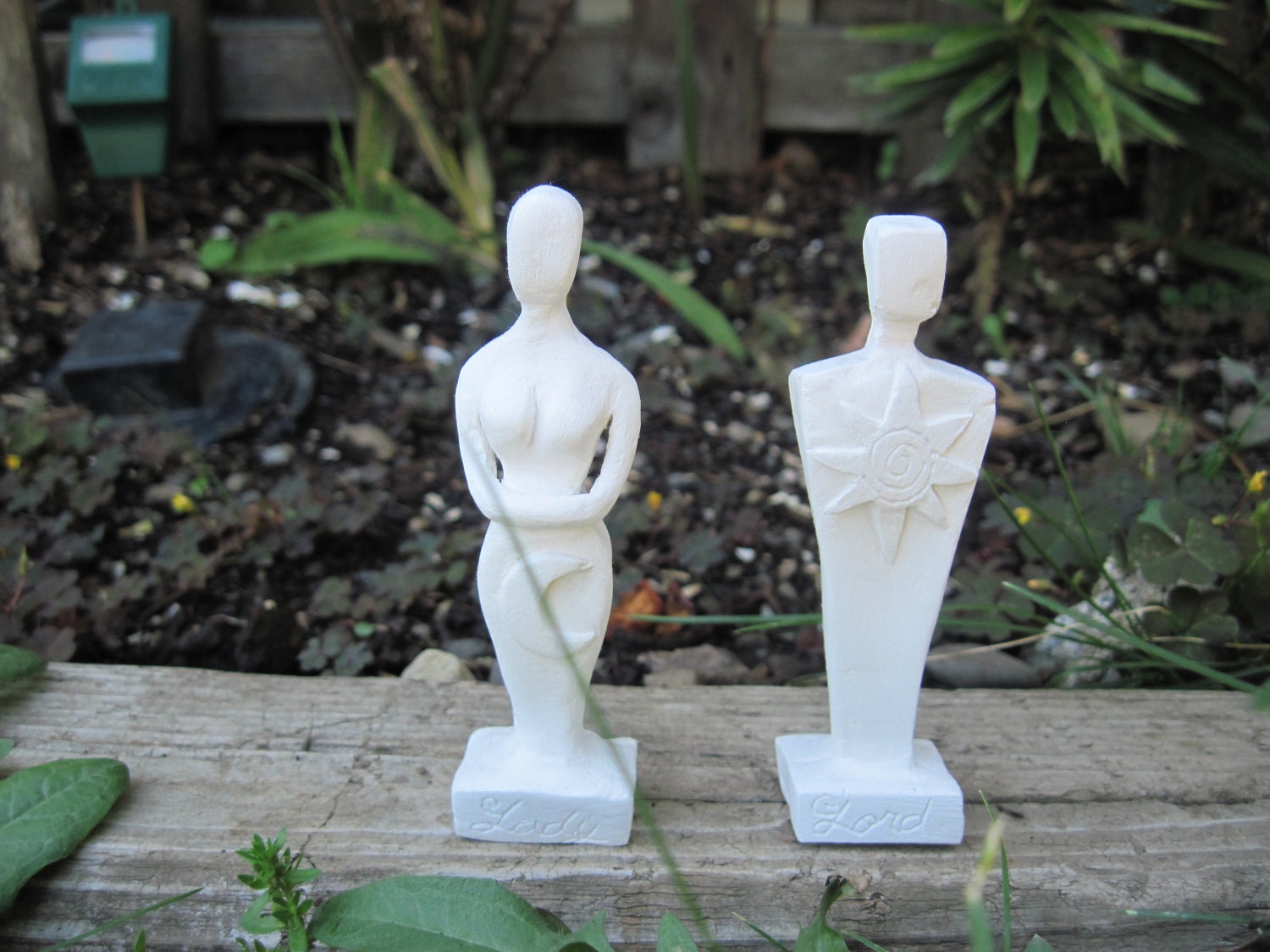
These will symbolize the Goddess and God and their presence during your ritual. There are no rules for them. You can literally take figures (make them or buy them) of certain Gods or two figures of the classical representation of the Goddess and God in Wicca. Some people will prefer paintings/drawings over sculptures. I use a shell for the symbol of the Goddess (I dived for it myself) and a pine cone for the symbol of the God. Try and make these symbols special to you and that they really represent the male and female to you. If you like using two candles for this (as stated above) the do so. The main thing is that you feel comfortable in front of these symbols because you will be the ones looking at them the whole time.

Another idea is to get one figurine that represents the unity of the Goddess and God into one, though I think it's more practical to have separate symbols because some rituals will focus more on the Goddess and others on the God since they aren't both equally prominent throughout the year.

Try searching for appropriate pictures or sculptures in antiquarian shops or online, but it's always best if you can make these yourself. Of course, if you can't or don't know how to, then add some of your energy into these symbols in any way you see fit.

Water and Salt

There have to be two bowls on your altar: one for salt and the other for water. You will always cleanse the water with salt before using it. This act symbolizes the act of Creation or integration (water being a female element and salt i.e. earth a male element or rather a symbol of sperm - white color). In this sense, these two bowls represent the life force. For the bowls themselves, you can use any natural material. You can make them yourself you of clay, stone, crystal or wood or even use seashells. Be imaginative and find two bowls that will suite your taste, look nice on your altar but also be practical (so nothing spills out of them).

Water will obviously represent the element of water on your altar and salt the element of earth, just like your altar candle represents fire. Only one element is missing, or rather two if we count the spirit.

Incense

The incense you choose will represent the element of air on your altar. Many witches will choose a censer with some type of incense in it because censers have become sort of a tradition in magick and religious rights. You will most commonly see frankincense being used because of its long tradition of being used for cleansing the space around it. Also, it is thought to carry your words to the heavens with its smoke.

Because incense is often waved about with (or twirled around in a circular motion), a swinging censer is recommended. If you choose this method, you'll also need briquettes of coal on which you'll scatter frankincense powder. You can buy both in any shop that sells church supplies or possible new age shops if you have any around your house.

If you aren't fond of this option or can't find the necessities, you can always use incense sticks or cones, like I do. I wouldn't recommend using incense oils because the smell isn't as intense as with the alternatives, but also the incense is supposed to let out smoke which symbolizes the element of air, and oil doesn't really let out much smoke (you can only see the water evaporating a bit). I prefer to change the smell depending on the occasion, but I usually use sage because it is thought to have cleansing properties. If you prefer this option over the censer, you'll need either an incense holder or some sort of small bowl for holding the cones. If you use to burn incense or frankincense (with coal) in a bowl, then you'll need sand which will serve as a thermal insulator (if the bowl gets too hot it can break). You can put sand with the cones too, but they don't radiate with the same warmth as the previous option.

A Pentacle

Pentagrams and pentacles are symbols of the element of earth and some people will prefer to use them for this exact purpose in rituals, but if you decide to use salt, then this isn't really obligatory. I, for instance, have a pentagram drawn on my altar as a symbol of cleansing, protection and the unity of the five elements. You can use it in this context as jewelry or for decorations. It is, once again, recommended you make it yourself if you can. You can draw it of sculpt it out of a natural material of your choice.

Cakes and Wine

Food and drinks are a part of every ritual because they are thought to bring you "back to earth" i.e. grounding. To elaborate, during rituals you enter a different type of consciousness where you get detached from reality and stop thinking about mundane things. When you finish your ritual, you need some sort of physical signal that you're just about done and that you can return to your everyday life. This is exactly why we use cakes and wine. While you eat and drink, your body get signals that you are finishing the ritual and returning to your "normal state" and what better way to get in touch with the physical world again than the most direct physical contact you can imagine - consuming food.

Harvest altar detail by
Thorskegga Thorn
The most traditional options for food and drinks are cakes and wine (as stated in the heading). I prefer to bake something for every occasion (either cakes or bread of something completely different), but if you aren't very good at cooking/baking don't worry...alternatives always exist. The same goes for wine. You don't have to make your own but make sure that the drinks are also fitted for the occasion. Don't drink normal water, but if you don't like wine or beer then you can choose something non-alcoholic. As I begin to write about every Sabbat individually, I'll give examples of traditional food and drinks for these occasions. Though I would recommend drinking milk for Esbats (the ultimate symbol of maternity and the moon is full on these days and hence symbolizes the Mother aspect of the Goddess in its full power). The food you can choose according to your preferences :)

Just be careful not to eat or drink too much because the goal isn't to eat/drink until you barf, but to get grounded, though this part of the ritual tends to turn into a feast or party in covens and other larger circles.

For this, you'll also need a chalice and a plate. You can choose the color shape and (natural) material of both these tools. My glass is made out of crystal, but you can choose a wooden or ceramic one or even metal, but in some traditions you'll even see a horn being used. Consecration of the food and drink is done by putting the tip of your athamé/wand in the drink while saying appropriate words and then just touching the food with the same tip (again while saying something appropriate). All that's left to do is to say "cheers" to the Gods (keep in mind that you have to be polite) and enjoy this bounty....not that complicated :D

It's nice to have a special dish for toasts/"sacrifices" in which you will pour a bit of the drink (before you start drinking it, but after you have consecrated it). You can also add a bit of food but keep this dish separate from the rest of the food and drink because you will give this back to the Earth by pouring it onto the ground later. Don't pour out too much wine/juice/milk because the action is symbolic (we don't want to spoil the quality of the earth when we pour it out). Notice that the sacrifice is indeed symbolic. You will NEVER find animal/human sacrifices in Wicca.

Ritual oil

This oil is usually used in special occasions, though some will like to use it for every ritual. It is put to use by putting it on your forehead (you put some on your thumb and then just press it onto your forehead or you put some one your forefinger and then draw a pentagram on your forehead). Though it is usually used only in special occasions like initiations, self-initiations, birth etc.

The traditional recipe is as follows:
  • Fill a small bottle with mint (the usual type is catmint i.e. nepeta cataria, but you can choose another type if you like). Use the fresh plant and cut it into smaller parts with your boline (mentioned before as a knife used for cutting herbs) or other sort of knife (this enables the plant to let out its natural oils faster).
  • Pour olive oil over the plant (enough to cover the plant and fill the small bottle up to the top).
  • Seal the bottle well and leave it in a cold and dry place for 24 hours (turn it over every six hours).
  • After these 24 hours, distill the oil using a gauze or small filter into a bowl.
  • Fill the same bottle with mint again (same process), fill it with the already made oil you just distilled and then leave this new mix to sit for another 24 hours.
  • You should do this at least three times (3 days). Remember to use the same oil all the time but just adding freshly cut mint.
  • Filter the oil fort he last tame after you think the scent is strong enough and leave it in a (preferably) dark bottle in a nice pantry or other dark and cold place.

The Sword

The sword is quite similar to the athamé. Some will substitute one for the other but some can have both. The sword can be used for opening the circle (like the knife) but it is often used at initiations and other rituals. It is often used in covens as a group sword (not everyone has their own). In covens, only one person will use it at a time (depending on the ritual, but usually the the same person who opens the circle) and everyone decorates it together.

Of course, this is much harder to get your hands on than an athamé and even harder to make but if you really think it's necessary then get one :) I just want to say (again) that you remember to put as much energy as you can into it and that you don't forget to you use it as you would and athamé (as an extension of your hand). It's all your choice, but I find the sword a bit impractical if you're working on your own.

The Broomstick

This is probably the most "traditional" witchy tool and has probably been your first association to witches since you were children. Broomsticks are used for cleansing the circle (i.e. to remove negative energy and create a sacred space). Some people even choose to use a broom stick as a replacement for the sword/athamé/wand and use it to open the circle. In addition to this, broomsticks are used in special occasions like wedding ceremonies or certain Sabbats when couples jump over the broom for luck and love.

The broom itself is a symbol of love and life. By joining the handle (phallus) and gathered branches at the bottom (female sexual organ) you symbolically enact the unity of the Goddess and God, but also man and woman in general.

The handle is usually made of a "male" tree (usually oak), while the branches will be from a "female" tree (e.g. birch or other type of woody plant). All this is tied together with willow branches or some sort of cord or twine.

The Bell

Every sound has its own vibrations. The high-pitched sounds used in rituals are thought to send their positive vibrations through the air during rituals. In this way, these vibrations fulfill the already existing energy in the air and enable a special sort of unity among all the participants in the ritual. If you decide to use the bell, then be careful to make sure that the sound completely suits you and that the bell is quality because low-quality bells really have a hollow, nasty sound to them so they're not nice to hear at all, but especially not in the circle.

The White-Handled Knife

While the athamé is the ritual knife, this knife has a more common, mundane use. It can be used for engraving, carving and so on. You can use it to carve candles, engrave symbols and words into objects and parts of your ritual tools etc. You don't have to use it only inside the circle, but it's actually best if you use it as much as you can. Some call it a boline (though some separate these two types of knives and use the boline especially for cutting herbs and have a completely different-shaped knife for this purpose). This doesn't even have to be among your ritual tools, but if you decide to think of it that way then sure :) Though this doesn't even have to be a knife...some will even use "primitive" technology for engraving and such like a simple nail in a piece of wood. The main thing is that it does what it's meant to do.

Cords

Some traditions use cords as a system of denoting level of initiation (using different colors), but when we mention cords, we usually think about cords used in magick. You can use it in the circle as a piece of "functional jewelry" and tie it around your waste. It will absorb your energy all the better this way and be of even better use when the opportunity comes. It is traditionally red and 274.32 cm (9 feet) long. This length of 9 feet is the typical diameter of a coven circle so you can use this rope to define the width of the circle.

This length and color aren't obligatory. This is the tradition but you can adjust everything to your preferences. If you decide to color the cords, then keep in mind that you have to soak the cord and that they often shrink after being soaked so I recommend cutting it to the appropriate length after coloring it. 

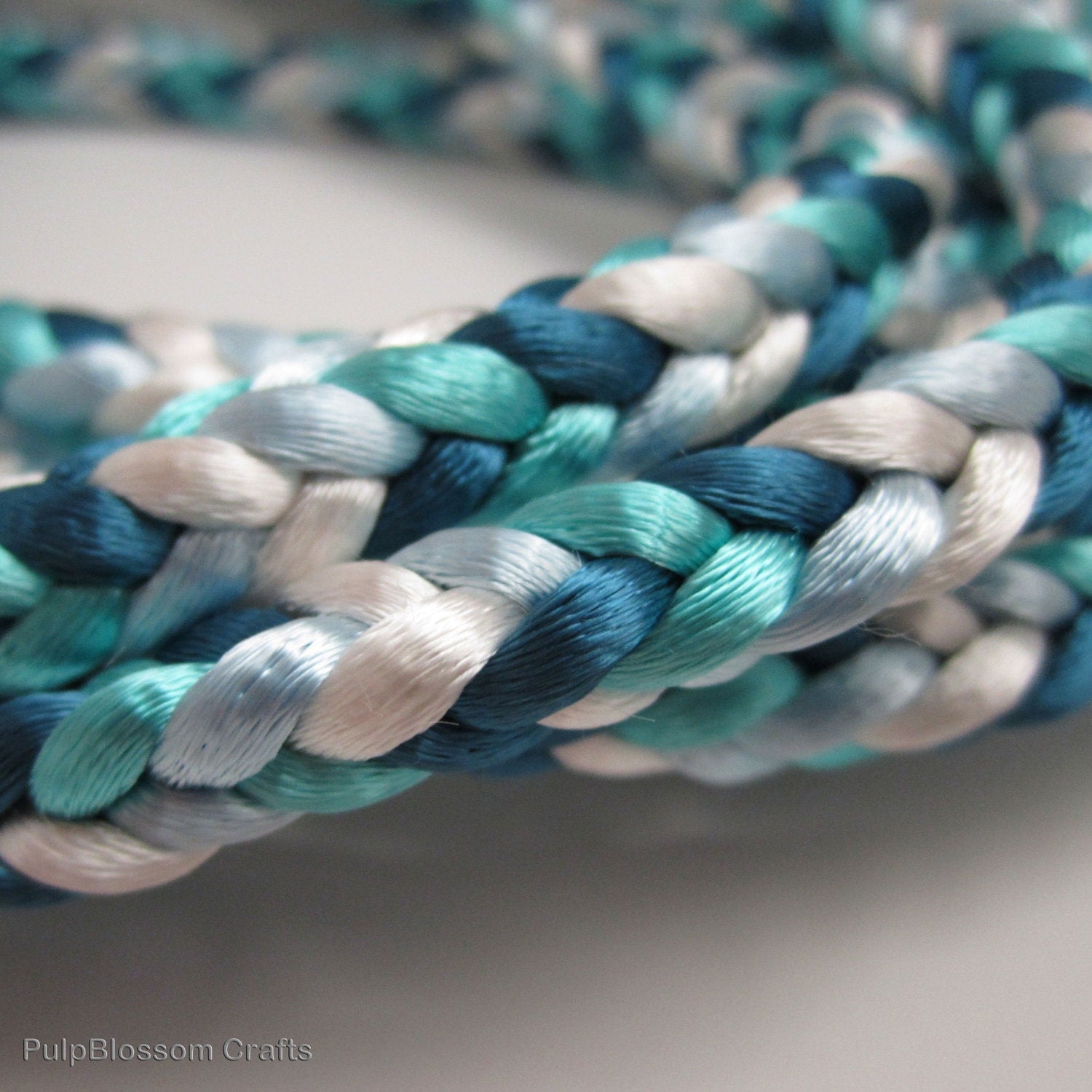
If you want to make it unique, you can make your own cord by entwining several pieces of cord (in the form of a braid or something similar).

Rough cords are used more often than not. Materials like silk are very rare but then again...not a rule :)

Clothing

It's important to remember that your ritual clothes aren't the clothes you will be wearing every day (actually it's best if you wear them only for rituals). The clothes become special this way (like the "fancy" party clothes you have in your cupboard but wear only for special occasions). Contrary to the usual belief, these clothes DO NOT have to be black but any color you like. If you like, you can even wear usual jeans and a T-shirt if you like, but try not to wear these outside the circle. The clothes have to be clean because you have to be clean for special occasions, right? :)

It is common to take a shower/bath before changing into these clothes in order to remove all the negativity from that day and enter the circle with a clean body and mind.

You are the ones that choose the way in which you will dress during rituals. If you prefer something floor-length and with long sleeves, then wear that. If you like jeans and T-shirts more, then wear that. Then again, some people don't even like ritual clothing and prefer to work naked i.e. skyclad (clad/clothed by the sky). This isn't unusual in any way. You don't have to be embarrassed of anyone if you're working alone and I congratulate those of you that don't mind being nude in front of more people). 

You can either buy or make your clothes yourself. Just keep in mind that anything you choose has to be practical (so you don't set your sleeves on fire or keep tripping on the end of your robe etc.). Choose the color you like, of course. It doesn't have to be black or white or even the same color all the time. You can have several sets of ritual clothes of different colors you change according to the occasion. Try and make the clothes out of a natural material because everything is better if it's natural and also because these materials enable your skin to breathe and you won't get itchy or uncomfortable.

The most popular are white ritual clothes. In covens, you'll often see the High Priest and High Priestess wearing a dark purple/white/dark green robe while others wear green/yellow/brown or blue clothes. It all varies from coven to coven and from individual to individual.

Jewelry

Jewelry can also be used as a system for recognizing your level of initiation inside covens. In Gardnerian Wicca for example, everyone can wear necklaces (a symbol of reincarnation and the cycle of life), while only the High Priestess can wear a bracelet (and a large one at that which is highly noticeable and adorned with many crystals or other decorations). A Queen (a Priestess of several covens) can wear a silver crown with the symbol of the Triple moon and/or a green garter with a silver clasp.

You can choose whatever you like if you're working alone. Jewelry doesn't even have to be expensive. You can make it yourself out of cords, rocks or any natural material. Ribbons of various colors are also popularly used as a sort of chaplet (head adornment).

Of course, if you choose not to wear jewelry at all then that's fine too. I prefer not to wear jewelry at all but it's all a matter of personal preference.

Just make sure that the jewelry doesn't get in you way and that it's made of natural materials. If you can make it yourself then so much the better! And if you'll let me say so, the same goes for clothes. I recommend that you wear this jewelry exclusively inside the circle because then it gets the "special occasions" label.

Decorations and Other Occasional Objects

I won't linger to long here because I plan to write about this in the Sabbats posts to follow. If you're working alone, you can practically add anything you feel like adding to the ritual, but I will suggest certain things in time.


Now that you know what you need for your rituals, you can start getting everything you need :D Just consciously use every object and don't forget to cleanse it with the four elements and consecrate it. I will dedicate separate post only to this.

In the meantime, I wish you a lot of luck with the making and gathering of tools. You can soon expect a post on the theme of the altar form and there I'll recommend a layout of all these tools. 

To finish off, I present to you a list of "male" and "female" tools to make some things clearer corresponding elements along with the cardinal point and object it goes with.

Male tools
Female tools
athamé/wand/staff/
sword
God symbol
Goddess symbol
salt (and its bowl)
water and its bowl
chalice
food plate/bowl
broomstick handle
broomstick branches

Element
Cardinal point
Tool(s)
Air East Incense
Fire South Candles (primarily the
altar candle)
Water West Water and its bowl
Earth North Salt and its bowl

I think that this is enough for today :)

Until next time. Yours,
Witch's Cat