Prikazani su postovi s oznakom December 21. Prikaži sve postove

23.12.15

Swedish Tea Ring

This ring, as the name suggests, goes perfectly with tea (or coffee if you prefer it), and its taste and aromas, primarily the divine combination of cinnamon and nuts, evoke the pleasantness of Yule (and also Christmas) and call to mind a warm home during the winter months.


You Will Need:

For the Dough:

  • 1 cup milk
  • 1/2 cup sugar
  • 2 tsp salt
  • ca. 50 g butter
  • 1/2 cup warm water (ca. 1 dL)
  • 2 packets instant yeast
  • 2 eggs
  • 6 cups flour (plain wheat flour, or self-rising flour)
Notes: the cup I used for measuring holds about 200 mL of liquids, or 125 - 130 g flour. This was actually your typical small coffee cup.
I put only 1 packet of instant yeast in my cake, but I would recommend that you use 1 and a half - 2 packets given the amount of flour that is needed for the recipe. The dough can only turn out even better and softer if you do this.
Also, with regard to the flour, I recommend you use either entirely self-rising flour, or mix both the self-rising and plain flour. This time, I experimented with a combination of 4 cups plain flour and 2 cups self-rising. I also floured the surface using self-rising flour.

For the Filling:

  • 1/2 cup sugar
  • 50 g melted butter
  • 2 tbsp cinnamon
  • 150 g nuts (I combined 75 g almonds and 75 g hazelnuts)

How To Prepare:

  1. Scald milk.
  2. Add sugar and butter to the milk and mix until both melt.
  3. Mix water, yeast and one teaspoon sugar in a larger cup (keep in mind that the yeast will rise). Cover the cup with plastic wrap and leave it to rise for about 10 minutes. When the yeast becomes foamy and rises to the edge of the cup, or perhaps even starts to overflow, you will know it's ready for use.
  4. Leave the milk to cool down until lukewarm.
  5. When the milk has cooled down, pour it in a bowl, mix in the yeast and add the eggs. Mix.
Note: it is necessary to leave the milk to cool down because if you put the yeast in hot milk, its effect will be nullified. Also, if you put the eggs in hot milk, they could end up being "cooked", which also isn't good at all.
  1. Add 2 cups flour to the mix thoroughly.
  2. Keep adding the remaining flour one cup at a time and blend it in (I recommend you use a whisk or a wooden spoon for this) minding that there are no clumps left.
  3. When you get a compact, relatively smooth, non-sticky dough and when the dough begins to form a ball, put it onto a floured surface and knead for 5 - 10 minutes. If needed, add more flour. In the end, the dough should not be sticky, although it's good to let it keep some moisture and elasticity. It should feel soft and satiny to the touch
  4. Lightly grease your bowl with sunflower oil. Place the dough back in the bowl and flip it once so that you get some oil on all sides of the dough.
  5. Cover with a moist piece of cloth and leave in a warm place to rise for about 60 - 90 minutes.
  6. Your dough should double in size. Get it out on a floured surface and roll it out into a rectangle about 35 x 45 cm in size.
  7. Place baking paper on a baking tray and scatter the nuts on it (in this case the almonds and hazelnuts). Heat your oven to 200°C and bake them only for 5 minutes. Don't leave them in the oven for too long otherwise they may get over-baked and take on a bitter taste.
  8. Prepare the filling: beat the nuts using a meat cleaver (you can wrap them in plastic wrap beforehand so you have less to clean later on). Mix the crushed nuts with sugar and cinnamon.
  9. Melt butter (it doesn't have to be completely melted and it's better if it's not hot). Smear the dough with it and sprinkle with the dry mixture of nuts, cinnamon and sugar.
  10. Wrap the dough into a long rope taking care not to leave too much air while rolling it and to connect the ends/edges together.
  11. Twist the rope into a ring and connect the two ends as best you can so that they don't fall apart in the oven.
  12. Using scissors, or a knife, cut the dough 2/3 the way ever 2 cm. That is to say, the ring should remain connected on its inner side and you should not cut the slices off the ring itself.
  13. If you have some more time and will left in you, gently twist the slices you just cut into one direction so that the cross-section of the dough is visible and the slices are slightly leaned against one another. In the end, your ring should slightly resemble a flower (as in the picture above).
  14. Move the ring to a baking tray (which is lined with baking paper).
  15. Cover the now shaped ring with a moist towel once more and leave it to rise in a warm place about another hour.
  16. Bake for 25 - 30 minutes at 175°C.

20.12.15

Yule and the Cycle of Life


Yule, which is also known as the winter solstice, has two sides - one light and one dark. It is positioned at the crossroad between life and death because with it ends the dark period of the Pagan year, and the light period begins. Yule, among other things, signifies the lengthening of the day. However, the winter solstice also marks the darkest night of the whole year and reminds us of the difficulties of winter; the time of year when trees are bare, the earth cold, when the wind blows stronger than usual and rain and snow shower the earth. It seems as though the earth is asleep during this time of year.

Yule marks the beginning of winter and the coldest period of the year when endurance is needed to survive to the first inkling of spring which appears only at Imbolc (February 2). So this is a time when it is necessary to take a good look at the depths of one's soul and nurture one's inner flame, be it real or metaphorical, right until the coming of spring when the fear of winter tempests extinguishing our inner flames finally dies down.

Winter insures the survival of the fittest and a few days ago, right before Yule, I lost another family member. At Ostara my grandfather died, and this time my grandmother passed away. Her passing prompted me to once again think about the cycle of life and death in nature. She was weak and with the coming of colder days, she found it all the more difficult to live. Finally, her weakness prevailed and she died almost asleep.

Her eternal slumber marked the beginning of winter for me this year. It seems it will be more difficult than usual. Yule, just like Christmas, is a time when (my) family gathers, celebrates, bakes cakes together, laughs for the happy moments and cries for the sad ones and share gifts and love. This year, my family is one family member short. And this is not just any person. My grandmother was the one that practically brought Christmas every year with her little traditions. She will no longer be able to make her traditional gnocchi, or make everyone smile with her beautiful smile, or sneakily give out sweets.

But that's the cycle of life. The wheel of the year turns, and life inevitably follows it.

Above all, Yule celebrates the rebirth of the young God. However, the central figure from a Pagan point of view is the Goddess that gives birth to him. In the mythological sense, the Goddess is rejuvenated at Yule just as the God is reborn. She is transformed from her Crone aspect (which is predominant at the moment when I'm writing this) into a beautiful young Maiden and begins the new year in full bloom. Of course, birth is the central theme here. But birth does not exist without death. In Pagan mythology, but also in the mythology of numerous other cultures and faiths, a god has to die in order to be born once again. At some point (which is albeit less precisely defined in Paganism), the Goddess also has to die in order to move from her Crone aspect to her Maiden aspect.

I return to the dualistic nature of this holiday which has its gentle side (birth), but also its cruel side (death, coldness, winter).

During this time of year, cultures throughout the world celebrate mother goddesses and fertility goddesses such as Frigg, Holda, Bona Dea, Koliada and so on. However, they also celebrated darker goddesses such as the Celtic Cailleah, or the Slavic Baba Yaga. Both are often depicted as crones, and more often than not caricaturized to represent death and embody winter and darkness.

I believe I could focus a bit more on the figure of Baba Yaga in this context who is, in my humble opinion, an excellent embodiment of both aspects of this holiday. Depending on the tale and its source, she can be malevolent, or even very benevolent. Most stories about her suggest that she lives in a lonely cottage in the least accessible part of a forest. According to some, this cabin stood on chicken legs, while others claim that it was supported by a spinning wheel which emphasizes Baba Yaga's role as the spinner of the thread of life and death. As such, she has the power to give or take away life, both from the earth and from people. In mythology, her chthonic characteristics are often emphasized and it is believed that in the underworld, she is the one that decides which souls will go to a newborn child (which emphasizes her benevolent aspect and the motif of birth) and which ones will stay in the underworld (which emphasizes her malevolent aspect and the motif of death). She is believed to be the guardian of the fountain, which the water of Life and Death springs from. Her omnipresence and mysteriousness are emphasized by a tale which says that she does not ride throughout the night sky on a broomstick, which is a stereotypical image, but rather in a mortar. She propels herself using a pestle and she erases every trace of her passage in the sky and people's lives using a broom. The mortar and pestle in this case symbolize the creative and destructive forces because they are used to both grind grains (destructive) which are later used to prepare food, but also flax which is later used for spinning. Using her broom, she can create and nurture life, but she can also erase it from the face of the Earth with just one sweep. The bottom line of all this is that with every death comes a birth and that something has to be given/invested in order to get something else.

Baba Yaga is not exactly connected to Yule, but this association just seemed to impose itself to me this year. Year in, year out, I understand how all of these Pagan holidays I celebrate are actually very layered and complex and how one holiday does not represent just that one thing but rather a whole plexus of ideas. Each has its own unbelievably deep roots which can be studied for years. But this is wherein beauty lies.

This year, I think of Yule in a considerably different way and I don't see it as just another celebration of life, but also as an acknowledgement of death as an equally valuable part of life. Each year has to come to an end, and so does every life. Such is the natural cycle. This is why I will spend this period in quiet meditation on this topic. Nevertheless, I urge you to explore what this Sabbat means to you and celebrate it in accordance with this.

But not to finish on such a sad note, I want to wish you all a merry and blessed Yule. And to those of you who have decided to celebrate the winter solstice in its full glory (which, by the way, falls on December 22 this year), I wish it to be filled with happiness, love, celebration, feasts and holiday cheer.

Until next time.
Yours,
Witch's Cat

9.5.13

Yule (December 21)

Yule usually falls somewhere between the 21st and 23rd of December. It is also knows as the Winter solstice; the day of the year when the night is the longest and the Sun is just beginning to regain its strength since from this day on, the day will begin to get longer. The name itself comes from the Norse word iul which mean wheel (as in the wheel of the year, life etc.).

In some traditions, this day signifies the death of the Sun God and the triumph of the Oak King over the Holly King (for more details on this story, you can have a look at my earlier post entitled "Wiccan Beliefs"). This wheel symbolizes the death and rebirth of the Sun God for what has an ending must have a beginning (at least in Paganism). The Goddess is at this point in her Crone phase, but her time will also come to be rejuvenated.

A Synthesis of Beliefs and Traditions

I would like to take a bit of my time to talk about other traditions and beliefs which have a few things to do with this celebration in order to make this Pagan festival a bit clearer to you non-Pagans out there :) and if you are, no harm from broadening your horizons a bit, right? So let's start.

The Holly King
The Oak King
The Christmas story of the birth of baby Jesus (who is often compared to the Sun) can be related to the story of the rebirth of the Sun God on Yule (what with the Sun beginning to regain its strength from this point onward). My goal isn't to demean any other faiths, but to simply emphasize the fact that traditions have always borrowed traditions and beliefs from one another since humanking has existed. This made them all, in a way, synthesized. Even other Sun gods (for example Mithra in Persian mythology) "take" this day for their date of birth. It wasn't until the year 273 AD that the Church took this date as the official date of birth for their savior. Mind you that Christianity wasn't even accepted (or legal) at this time. This happened in 313 AD with Constantine the Great's Edict of Milan. In order for Christians to assimilate into the Pagan society of that time, they took the same date as the Pagans did for their celebration so on this day, they celebrated their God while the Pagans celebrated their gods. If we decide to compare the Virgin Mary with the Goddess, we can see a few similarities here too. On this day, both of them give birth to the Sun God/bringer of Light/Savior or whatever you decide to call him. So slowly but surely, the cult of the Virgin Mary became popular (but don't comprehend the word "cult" as something bad but simply as a group of worshipers/followers of something). But, the worshiping of the Virgin Mary was only accepted in 431 AD with the First Council of Ephesus. She was then allowed to be praised and viewed as an important figure in the Catholic faith, but she still wasn't glorified as much as God was (not even closely). What happened was that she gained some godly characteristics and hence became slightly less humanized. 

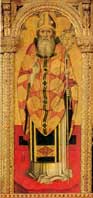
Lovro Dobričević
(a Croatian painter),
St Nicholas, 1448
A few sentences ago, I mentioned the story of the Oak King and the Holly King. The Oak King symbolizes the God in the waning ("growing") part of the year, while the Holly King resembles him in the waxing part. Logically, with the triumph of the Oak King on Yule we are told a story that is actually an allegory for the waning year i.e. the triumph of light over darkness. The exact opposite happens in the Summer solstice when the Holly King wins the battle against the Oak King.

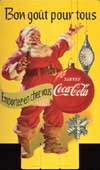
Now where does good old Santa Claus fit in here? This is a slightly more complex question which I will try to answer in a few lines. In Christianity, there was the belief that the presents on Christmas Eve were brought by St. Nicholas (this tradition survives even today) and that the baby Jesus brings them on Christmas day/after Christmas. This simply changed with time. Namely, the first depiction of St. Nicholas (which got "shortened" to Santa Claus) in the form of the Santa Claus we know today first came to exist in 1931. The person who ordered this depiction was no other than Coca Cola who dressed him in their signature colors (red and white). Until then, St Nicholas was depicted in a completely different way (as you can see by the pictures I put in this post). Though there were many other famous gift-bringers in other cultures too. Good examples would be Kristkindl in Germany (often depicted as a gnome of some sort, and when translated, it literally means baby Jesus), Pére Noël in France (translation: Father Christmas) and a slightly different example from Italy - the witch Befana. She would deliver presents to children on her broom and is obviously different from the previous examples. But at least she is proof that not all Witches are bad :D

Haddon Sundblom,
Santa Nicolas,
1931
You're surely familiar with the tradition of decorating the Christmas tree. This is a variation of the Pagan tradition of decorating the Yule log. This log was usually taken from an oak tree (a symbol of the triumph of the Oak King) and a part of this tradition still lives through a cake known as the Christmas/Yule log (at least in Croatia).

I think I've talked enough about other traditions, so let us return back to Paganism.

Let us return to the Goddess for a second and her aspects at this time. If we look at the Celtic tree calendar (which I talked about a bit in this post), we will notice that the Elder tree month lasts from November 25 until December 22, but also that December 23 doesn't fall under any category. This is because it is the so-called "plus one" (+1) day. To elaborate, this month is represented by the Elder tree, which is a symbol of the Goddess in her darker aspects. This plant has white flowers and dark red berries which reminds us of the combines symbols of purity (white, usually the color of female purity i.e. chastity) and menstrual blood (red, of course). December 22 is that day that signifies the death of the Goddess, or rather the God, but at this time, she mourns over him and starts to change (a symbolical death). The day after, December 23, is the day of her (and the God's) rebirth. This myth of the Goddess mourning over the God can also be found in Egyptian mythology when Isis mourns over Osiris after he is killed by his brother Seth (again, a myth in which darkness overcomes light, but light is born again and prevails). The story goes like this: after Seth kills Osiris, he scatters his body parts over the deserts so he can never be reassembled and thus reborn. Isis is the one who searches for these scattered body parts and, after finding them all, asks her sister Nephthys (also her dark side) for help with putting them together. They, of course, succeed in performing this task and banish Seth back to the Underworld...at least until next year hehe :) Connected to this story is the myth of Isis burying Osiris, which happens on December 21, but already on December 23, Isis gives birth to his son (also his reincarnation), Horus. Notice the similarities between the dates and importance of all these characters in various traditions.

I wouldn't like to go on too much longer, so here's a small table that might help you in creating your ritual since it somehow sums up all the important facts about Yule :)

Sabbat: Yule
Pronunciation: /'ju:l/
Date: December 21
Other names: Winter solstice, Yultide, Midwinter,
Christmas, Mother's night
Phase of the God: Dies (the Oak King)
Phase of the
Goddess:
Mourns the God
(the Crone)
Symbolism: Regeneration and rebirth during the
Winter months
Traditions:
Lighting a fire, the Yule log,
carrying candles around the circle
Symbols and
colors:
Red, green, white, silver, golden,
a log/small tree (in a pot), the wheel
Traditional food: Yule log, Christmas bread,
traditional gingerbread cookies,
"fritule", icicle cookies...
Traditional
incens:
Cedar, pine, rosemary

Of course, I could go on and on about this topic, but I think you feel the spirit of this festival like it or not so there isn't much point in endlessly talking about it :) Most of you probably decorate your own Christmas tree, the streets are probably decorated with Christmas lights...but when you look at all this, I just want you to remember that all of these traditions are intertwined some way or another. You will often hear Pagans saying that Christianity took this or that tradition from Paganism, but I don't see how this is in any way bad. And the end of the day, it's not important how we will celebrate a day/a certain God, but how we will celebrate this happy time of the year. If this isn't a happy time, then I don't know what is :) even though it may be dark by 4 p.m., the Sun will soon shine again and the God and Goddess be merry and in love before you know it. 

This is a time of giving...not only of physical gifts but also of emotional and spiritual ones. Remember the only rule of Wicca: harm none. This is the ideal time to apply this rule and think about its deeper meaning.

Since I talked about quite a few topics in this post and in the process managed to forget to mention something you find more interesting/important, feel free to ask questions or add what you feel necessary. If I'm able to answer, I will and I will always hear you out and add what you have to say to the post. 

For now, I wish you all a happy Yule!
Until next time. Yours,
Witch's Cat