|
Paolo Veronese - The Resurrection of Christ (cca. 1570)
|
I had no intention of writing an Easter post, but I got more than enough encouragement from the people I love who have really proven themselves to be tolerant and open-minded. The first stimulus I got was from a dear friend of mine who texted me to wish me a happy Easter in the sweetest way possible! The second was a basket full of colored eggs and other Easter decorations including an Easter bunny figurine and some butterfly figurines. When I asked my mother (who arranged the basket) why she put butterflies in it since they do not have any direct connection to Easter, she simply said that they do because they symbolize the spring! This sentence delighted me because it proved that Catholics perceive Easter in a deeper way; one that goes beyond religious doctrine.
In my previous post on Ostara, I talked about the similarities between the Pagan celebration of the vernal equinox and Easter, but I would like to go into a bit more detail in this post. In researching this, the biggest help was James Frazer's book The Golden Bough. In his own research, he came to the conclusion that many Catholic holidays were inspired by Pagan ones. This was in the Church's best interest as they wanted to get as many followers as they could on their side and get them as far away as possible from Paganism. As Frazer says:
"When we remember that the festival of St. George in April has replaced the ancient pagan festival of the Parilia; that the festival of St. John the Baptist in June has succeeded to a heathen midsummer festival of water: that the festival of the Assumption of the Virgin in August has ousted the festival of Diana; that the feast of All Souls in November is a continuation of an old heathen feast of the dead; and that the Nativity of Christ himself was assigned to the winter solstice in December because that day was deemed the Nativity of the Sun; we can hardly be thought rash or unreasonable in conjecturing that the other cardinal festival of the Christian church - the solemnisation of Easter - may have been in like manner and from like motives of edification, adapted to a similar celebration of the Phrygian god Attis at the vernal equinox." (pp. 283-284 in the pdf)
The motives of the Church are not important here. Maybe it really did believe that Pagan beliefs were heretical and that many innocent souls would end up in Hell if they were Pagan, or maybe it was just an issue of popularity, politics or something else. What is important is the synchronicity that occurred and because of which I believe Paganism and Christianity should not drift apart but rather learn to tolerate one another (if not love each other). Whose belief/tradition came first isn't worth fighting over because, in the long run, all motifs that are celebrated in the world have long ago been embedded into the human psyche. People have been celebrating more or less the same things since the dawn of man, except they have changed the names every now and then. Frazer was apparently also aware of this and commented on past conflicts caused by this in his book:
"...Christians and pagans alike were struck by the remarkable coincidence between the death and resurrection of their respective deities, and that the coincidence formed a theme of bitter controversy between the adherents of the rival religions, the pagans contending that the resurrection of Christ was a spurious imitation of the resurrection of Attis, and the Christians asserting with equal warmth that the resurrection of Attis was a diabolical counterfeit of the resurrection of Christ. In these unseemly bickerings the heathen took what to a superficial observer might seem strong ground by arguing that their god was the older and therefore presumably the original, not the counterfeit, since as a general rule an original is older than its copy. This feeble argument the Christians easily rebutted. They admitted, indeed, that in point of time Christ was the junior deity, but they triumphantly demonstrated his real seniority by falling back on the subtlety of Satan, who on so important an occasion had surpassed himself by inverting the usual order of nature." (p. 284 in the pdf)
These discussions have been going on for centuries and it would be unrealistic for us to expect them to end now. Questions like this are eternal. This is why my intention is not to answer the question of whose holiday came first but rather to point out the similarities between the celebration of Easter and certain Pagan practices which some people still practice today and which have existed since antiquity. These similarities should be able to connect people and not to separate them. It is precisely because of these similarities that Pagans also can experience and celebrate Easter, or at least some of its aspects.
The Etymology of Easter
The word "Easter" is familiar to almost everyone in the world. The origins of this name don't have any connection to the Bible and are thus often used as "proof" by Pagans that the "celebration of the equinox predates the celebration of Easter" (notice the quotation mark because this is almost a quote, and it is also not the main topic of this post so I won't be getting into this issue, although it was worth mentioning). The roots of the word can be found in the Old English phrase Easterdæg (Easter day). This day was dedicated to the goddess Eastre/Eostre (the Anglo-Saxon goddess of fertility, the spring and originally of dawn) which was celebrated on the vernal equinox. Some believe that the words "Easter" and "east" have the same background, which would be logical as east is where the Sun rises (and Eostre is, among other things, the goddess of dawn/daybreak). Also, the symbolism of Easter fits very nicely into this story too. In this context, the Teutonic goddess Ostara, another fertility goddess, is also often mentioned. The German name for this holiday, Ostern, is very similar to the English "Easter" and can be seen as proof that these two Germanic languages were both inspired by their Anglo-Saxon history and mythology.
In Croatia (where I come from), we call Easter "Uskrs". A similar term exists in Serbia - Vaskrs. Both names are really an exception to the rule but they are also the most direct of all the names. The noun "Uskrs" comes from the verb "uskrsnuti" which means "to be resurrected". Obviously, it is a direct reference to the resurrection of Jesus Christ which is celebrated on this day.
Another interesting term worth mentioning here is Vazam. This term doesn't only refer to Easter but to three days: Good Friday, Holy Saturday and Easter Sunday. In several countries, these days are called "great" or "big" days (in Croatian for example, we call Good Friday "Veliki petak" i.e. "Large Friday" and we call Holy Saturday "Velika subota" i.e. "Large Saturday"). The idea of these days being so "large" and important can also be seen in the Greek name for Easter - μεγάλη ἡμέρα (megálē hēmera) which translated into "large night". Of course, these days are so important and large because this is the day when Jesus Christ was resurrected. Several languages have accepted this etymology, including Czech (Velikonoce), Polish (Wielkanoc), Slovak (Vel`ka noc) and Slovenian (Velika noč) which all refer to this holidays as an important night. In other languages, Easter is called the big day, such as in Macedonian (Велигден), Bulgarian (Великден) and Ukrainian (Великдень).
Nevertheless, the most widespread name for this holiday stems from the Hebrew word pesah ("passing over") which in turn comes from the word pasah ("he passed over"). The aforementioned passage over something refers to the Old Testament passage of the Jewish peoples through the desert, which is commemorated on the Jewish holiday of Pasha. Similar names for Easter can be heard all around the world: Pâques in French, Pasqua in Italian, Pascua in Spanish, Pessach in Portuguese, u Pasen in Dutch, Påske in Danish, Paskha in Russian and Pészah in Hungarian. It is believed that a Middle English name for Easter was Pasche. In addition to this, in the 16th and 17th century, Easter eggs were called pace eggs, or pasch eggs in England and Scotland. The term pasah and its translation (he passed over", "to pass over") is also the origin of the Passover, as it is called in English. The name for the Passover supposedly comes from the Hebrew phrase ha-pesah which has the same meaning - the passing over of something/somebody. In this case, it refers to God's passage over the houses of the Israelites in Egypt when he killed all the first-born Egyptian children. I'm sure you know this story as it is one of the most famous Biblical stories.
Certainly, Pasha and Easter are inevitably connected because Jesus is equated with the paschal lamb. In Exodus, the Israelites had to draw symbols over the doors of their houses with the blood of the paschal (sacrificial) lamb so that God would know that he had to simply pass over these houses and harm nobody in them. Jesus himself is, in a sense, the paschal lamb because his death on the cross is seen as a sacrifice for the sake of humanity's salvation. And not to mention all the other connections between Jesus and lambs which you are surely familiar with.
The Resurrection Motif in Other Traditions
Resurrection is obviously the central theme here. But Christianity isn't the only religion in which this motif is present. Many other mythologies, religions, spiritual paths etc. celebrated with phenomenon (if it can be called that) and understood it to be an important symbol of the spring.
Returning to the previously mentioned connection of Easter and spring, it's worth mentioning that the Pagan "Easter" (i.e. the spring equinox) is in its essence a celebration of the return of the Sun after the long and tiresome winter months. Or rather, the Sun is reborn, just as Jesus is reborn on Easter. We must also keep in mind the linguistic connection between the words "Easter" and "east" (east being the place where the Sun rises).
It is obvious that spring was of great importance to all cultures and religions because both Pagans and Christians alike celebrated the return of the Sun (whatever they called it) and thus of warmth, longer days and favorable living conditions.
Many deities throughout mythology were resurrected in some way (although I will not go into too many details): the Mesopotamian goddess Ishtar (or the Sumerian Innana), the Egyptian god Horus, the Indo-Iranian god Mithras, the Greek god Dionysus and others. Frazer believes that two myths had the greatest influence on Catholic practices; the resurrection of the Greek god Adonis and the resurrection of the Phrygian god Attis.
The Resurrection of Adonis
Adonis was actually born out of a plant (as Aphrodite, the Greek goddess of love, turned his mother into a myrrh plant). She saved/found the young Adonis and left him with the goddess Persephone (the Greek goddess of the underworld) so she could raise him. This is what Persephone did, but as he grew older and more handsome, she fell in love with him. Aphrodite came back wanting Adonis for herself (it seems that she also fell in love with him), but Persephone didn't want to let him go. Adonis was soon after killed by a wild boar and there are many theories as to which god sent this beast on him, but this is not important right now. What is important that Aphrodite held him in her arms as he died. She sprinkled his blood with nectar and from it sprung anemone flowers. This is the first motif of resurrection in this story. But both goddesses felt they had the right to his body after he died, but Zeus decided that they would have to share him. It was thus decided that Adonis would spend half the year with Persephone in the underworld and the other half with Aphrodite in the upper world (or rather one third with Persephone and the other two thirds with Aphrodite since he was allowed to choose where he would be for one third of the year and he always chose Aphrodite). His return to the upper world from the underworld each year is another symbol of resurrection.
Since Adonis is the god of corn and primarily of fertility, he is also seen as the herald of spring. His resurrection is simultaneously an announcement of the upcoming spring and the nicer, warmer months when the fertile aspects of spring are most visible. Frazer connects this myth with the celebration of Adonis' resurrection in Syria which occurred at about the same time as Easter.
The influence of the cult of Adonis is most visible, according to Frazer, in Greece, Sicily and in the south of Italy (basically the Greek-speaking parts of the ancient world). He mentions the "gardens of Adonis" in this context which were most popular on Sicily. They were baskets or flower puts filled with earth in which wheat, barley, lettuce or flowers were planted. The plant was allowed to grow for eight days and then thrown in the sea or a stream along with depictions of Adonis. The plant itself was seen as an unanthropomorphic representation of Adonis or as manifestations of his power, while the other depictions were anthropomorphic. Speaking from personal experience, a remnant of this tradition is still present in Croatia (my home country) where wheat is sown for Christmas. It is also a symbol of fertility in Christianity and it is believed that the following year will be bountiful if the wheat grows well (although it isn't sown near Easter bur in stead on the holiday of St. Lucy which is on December 13).
The aforementioned gardens of Adonis used to be placed on Adonis' grave, and this practice is still visible today in some countries when gifts (often wheat, Easter cake or other gifts) are left on Christ's grave on Good Friday in both Catholic and Greek Orthodox churches. Frazer believes this tradition to be the strongest on Sicily but is also visible in other countries (Croatia included, although the gifts are more commonly placed on Christ's grave on Holy Saturday).
Some have also noted the iconographic similarities between the depictions of Adonis' death where he is usually shown in Aphrodite's arms and the famous Pietà motif in which Mary holds Christ in her arms.
 |
Michelangelo - Pietà, St. Peter's Basilica,
Vatican (1499)
|
 |
Giovanni Bellini - Pietà (1505)
|
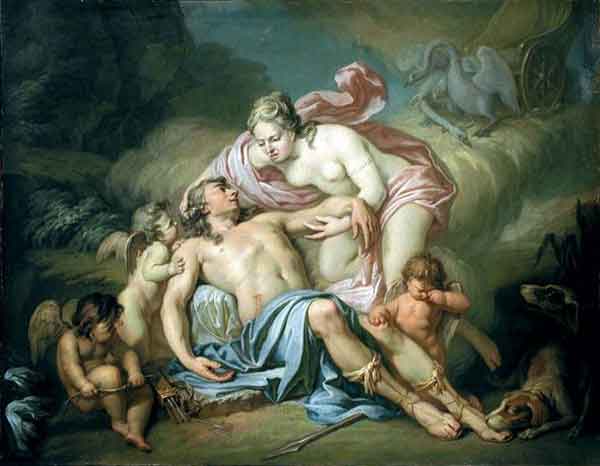 |
| Anton Losenko - The Death of Adonis (1764) |
 |
Thomas Willeboirts - The Death of Adonis
(after 1642)
|
Adonis is often compared to, or even confused with the Phrygian god Attis who also holds an important place in the iconography of resurrections.
The Resurrection of Attis
I have already told the story of Attis' death in a previous post, but I will retell it here. So this is how it goes:
Zeus fell in love with Cybele but she rejected him. He, of course, didn't know the meaning of the word "no" so he decided to simply spill his seed on her while she was sleeping and in doing so have his way with her. Cybele got pregnant and soon gave birth to Agdistis - a hermaphroditic demon who all the other gods feared. In one of their rushes of fear, they cut his penis off (here's the sacrifice motif) from which an almond tree sprouted. A new figure enters the story now - Nana, who ate an almond from this tree and thus got pregnant. She gave birth to a wonderful baby boy who ended up in the hands of a caring shepherd couple who lived nearby (or rather Nana wanted to get rid of him since he didn't have a father, which was thought to be shameful). Now this boy grew up to be so handsome that Cybele herself fell in love with him (his grandmother, in case you don't feel bothered to do the math). This boy was called Attis and he was in love with another woman, but Cybele didn't really care much for that. She wanted him all to herself and became much too jealous. He, of course, wanted to protect his beloved and started hunting Cybele down all over the mountains but in the process went mad. So one day, while standing next to a pine tree, he decided to commit suicide. From his blood, the first violets sprung, but the pine tree took his soul and Cybele his body, which she resurrected with Zeus' help.
Frazer explains that Attis' resurrection was celebrated in Rome on the 24th and 25th of March i.e. around the date of the vernal equinox. Another similarity between Attis' and Christ's resurrection is that both lay in their tombs for three days before being reborn. This myth, in contrast to that of Adonis, influenced the Latin-speaking countries of the ancient world (so basically Rome and most of the West).
It is obvious that the motif of resurrection and its symbolism were familiar to almost all cultures. Even the myths are very similar to one another when you look at the details (for instance, both Adonis and Attis were killed by a wild boar, both Attis and Christ lay for three days in their tombs before being resurrected and so on). The only difference is the name of the protagonist. But then again, too many books have been written on the topic of Jesus' resurrection as the symbol of the returning Sun. This is why I will leave further research on the topic to you, although you will find much more information in Frazer's book. And now we move on to the next topic.
Defining the Date for Easter
Many people refer to the very way in which the date of Easter is defined as being "Pagan" because it is based on the phases of the Moon. As you may know, Easter has no fixed date; it actually falls on the first Sunday after the first full Moon following the spring equinox (which the Church has a fixed date for - March 21). This year, the first full Moon after the spring equinox was on April 15 which means that Easter couldn't be before April 20 (which was the first Sunday after the 15th this year). It's worth mentioning though that this only the Catholic way of defining the date for Easter.
There are many more comparisons that could be made, but I believe that the main aspect of Easter is the celebration of new beginnings. The fact that Christians celebrate this in the form of Christ's resurrection and Pagans celebrate it a few days earlier in the form of the spring equinox and the rebirth of the Sun is of no great importance. There are too many similarities in the symbolism of new beginnings for these two familiar traditions to be fighting.
This is why I wish all my loved ones a happy Easter even though I am not Christian, and my loved ones also wish the same to me even though they know I don't believe in it in the same way that they do. But seriously though, why not accept another person's blessing or nice wishes? In my opinion, the religious background of these wishes/blessings does not matter as long as the intention is good. I just thought of a dear Pagan friend of mine who once told me that she will never refuse a house blessing from a Catholic priest because any blessing is a welcome blessing no matter what religion it comes from.
So I wish you all a happy Easter (both to those of you that celebrate it, and to those of you that don't) as well as a pleasant time with your families. Remember to be tolerant towards others whose beliefs differ from your own and to focus on the similarities rather than the differences.
Until next time. Yours,
Witch's Cat