4.5.14

International Workers' Day, Walpurgis Night and Beltane Have Nothing to Do with Satanism!

Slavic Rodnovers in Russia raising an idol
(i.e. a "kumir") for George's Day (
Jurjevo)
May Day (May 1) has always been celebrated in Paganism as the day of fertility and the culmination of spring. All of my loved ones know that I celebrate this date under the name of Beltane. And so I received a link on Facebook from a local newspaper (or rather a national one) which was written by a Zrinka K. and is entitled (in translation) "THE REAL TRUTH ABOUT INTERNATIONAL WORKERS' DAY: Do not be deceived, on this day everyone bows down to Lucifer by celebrating Walpurgis Night, the most demonic holiday of the year" (you can read the full article here, but it is in Croatian). I have tried to find similar articles in English but didn't manage to, so I hope you will take my word for what is said in the articles I will mention in this post. Anyway, the title isn't the least bit practical because of its length, but it will catch a lot of looks. I couldn't resist reading the article and by the time I came to the end, I was beside myself with anger. I didn't know whether I should laugh or cry. Of course, I knew that my friends had sent me the link as a joke, but I was also aware that many people would take it seriously.

I have to admit that I was very sad to find out that I was right. Only two days after reading the article, I was talking to a few colleagues of mine and we came upon the topic of International Workers' Day. They are all Catholic (I know this because we are also friends). One of them said that May Day and Walpurgis Night are Satanistic celebrations. It was clear that she really meant what she was saying so I interrupted her to explain where Walpurgis Night even got its name, although I didn't go into too many details.

Inspired by the aforementioned discussion, I decided to write this post in the hopes that everyone that read this and similar articles will stop blindly believing everything they read in them and so that those that have not heard the other side of the story yet will finally get a chance to hear it. 

I found similar articles to the one by Zrinka K. all over the Internet simply by Google searching the key words, so you can feel free to search for yourself. In any case, all of the articles I came across (most of them in Croatian, admittedly) say the same things:
  1. That International Workers' Day is a cover-up for the Pagan and/or Satanistic holidays of Beltane and/or Walpurgis Night
  2. That Anton LaVey, the founder of the Church of Satan, is directly connected to these celebrations
  3. That the Illuminati (and I will directly translate what Zrinka K. said in her article) "organized the protest in Chicago and the conflict between the workers and the police on May 1, 1886" (this is a typical conspiracy theory if you ask me, and the author could have at least written the correct date of this protest which was on May 4).
The inconsistency of these authors throughout their articles particularly bothered me because they say that Beltane is a Pagan celebration, and then they call it Satanistic. They also claim that Beltane and Walpurgis Night are the same thing and later on differentiate them. Thus, I would like to explain that neither Beltane nor Walpurgis Night are Satanistic celebrations and that they aren't even the same holiday.

This specific new website additionally disappointed me because they obviously allow copy-pasting entire paragraphs of text from one article to another. I remember that I read a similar article last year, but I simply decided to ignore it at the time. The article I am referring to was written by Mladen Prenc in 2013 and is entitled (in translation) "International Workers' Day: Did you know that it is the birthday of the Illuminati and also a Satanistic celebration?" (original link here). It is evident that Ms Zrinka took the easiest route and simply copied a few whole paragraphs from this article and used them in her own text. This is extremely unprofessional behavior which is reason alone why this article should not be taken seriously. I am obviously not well-informed about how the media functions because, in the academic world, plagiarism is harshly punished.

I also find it disturbing when these sorts of "professional" websites neglect to check their spelling. It is expected that any respectable website will check grammar and spelling of all articles before publishing them, but this site obviously does not wish to be taken seriously and does not care for itself as I found large amounts of mistakes in both articles. In the Croatian version, even Walpurgis Night is misspelled (throughout the articles and even in the titles!). 

The History and Meaning of Walpurgis Night

Walpurgis Night was named after Saint Walburga (or Walpurga), a nun from Wimbourne in England who lived in the 8th century. She devoted her life to missionary work in Germany where she established a monastery and was well-known for her good deeds. Given her background, the original name of this holiday is in German - Walpurgisnacht. As is expected of a saint, she was pure, enlightened and mild-mannered. According to the Roman Catholic calendar, May 1 is dedicated to her because she was canonized on this date. Walpurgis Night is simply the eve of this day (i.e. the night of April 30 to May 1). But in 1955, Pope Pius XII dedicated this day to Saint Joseph the Worker thus supporting all workmen and creating a counterpoise for a communist holiday which was celebrated on the same date (as he was strongly opposed to communism). 

The main question that has to be asked now is how Saint Walpurga was connected to witches, Pagan celebrations and even Satanistic practices? This connection fascinates me so I will try to explain it.

Medieval Misapprehensions

As is the case with most delusions regarding witches, this one too has roots in the Middle Ages and the witch persecutions.

During the numerous tortures that happened during this period in time, Inquisitors were able to get the "truth" out of the many poor souls they tortured. These "truths" were actually the prejudices and speculations the Church had of heretic celebrations (keep in mind that anyone who wasn't a Christian back them was a heretic). Those being tortured were forced to confirm all of these beliefs and confess to all sorts of ridiculous claims simply because they endured horrible pain throughout the whole "questioning" process. The tortures included breaking bones, cutting meat all kinds of torture devices that caused inhumane pain and psychological traumas that no normal person could endure. Simply put, the Inquisitors got the affirmation they needed by putting people in situations they could not get out of alive; they just had to confess to everything they were told. They were "let go" only after they confessed to everything, but this just meant that the torture was put to an end. They were still sentenced to death either by hanging or by burning at the stake.

Countless testimonies exist for these tortures and not to mention the numerous technical drawings for torture devices, the descriptions of the trials and tortures themselves and so on. Surely, the most famous work related to these topics is the Malleus Maleficarum which you can read about in this post. Of course, these testimonies cannot be taken as certifications of verity because they were gained through torture, that is by force. People will admit to anything when they are in such pain. In addition to this, the theories that the Church represented were absurd, at least from our perspective. Theories such as those that witches ride brooms, have intercourse with the Devil himself, eat newborn children etc. were widely accepted. Today, they are only proof of the misunderstanding of older beliefs and practices that were heretic in the eyes of the Church.

In this witch craze, many prejudices and misconceptions were formed...enough to fill an entire book. But I would like to mention only one at the moment; the preconception regarding sabbats. In the Middle Ages, witches' sabbats were synonyms for orgies, Satan worship and many other unconventional things to say the least, some of which can truly be called disgusting. The first time the term sabbat (or sabbath) was found in an inquisition document was in 1335 in Toulouse (France). Despite this, the word itself goes back to the Hebrew word shabbat which means "to rest" (or rather "to cease form work") and which refers to the Jewish day of rest (Saturday). This term was accepted as the name for any heretic celebration or holiday since, back then, Jews were also seen as heretics in the eyes of the Roman Catholic Church. It wasn't until the 15th century that the phrase was more widely accepted and used only in the context of witches as well as all of the stereotypes and misconceptions that go with it.

It was believed that these witches' sabbats were held in hidden places - in forest openings, mountains or caves and only during the night. In time, maps were dotted with "notorious" locations of witches' celebrations and among them was Brocken (a.k.a. Blocksberg) in the Harz mountain in Germany. Some sort of synchronicity occurred because the German tradition of celebrating Walpurgisnacht was connected to the belief that Brocken is a traditional place for witch gatherings. The basis for this synchronicity was a certain date and a document from 1591.

German folk tales (I cannot emphasize folk tales enough) say that Brocken is a very mysterious place where witches (Hexen) used to gather from very ancient times. These stories were fused with popular celebrations of spring which were also held at the beginning of May. The most famous of these vernal celebrations is May Day which was celebrated throughout the world, and thus also in Germany.

It is worth noting that the witch hunts didn't get to Germany until the 16th century, which is quite late in comparison to the rest of Europe. But this delay was more than compensated for with the sheer brutality of the tortures that were conducted and by the number of accused that were burnt at the stake. One notable author on the subject of German witchcraft (and a strict opponent of the same), Johann Georg Godelmann, wrote an important work in 1951 entitled De Magis, Veneficis Et Lamiis, Recte Cognoscendis & Puniendis in which he said the following:
"It is widely believed that all German witches are carried, on the night of the first of May, in the shortest time imaginable, to the mountain called Blocksberg and Heinberg, in the Brusteri region, having first anointed themselves . . . . They spend the whole night in feasting and jollity, dancing with their lovers."
If nothing else, Godelmann affirmed and possible even prompted the beliefs about Brocken. They just continued to develop until they reached their famous culmination in Goethe's Doctor Faustus. In his article, Prenc mentions that Goethe describes "Satanistic" gatherings on Brocken, but we have to take into consideration the intention with which this work was written. The main point of this play is Christian; any soul can return to God because God will forgive all of our sins, but it cannot expect salvation if it completely gives in to Satan (which is what Faustus does in the end). The demon Mephistopheles leads Faustus throughout the play and shows him the many manifestations of Satan on Earth and urges him to do all sorts of immoral things. These scenes were intended to frighten the reader and thus turn him/her away from Satan and back on the right path to God. This tragedy has a nice moral message, but it still accepts certain stereotypes and misconceptions in order to prove the verity of its main point.

The conclusion of this part of the post is as follows: Brocken is not a gathering place for Satanists nor is Walpurgis Night a Satanistic celebration. Satanism and Walpurgis Night have nothing to do with one another because Walpurgis Night is essentially a Christian holiday. The celebrations that occur on Brocken are very modern and are the product of the aforementioned legends and beliefs. Such modern celebrations are only marked by people dressing up as witches, devils and similar things while any deeper religious meaning is found lacking. Still, this does not mean that gatherings on Brocken did not occur because this soon became an almost traditional place for vernal celebrations. If people sometimes went there to celebrate the coming of spring, this does not mean that they worshiped Satan. This also does not imply that they were Pagans, or followers of any faith at that. Maybe they were just non-religious people who went there with their families to have a nice picnic and enjoy nature. Not firm estimate can be made of how many gatherings have been held on Brocken. In fact ,this cannot be said for any place on Earth. One thing that can be claimed is that not all of these gatherings were either witch meetings or Satanistic ones. Such generalizations would be insubstantial.

You have probably notices that I differentiate the terms "Pagan" and "Satanistic". The authors of the above mentioned articles do not and I strongly object to this. In addition to this, they connect Anton LaVey, the founder of the Church of Satan, to Walpurgis Night. But since many people do not know the background and the proper meanings of these terms, I feel obliged to elaborate.

Why Walpurgis Night and Beltane Are Not Satanistic Celebrations

As I have already emphasized, Walpurgis Night is dedicated to Saint Walpurga. I take my hat off to anyone that manages to connect this Christian saint with Satanism which didn't even exist (at least not in the form that we know it to have today) until 1966 when Anton LaVey established his Church of Satan.

Also, Walpurgis Night and Beltane are not the same celebration, as you might have concluded up to now, although they are celebrated at almost the same time. Beltane is marked on May 1, while Walpurgis Night occurs on the night of April 30 to May 1. In addition to this, Beltane is a Pagan celebration and Walpurgis Night is originally a Christian holiday which was later distorted.

What I am left with now is the task of explaining why Beltane is not connected to Paganism. This is a very old discussion which we one always stumbles onto because of misconceptions. Namely, Beltane is a Pagan holiday which celebrates nature, the spring, the fertility of the earth and also fertility in general (for more information, please read this post). But it seems as though Mladen Prenc has his own opinions on the subject which he clearly states in his article. He says the following (translated from Croatian):
"On this occasion [for Beltane], fires were lit and games and dances were held at the base of a pole around which colorful ribbons were tied. This pole represented the male reproductive organ. In these ritualistic games, there is mention of ancient demonic gods such as Vaal, the Green Man, Pan, Green George etc.

When they had fallen in a trance overtaken by demons, they held orgies until sunrise. As an extension of Beltane, Pagans also continued to celebrate Walpurgis Night . . . Walpurgis Night is one of the most important Satanistic holidays and often implies ritual human sacrifices to Lucifer!"
In Croatian: "Tom prilikom [za Beltane] su palili vatre, igrali i plesali oko stupa oko kojeg su vezivali trake raznih boja, a koji je simbolizirao muški spolni organ. U tim ritualnim igrama spominjali su i drevna demonska božanstva Vaala, Zelenog čovjeka, Pana, Zelenog Juraja itd…
Kada bi pali u trans obuzeti demonima, orgijali su do zore. U produžetku Beltana pogani su nastavljali slaviti Valpurgijsku noć. (...) Valpurgijska noć je jedan od najvažnijih sotonističkih praznika i redovno podrazumijeva ritual prinošenja ljudskih žrtava Luciferu!"

He correctly noticed that Beltane traditions do include lighting a fire (also known as a balefire), dancing and making the Maypole (which really is a phallic symbol and thus fertility which is the focus of this holiday), but the second part of the quote is completely negligible. First of all, the phrase "demonic gods" is pure nonsense. All mythologies of the world differentiate demons and gods and the fact that some of these gods are Pagan by nature (i.e. they have ancient roots and were celebrated in the context of fertility worship) does not make them evil, "demonic" or Satanistic. Even the first deity that Prenc mentions is misnamed. The god "Vaal" is actually the Celtic god of light, fire, warmth and the Sun whose real name is Baal. The Green Man is more of an archetype than a god as he has many other names around the world. The Green Man is the very embodiment of nature in spring which truly is green as green can be, in bloom and lit by the Sun's warm rays. This is why the Green Man is depicted as a man with a green beard, or wearing a mask of foliage and flowers. Pan is surely the most famous of the gods on the list. He is the Greek god of the wild, nature, hunting etc. He was depicted with goat's legs and horns precisely because of his connection to the wild but also to shepherds and their flocks. Just because he had horns, he was equated with Satan with whom he doesn't have any connection whatsoever; neither in their iconography, characteristics or mythology. Green George is another name for the Slavic god Jarilo; the god of fertility, spring and vegetation. He is celebrated on Jurjevo (April 23...rather close to both Walpurgis Night and Beltane, don't you think?).

No proof of demon possession or the existence of orgies is stated in either article. Beltane celebrations were your usual festivity. People would eat, drink a few glasses of wine, dance and have fun. As with every party, there is definitely a chance of someone going home with someone else, but this does not mean that any orgies were held. And if these people were possessed by demons then every person on any birthday party, wedding feast or concert should be exorcised.

The most drastic claim in the whole text is surely that human sacrifices are offered to Lucifer on Walpurgis Night. I would kindly ask Mr. Prenc to show me proof of this. Personally, I have not taken part in a Walpurgis Night celebration, but I have taken part in Beltane celebrations. Speaking from experience, I can firmly say that no human sacrifices are performed as I didn't witness any nor was I the sacrifice.
But just so that I don't come off as nonobjective, I have to mention that the anthropologist James Frazer talks about this subject in his work entitled The Golden Bough. He leaves the possibility of human sacrifices open but clearly states that if they ever were performed, that this was in pre-Christian times in Scotland. Nevertheless, this practice is obsolete and brutal. Reminiscences of such sacrifices have been preserved in other, metaphorical versions of the sacrificial rite. So in Scotland, there is a tradition that includes the "person being sacrificed" jumping over/through the balefire three times. The other participants then act as if the person is deceased, but things soon return back to normal. In other cultures, a symbolic sacrifice is offered to the fire - small pieces of paper with things written on them, woven figurines (often human in form) made from various dried herbs and so on.

Undoubtedly, all sacrifices that are performed at Beltane are not given to Lucifer or Satan. They are not blood sacrifices; they are metaphorical sacrifices (like I said - papers, dried herbs, some plant seeds in the earth as a gift/sacrifice to nature etc.) and nobody is harmed in the process. They were/are performed as a token of gratitude to the spring for returning once again but also to feed the Beltane fire. The Beltane fire needed to be kept lit as it symbolized the growing strength of the Sun during this time of year.

Still, I would like to make a few more distinctions between Paganism and Satanism just to elaborate more on the topic.

Paganism is an umbrella term that covers all the faiths and spiritual paths of the past which are based on celebrating the fertility of the land and the cycles of nature. The very etymology of the word "Pagan" gives indications to the roots of this spirituality which can be found in the countryside and in rural areas where the people were primarily concerned with agriculture. In this sense, the religions of ancient Greece, Rome and many other ancient civilizations can be called Pagan. Neo-Pagan faiths also exist. They are simply the reconstruction or perhaps adaptation of these old customs and the general mentality of celebrating the earth and nature.

Paganism existed long before Satanism. In addition to this, Satanism is a by-product of the Church, or rather a reaction of the many dissatisfied individuals with the austerity of the Roman Catholic Church. To elaborate, the Church forbade many things during the Middle Ages, including sexual intercourse, or more precisely, sexual satisfaction. It believed that sex was to be performed only for procreation. Taking satisfaction in it was strictly forbidden. In order for this idea to be enforced, the Church introduced prohibitions for sexual intercourse. And so it came to be that sex was forbidden on Sundays, Wednesdays and Fridays, 40 days before Christmas and Easter, three days before confessions or receiving any sacrament (and it was mandatory to do both on a regular basis), during pregnancy, 40 days after giving birth and so on. In short, medieval people were allowed to have sex only two months in the year. This resulted with general discontent and people starting turning to God's rival - Satan. This is why I say that Satanism is a by-product of the Church and Christianity.

Also, Satan is a Christian concept which Pagans do not believe in. Another idea that is alien to Pagans is the notion of ultimate evil and ultimate good such as Satan and God in Christianity. In this spiritual path, it s very widely accepted that everyone and everything has good and bad aspects and that the ratio of these aspects can vary. Nature itself is neither completely good nor completely bad, the same can be said of people. Even Pagan gods aren't seen as manifestations of pure good or pure evil because they are very anthropomorphic. This results in them also having good and bad characteristics.

Although, this turning of medieval people to Satan isn't Satanism in the real sense of the word, or at least not in the modern sense. Back then, Satanism was not organized and it was more often than not simply an expression of resistance rather than actual Satan worship.

When one says "Satanism" today, they are usually referring to the officially organized Satanism which arose when Anton LaVey established the First Church of Satan. This happened on April 30 (that is Walpurgis Night) in 1966 in San Francisco. Zrinka K. and Mladen Prenc notice this correctly, but they say it as a strong claim and not as a concrete, profound conclusion. They basically manipulate the reader into coming to the conclusion that Walpurgis Night is Satanistic simply by stating a fact or two in such a context, yet they do not give any proof to confirm this conclusion.

Paganism cannot be the same thing as Satanism because it is not centered around Satan (who is a Christian concept anyway) and it was not "established" even remotely at the same time (although Paganism was never formally established because it is not an institution such as LaVey's church; it is a spiritual path, a phenomenon, a way of life and a series of ancient beliefs). The fact that the word "Paganism" has been pejorized over time and came to be connected to heretics or ungodly practices is a very relative thing. Pagan practices are heretical only in the eyes of the Christian Church anyway. Then again, any other religion of the world is deemed as heretical from their standpoint. The word "Pagan" can be taken as a synonym for the word "non-Christian", but this does not imply Satan worship.

Non-Christian faiths and religions include Buddhism, Islam, Judaism, Hinduism, Shintoism, Sikhism, but also Neopaganism and many others. Should all these faiths be equated with Satanism just because they are not Christina?

Therefore, Walpurgis Night and Beltane are not the same holiday. Paganism and Satanism are not the same faiths; in fact, they have nothing to do with one another.

May Day as International Workers' Day

International Workers' Day is essentially a commemoration of the revolt that occurred on May 4, 1886 on Haymarket Square in Chicago (NOT May 1 as both of the articles claim). Workers demanded eight-hour workdays, but the police reacted with gunfire. The affair, of course, caused many deaths and suffering, but it also inspired other protests which managed to achieve their goals in the end.

May 1 was set as the date for the International Workers' Day celebration in Paris, 1889 on the first congress of the communist Second International. This congress actually invited all workers to demonstrate in 1890 on the anniversary of the Haymarket Affair. It wasn't until 1904 that the International Socialist Conference invited all Social Democratic Party organizations and trade unions to cease work on May 1 in order to legally establish the eight-hour workday. They were obviously successful and May 1 was pronounced a national holiday in most countries of Europe and on other continents.

The authors of both of the articles claim that the "Illuminati . . . using their great influence in America, organized the workers' demonstration and their confrontation with the police in Chicago, on May 1 1886" (as I have mentioned, this did not happen on May 1, but on May 4 of the same year). This is just another conspiracy theory. Of course, I cannot forbid anyone to believe in it, but I have to emphasize that the authors to not give any proof of this theory.

Mladen Prenc says the following (freely translated from Croatian):
"The roots of this theory can be found in the life of Adam Weishaupt, a Roman Catholic priest, Jesuit and professor of Canon law at the University of Ingolstadt, who was born on May 1, 1748..."
Adam Weishaupt is known to be the founder of the Illuminati. First of all, he was not born on May 1, but he did found this organization on May 1, 1776. In addition to this, he WAS NOT a Roman Catholic priest, although he was educated and raised in a Jesuit school. I believe that the authors got this information from sources in a foreign language that they did not understand all that well and simply misunderstood what was said. All in all, they are propagating disinformation or are intentionally making things up in an attempt to prove their theories.

Prenc also says that Weishaupt "strayed from the ecclesiastical path and started engaging with witchcraft and Satanism". He did not stray from the ecclesiastical path because he was not a priest and he was not occupied with either witchcraft or Satanism. Weishaupt really was a firm opponent of the Roman Catholic Church mainly because he though to be intolerant and bigoted. This caused conflicts him and Church members, but this does not imply that he practiced witchcraft or was a Satanist. In addition to this, the authors' claims that the Illuminati are a Satanistic organization is absurd.

The Illuminati were opposed to the Roman Catholic Church, but they did not worship Satan. They were not a religious group but rather a socially-political one. Their main goal was to enlighten people (hence their name; Illuminati = the enlightened) in the sense that they wished to show them that they can and should think for themselves. They were opposed to the Church because they believed it abused its power and controlled people. In addition to this, they were also against the government's abuse of its power and, among other things, they advocated equality of all people and equality of the sexes.

This theory about the Illuminati is similar to the numerous conspiracy theories which exist in connection to them and I have to admit that I did not find any proof of it whatsoever. But I believe that my task is not to find proof. This is the task of the proponents of this theory such as Zrinka K. and Mladen Prenc.


I suggest all of the readers of these and similar articles to completely disregard them because their authors just spread misinformation and use (or rather contort) those correct facts that they have to their own advantage. And just to be clear, there aren't that many correct facts in these articles. Thus, the authors do not provide the reader with a full picture and lead them to make the wrong conclusions simply by manipulating words. I sincerely hope that I have given sufficient information in this post to back my opinions as well as enough arguments to explain why I am so opposed to these articles. In case you feel that I have not given enough arguments/proof, feel free to contact me via the contact form or by leaving a comment on this post.

Until next time. Yours,
Witch's Cat

1.5.14

Majska zmija

Recept za ovogodišnju proslavu Beltanea sam pronašla na blogu Confessions of a Kitchen Witch kojeg već duže vremena pratim.

Sama autorica bloga objašnjava simboliku ovog kolača (iako bih ga ja prije nazvala aromatičnim, slatkim kruhom) pa bih ponovila njezine riječi i dodala još nekoliko informacija. Zmija je simbol ovoga sabata jer je simbol plodnosti, a Beltane kao takav slavi proljeće, plodnost prirode, a u mitološkom smislu sjedinjenje Boga i Božice (tj. njihovo vjenčanje i seksualno sjedinjenje). Ona je također simbol obnove zbog njezine sposobnost presvlačenja tj. mijenjanja kože. Pošto je većina zmija direktno povezana sa zemljom (jer gmižu po njoj), prikladno je da ju se slavi u paganskim vjerama koje su djelomično baziranje na štovanju zemlje. Uz sve to je ona i falusni simbol (mislim da je jasno zašto). Napomenula sam već da je Beltane blagdan za vrijeme kojeg se slavi plodnost pa je ovo jako prikladno.

U nekim običajima ovog blagdana se može naći simbolika zmije. S tim u vezi moram spomenuti ples oko majskog stupa. Ples započinje tako da svaki sudionik drži vrpcu u ruci koja je zavezana za vrh stupa. Tijekom plesa se ove vrpce isprepletu jedna oko druge i oko stupa što podsjeća na poznati simbol isprepletenih zmija koje predstavljaju medicinu i liječenje uopće. Također, kao simboli plodnosti, ove dvije zmije mogu predstavljati i sjedinjenje muškog i ženskog pola, a time i stvaranje novog života.

Ovaj kolač stoga poprima svu simboliku zmije ako ga se napravi u tom obliku. Slobodno se igrajte s oblicima i pustite mašti na volju. :D Ja sam od preporučene količine sastojaka dobila dvije "štruce" tj. dvije zmije; jednu sam savila u spiralu, a drugu sam naprosto savila u vijugu kao da upravo gmiže po tlu. Zanimljiv mi je detalj bio i punjenje marmeladom od trešnje jer je na nekim mjestima zmija "pukla" u pečenju pa je malo marmelade iscurilo. Zaista izgleda kao da zmija (tj. kolač) krvari i da je bila na neki način žrtvovana bogovima. Ovo samo pridonosi blagdanu jer je uobičajeno da se nekakva žrtva prinese za svaki blagdan (ovo naravno nije krvna žrtva već simbolična; pokapa se hrana, malo pića se prolije po tlu, zakopaju se sjemenke, presade se biljke, zakopaju se kristali ili drugi dragi nam predmeti itd.). Za ovaj Beltane je moj kolač-zmija bila dar bogovima. :) Samo da ju prihvate...


Potrebno je:

  • 3/4 čaše brašna
  • 1/2 čajne žličice mljevenih klinčića (ja sam ih zamotala u celofan i istukla batom za meso)
  • 1 1/2 čajne žličice muškatnog oraščića
  • izribana kora jedne naranče
  • 1 čajna žličica sode bikarbone
  • prstohvat soli
  • 4 1/2 čaše brašna (imajte spremno još brašna za pobrašnjivanje površine i samog kolača tijekom oblikovanja)
  • 1/2 čaše omekšalog maslaca
  • 3/4 čaše rastopljenog meda (vrućeg)
  • 1/2 čaše turske kave
  • 1 jaje
  • 1/3 čaše amaretta (ili ruma)
  • džema/marmelade od trešnje (za zamjenu možete koristiti malinu, ili neki drugi džem od šumskog voća)
  • zrna kave, ili bademovih listića za ukras (za zmijine oči)

Priprema:

  1. Ugrijte pećnicu za 175-180°C.
  2. Izmiješajte šećer, klinčiće, narančinu koru, muškatni oraščić, sodu bikarbonu, sol i brašno u jednoj zdjeli.
  3. U smjesu dodajte omekšali maslac, tursku kavu, rastopljeni med, amaretto (ili rum ako nemate amaretta) i jaje.
  4. Mijesite rukama tijesto dok ne postane kompaktno i dodajte po potrebi još dvije žlice brašna (tijesto treba biti blago ljepljivo na kraju).
  5. Odvojite tijesto na pola.
  6. Izvaljajte jednu polovicu na pobrašnjenoj podlozi u kobasicu (duljina ovisi o vama, a ne preporučujem tanje od 4cm).
  7. Nožem napravite "žlijeb" u tijestu cijelom duljinom (nemojte prerezati tijesto na pola!).
  8. Prstima malo rastvorite žlijeb i ispunite ga marmeladom (nemojte stavljati puno jer se tijesto neće moći zaklopiti, a marmelada će previše curiti vanka).
  9. Spojite tijesto prstima preklapajući tijesto preko marmelade.
Savjet: Ja sam izdvojila malo tijesta sa strane. Deveti korak sam napravila reda radi, ali sam radila flastere od izdvojenog tijesta tako da bih uzela prstohvat tijesta, spljoštila ga i zalijepila preko reza u tijestu. Zaista mi je pojednostavnilo život.
  1. Pobrašnite gornji dio tijesta i okrenite ga tako da je rez put dolje.
  2. Tepsiju obložite papirom za pečenje.
  3. Oblikujte tijesto tako da podsjeća na zmiju (ovo prepuštam vama, ali pokušajte oblikovati i glavu i rep), dodajte zrna kave/bademove listiće za oči i prebacite tijesto na tepsiju.
  4. Ponovite korake 6-12 za drugu polovicu tijesta.
  5. Pecite cca. 20 minuta na 175°C.

I eto ga :D ja sam i te kako zadovoljna rezultatom. Marmelada se lijepo, suptilno osjeća, a kolač miriše na kilometre! :D Nadam se da će vama jednako lijepo uspjeti. 

Želim vam svima sretan i blagoslovljen Beltane! :D
Vaša Witch's Cat

May Serpent Cake

I found the recipe for this year's Beltane celebration on a blog called Confessions of a Kitchen Witch  which I have been following for quite some time.

The author of this blog explained the symbolism behind this cake (although I think it's more of an aromatic sweet bread) in her post so I would like to repeat her words and add a few of my own. The snake, or serpent, is a symbol of Beltane because it is a fertility motif and Beltane essentially celebrated springtime, the fertility of nature and, in the mythological sense, also the unification of the Goddess and the God (i.e. their marriage but also sexual unification). The snake is also a symbol of renewal because of its ability to shed its skin. As most snakes are connected to the earth (since this is their usual habitat), it is very fitting that an earth-based religions such as Paganism celebrates them. In addition to all of this, it is also a phallic symbol and I think it's pretty clear why. I have already explained that Beltane is the time when all forms of fertility are celebrated so you can see why this aspect of the serpent is also noteworthy.

The symbolism of the snake can also be seen in some traditions of this festival. In regard to this, I have to mention the Maypole dance. It begins with every participant holding one end of a ribbon which is tied to the top of the Maypole. During the dance, these ribbons get intertwined around themselves and also around the Maypole and remind everyone of the famous symbol of the entwined snakes (the symbol of medicine and healing in general). Also, as a fertility symbol, these two snakes can also represent the unification of the male and female polarity and thus the creation of new life.

Consequently, this cake takes on the whole symbolism of the serpent if is shaped like one. Feel free to play around with the shaping and let your imagination go wild. :D I managed to make two "loaves" (or rather snakes) out of the recommended amount of ingredients. I formed one snake into a spiral, and the other in a sort of curvy position as if it was just crawling on the ground. An interesting detail which especially liked was the wild cherry marmalade filling because the snake slightly broke in a few places during the baking process and a bit of the marmalade leaked out. It really looked like the snake (i.e. the cake) was bleeding and that it was, in some way at least, sacrificed to the gods. This only adds to the whole festivity because it is normal it is normal for some symbolic sacrifice to be given fro each holiday (not a blood sacrifice, of course, but a symbolic one such as burying food, planting seeds, spilling a bit of drink on the ground, replanting plants, burying crystals and other valuable objects and so on). For this Beltane, my snake cake was my gift to the gods. :) I just hope they accept it...


You Will Need:

  • 3/4 cup flour
  • 1/2 teaspoon ground cloves (I just wrapped them in plastic wrap and beat them with a meat cleaver)
  • 11/2 teaspoon nutmeg
  • orange zest (from 1 orange)
  • 1 teaspoon baking soda
  • a pinch of salt
  • 41/2 cups flour (have some more ready to flour your working surface and the bread/cake itself while molding it)
  • 1/2 cup softened butter
  • 3/4 cup honey (boiling)
  • 1/2 cup Turkish/strong espresso coffee
  • 1 egg
  • 1/3 cup amaretto (or rum)
  • wild cherry jam/marmalade (you can use raspberry jam/marmalade as a substitute though I think that any forest fruit will do)

How to Prepare:

  1. Preheat the oven to 175-180°C.
  2. Mix together sugar, cloves, orange zest, nutmeg, baking soda, salt and flour in one bowl.
  3. Add softened butter, coffee, melted butter and amaretto (or rum if you don't have any amaretto at home) to the dry ingredients mix.
  4. Knead the dough with your hands until it becomes compact and add two more tablespoons of flour if necessary (keep in mind that the dough should still me a bit sticky at the end of this step).
  5. Separate the dough into two parts.
  6. On a floured working surface, roll out one half of the dough into a long rope (the length is up to you, but I recommend you don't make it any thinner than 4cm).
  7. Make a vertical trough down the center of the rope using a knife (take care not to cut through the dough or cut it in half!).
  8. Make the trough slightly wider with your fingers and put some jam/marmalade in it (do not put too much because the dough won't be able to close then and the marmalade will start leaking out).
  9. Seal the dough by folding the dough over the marmalade.
Suggestion: I left a bit of dough on the side. I did step 9 just because, but I completely sealed of the trough by using this leftover dough as "band aids".  So I would basically pinch off some dough, flatten it with my hands and stick it over the trough. I just kept doing this until the whole cut was covered. 
  1. Put some flour on the top part of the cake and turn it over so the trough faces downwards.
  2. But baking paper on the pan.
  3. Form the dough so it looks like a snake (I'll leave this to you, but at least try to make the head and tail nice) and add coffee beans/almond shavings for eyes. Once you have shaped your snake, put it on your pan.
  4. Repeat steps 6-12 for the second half of the dough.
  5. Bake for 20 minutes at 175°C.
And there you have it! :D I am extremely happy with the result. The jam is just subtle enough and the cake can be scented from miles away. Beautiful aroma! :D I just hope that your cake will turn out just as well as mine did. 

I wish you all a happy and blessed Beltane! :D
Yours truly,
Witch's Cat

30.4.14

Hekata - božica vještičarstva

William Blake - Trostruka Hekata (eng. The Night of 
Enitharmon's Joy The Triple Hecate), 1795
Iako se Hekatu naziva božicom vještičarsva, ona je mnogo više od toga. Njezina mitologija, njeni kultovi i uloga u društvu su zasigurno vrijedni spomena jer su igrali važnu ulogu u antičko doba. Vjerovalo se da je ona imala moć promijeniti ljudsku sudbinu tako da im podari ili oduzme bogatstvo, omogući pobjedu ili uzrokuje njihovu smrt, tako da podari sreću lovcima i moreplovcima, ili ako su je oni razbjesnili da im podari lošu sreću. Uz sve ovo je još imala moć nad prosperitetom mladih ljudi i stoke.

Pokušati ću napisati kratku biografiju ove božice, iako će nekima biti previše jednostavna. Neću spomenuti SVE teorije i interpretacije koje postoje, već ću istaknuti samo one najvažnije. Bez obzira na ovo, nadam se da će vam ovaj post biti koristan. :) Ako vam se svidi, preporučam da pogledate jednu prekrasnu i jako profesionalnu web stranicu koja se zove Theoi Greek Mythology. Na njoj možete naći još mnogo informacija o ovom božanstvu, kao i o bilo kojem drugom aspektu grčke mitologije koji vam padne na pamet. Ono što se meni posebno dopada jest potkrijepljenost svih tvrdnji citatima klasičnih autora i izvacima iz dokumenata.

Porijeklo Hekate

Hekata (lat. Hecate, grč. Hekatê), kako se obično misli, je originalno bila tracijska božica mjeseca, a ne izvorno grčko božanstvo. Tračani su bili skupina indoeuropskih plemena koji su živjeli u središnjoj i jugoistočnoj Europi. Imali su kontakta s Grcima, iako su po onome što se zna vjerojatno bili neprijatelji. Izgleda da su Grci kolonizirali Trakiju u neko doba i vjerojatno se u tom procesu Hekata asimilirala u grčku vjeru i mitologiju kao i mnoge druge religijske i mitološke figure.

Vjeruje se da je njezino ime poteklo od ženske varijante epiteta hekatos (onaj koji radi iz daleka). Nije u potpunosti jasno zašto ju se tako nazivalo, ali jest poznato da se ovaj pridjev obično asocirao s Apolonom s kojim se nju također često povezivalo. Apolon je bio bog-strijelac koji je obično ciljao iz daleka (također je bio bog iznenadne smrti) pa je njegova asocijacija s ovim pridjevom jasna. Moje je mišljenje da je Hekata, kao božica lova (koja je također lovila pomoću luka i strijele) imala iste asocijacije kao Apolon kada je ova tema bila u pitanju. Naravno, postoje i druge teorije, ali je ovo najšire prihvaćena od njih.

Hekatina biografija

Rođenje

Najbolje prihvaćena priča o njezinom rođenju jest da su je na svijet donijeli titani Perzes (eng. Perses, nisam uspjela naći prijevod imena, ovako bih ga ja prevela) i Asterija. Perzes je bio titanski bog razaranja, a Asterija, koju se također nazivali "Zvjezdana noć" (eng. the Starry Night) je bila titanska božica proroka, proročanstava, noći, astrologije, snova itd.

Svi titani su zapravo predolimpijska božanstva što znači da su , prema grčkoj mitologiji, vladali nebom, zemljom i podzemnim svijetom prije nego što su Zeus i drugi olimpijski bogovi uzeli stvari u svoje ruke. Pošto je Hekata kćer dvaju titana, i ona je sama titan, a time isto prethodi olimpijskim božanstvima. 

Njezina uloga u gigantomahiji 

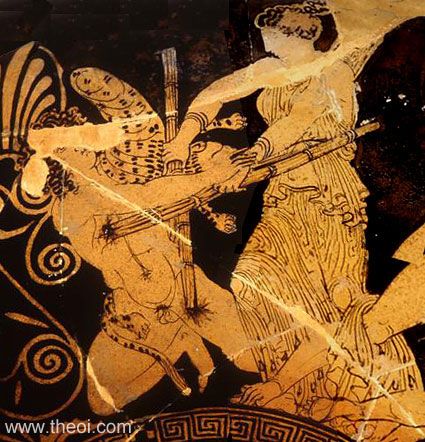
Hekata i gigant Klitije, atenska crveno
figuralna vaza, Antiken-museen, Berlin, 
Njemačka, cca. 410.-400.g.pr.n.e.
(ona je prikazana kako ubija giganta
pomoću svojih dviju baklji)
Priča gigantomahije je jako komplicirana, ali ću je pokušati skratiti. Dva božanstva iz grčke mitologije su povezana s grčkom pričom postanka svijeta: Uran (Nebo) i Geja (Zemlja). No, vrijedi napomenuti da oni nisu bila prva božanstva. U svakom slučaju, ovaj je par imao više djece koji su nama poznati kao titani. Postoji više generacija titana, a i Perzes i Asterija pripadaju drugoj generaciji, što bi značilo da su im Uran i Geja djed i baka na neki način.

Ali Geja i Uran nisu bili baš najbolji par. On joj je zatočio djecu a ona se htjela osvetiti. Uspjela je okrenuti titane protiv Urana te zadužila Krona, najmlađeg od sviju, da ga kastrira a time i ubije. U ovom je procesu nekoliko kapi njegove krvi palo na tlo (tj. Geju), a iz njih su se rodili, između ostalog, i giganti. Ovaj rat između titana i Urana je poznat kao titanomahija. Naravno, priča ne završava ovdje. Prije nego što je umor, Uran je na neki način prokleo Krona i predvidio da će njegova djeca njega svrgnuti s vlasti kao što je on svog oca (tj. Urana). 

Kron je odlučio ne riskirati te zatočio gigante u Tartaru skupa sa svime drugima koji su bila potencijalna prijetnja  njegovoj vladavini. S vremenom je postao još gori i pojeo svu svoju djecu osim jednoga - Zeusa. Naime, Kronova žena Reja je jedva uspjela spasiti Zeusov život tako da je zavarala Krona davši mu da pojede stijenu omotanu u deku umjesto Zeusa.

U svakom slučaju, kada je Zeus odrastao, natjerao je oca da izbljuje svu svoju djecu (odnosno Zeusovu braću i sestre). Ostvario je Uranovo proročanstvo tako što se pobunio protiv Krona i sam zavladao Olimpom. U osnovi je pobijedio sve titane i zatočio ih u  Tartar.

Sada konačno dolazimo do gigantomahije koju sam spomenula u podnaslovu. Geja je htjela vratiti titane na vlast i bila je bijesna na Zeusa. Stoga je povela gigante u rat protiv Zeusa i ostalih olimpijskih božanstava. Na kraju su olimpijci pobijedili uz pomoć Herkulesa kao što je predvidjelo bilo jedno drugo proročanstvo. Gigantomahija je bila golema mitološka borba i ovaj jako, jako kratki sažetak nije ni do koljena potpunoj verziji. No, trebati će biti dovoljno za sada. Svakako, mnoštvo božanstava i mitoloških figura je sudjelovalo u ovom boju, a među njima i Hekata.

Hekata se dokazala u borbi ubivši giganta Klitija. Zeus ju je nagradio nakon borbe što je bila na strani olimpijskih božanstava, odnosno ništa joj nije oduzeo. Kao titan, ona je imala određenu moć nad zemljom, morem, nebom i podzemnim svijetom (iako se ovo obično navodi kao tri cjeline: zemlju, nebo i podzemni svijet, ali ću ovo obrazložiti kasnije). Zeus joj je zapravo dozvolio da zadrži ovu moć jer je dokazala svoju vrijednost, hrabrost i, što je još važnije, odanost.

Otmica Perzefone - Hekata kao podzemno božanstvo


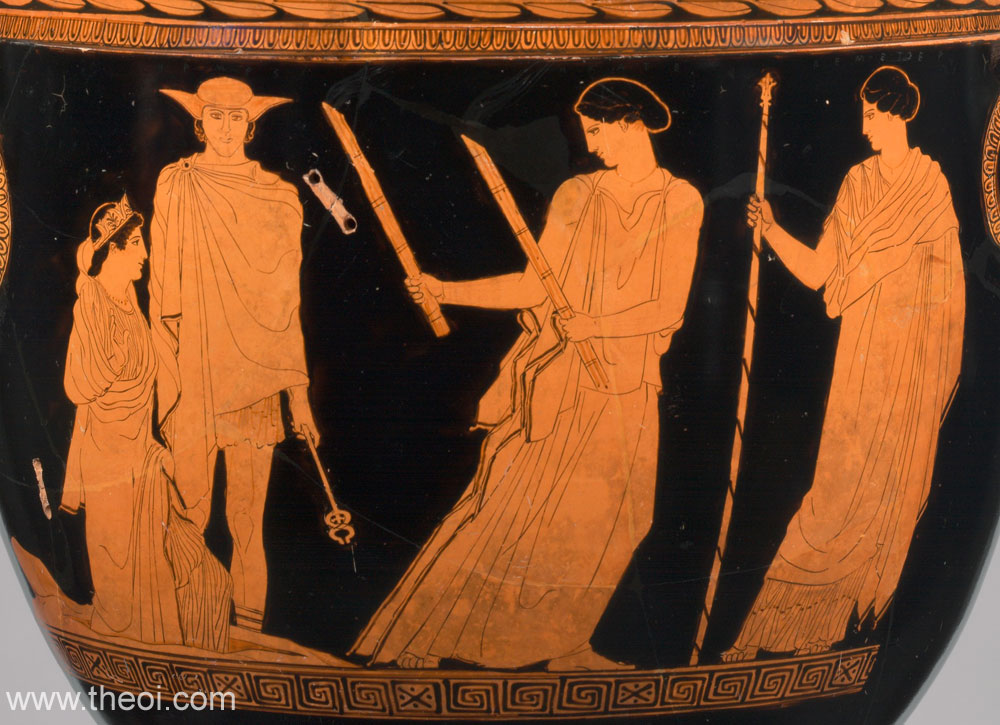
Povratak Perzefone, atenska crveno
figuralni krater, Metropolitan Museum, 
New York, SAD (Hermes vodi
Perzefonu iz podzemnog svijeta, Hekata
i Demetra joj pružaju dobrodošlicu;
Hekata je ona koja drži dvije baklje)
Prema mitovima, Had (bog podzemlja) se zaljubio u Perzefonu (božicu proljeća). te ju oteo. Njezina majka Demetra ju je tražila posvuda, a u tome joj je pomogla, naravno, Hekata. Kao što je i prije bio slučaj, i ovo je samo jedan mali fragment cijelog mita, ali će poslužiti za našu priču. Dok je Perzefona vikala u pomoć dok ju je Had otimao/silovao (ovo varira od mita do mita), Hekata je bila jedina koja ju je čula. Hekata se potom pridružila Demetri u njezinoj potrazi i vodila je kroz tamu pomoću svojih baklji kako bi skupa spasile Perzefonu. Nakon što su je našle, Hekata je odlučila ostati u podzemnom svijetu kao Perzefonina družica. 

Ovako je Hekata postala božica podzemnog svijeta. No, ovaj mit nije toliko star kao neki drugi jer potječe tek iz doba grčkih tragedija. U svakom slučaju, Hekata je u podzemnom svijetu bila zadužena za duše preminulih; ona ih je pročišćavala i pomagala im izmiriti dugove i popraviti stare greške.

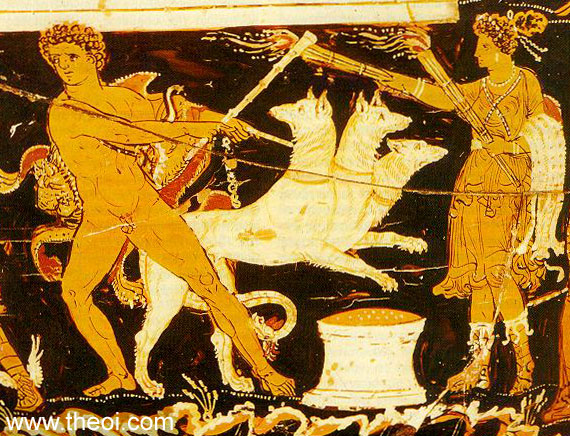
Herkules, Kerber i Hekata (krajnje
desno), apulijski crveno figuralni krater,
Antikensammlungen, Minhen, Njemačka, 
cca. 330.-310.g.pr.n.e.
Dok je Hekata živjela u podzemnom svijetu, razvila je mračnije aspekte (koje nipošto nisu manje vrijedni ili nužno "zli"; naprosto su mračniji, ali jednako vrijedni kao i svi drugi njezini aspekti jer pridonose ravnoteži svijeta. Svako božanstvo, ali i svaka osoba posjeduje mračne i svijetle aspekte). Počelo ju se povezivati s duhovima i drugim bićima podzemnog svijeta koje je po pričama slala na zemlju noću. Ponekad bi im se pridružila, što bi odali okolni psi koji bi počeli zavijati. Njezina asocijacija sa psima je jako intenzivna; česti pratitelj joj je bio pas Kerber koji je živio s njom u podzemnom svijetu. Imala je još jednog psa-pratitelja; crnu kuju koja je zapravo bila trojanska kraljica Hekaba (kraljica je skočila u more nakon pada Troje u Trojanskom ratu, a po nekim mitovima je bila kamenovana na smrt, no bogovi su je pretvorili u crnog psa i poklonili je Hekati).

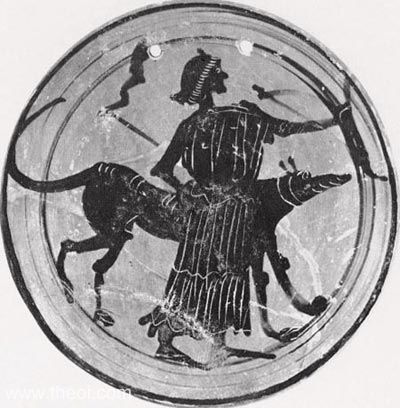
Hekata sa crnim psom, 
Antiken-sammlung des Archaologischen 
Insituts der Universitat, 
Eberhard-Karls Universitat, 
Tubingen, Njemačka, 
atički crno figuralni kiliks
Pošto je Hekata bila jako bliska s Perzefonom, s vremenom se ove dvije božice počelo poistovjećivati. Na žalost su se također razvile i mnoge negativne poveznice s božicom upravo jer je bila podzemno božanstvo. Počelo ju se smatrati zlobnom i vjerovalo se da prakticira vještičarstvo pomoću kojeg kontrolira sve duhove u podzemnom svijetu. Prema nekim izvorima je ona čak imala potpunu kontrolu nat podzemnim svijetom i svime što se u njemu nalazi.

Pošto se vjerovalo da duhovi obitavaju na raskrižjima (a Hekata je često bila s njima), također je postala poznata kao božica raskrižja.

Sve je ovo vodilo Hekatinoj reputaciji kao božici podzemnog svijeta, noći (jer se vjerovalo da izlazi sa svojim duhovima samo noću), otuda i s duhovima i dušama te Mjesecom. Ona je također bila i božica magije i vještica, odnosno grčka božica vještičarstva. Njezina asocijacija s Mjesecom je još jedan razlog zbog kojeg ju se miješa s Perzefonom.

Medeja, Kirka i Gale - vještica i Hekata

Postoji više mitova koji povezuju Hekatu s vješticama i vještičarstvom iako ovo nisu jedini razlozi zbog kojih ovakve asocijacije postoje.

Prvi mit je onaj o vještici Medeji koja je također bila Hekatina svećenica. U većini priča je rečeno da je Medeja dobila svoje čarobne moći od Hekate. Ovo se doima logičnim u priči jer je Medeja također kontaktirala s duhovima i dušama (odnosno njezina magija je bila nekromantična na neki način), a Hekata je, kako sam već pojasnila, božica podzemnog svijeta i svega što se vezuje uz ove pojave.

Također su prema nekim mitovima i Kirka i Medeja Hekatine kćeri (iako se obično kaže da je ona bila djevičanska božica). Ona je navodno prenijela sve svoje znanje o vještičarstvu, travama i slično svojim kćerkama, a napose znanje vezano uz otrovno bilje koje je bilo njezin specijalitet. Kirka se naročito zainteresirala za ove teme i nastavila majčinim travarskim putevima.

Što se tiče Gale (čita se /gejl/), ona je bila vještica koja se nije mogla suzdržati od ičega. Ovo se posebno odnosilo na njezin seksualni apetit, ali se nigdje ne spominje je li ovo također vrijedi i za njezine magijske postupke. U svakom slučaju, ovo je ljutilo Hekatu koja ju je za kaznu pretvorila u tvora koji je od tada bio njezin familijar tj. pratioc (uz crnog psa kojeg sam prije spomenula).

Hekatina povezanost s vještičarstvom ne prestaje ovdje. Hesiod objašnjava da je ona noćna božica vještičarstva zbog porijekla. Naime, Asterija je bila božica noći i zvijezda, a ime Hekatinog oca - Perzes - se lingvistički veže uz Perzefonu tj. božicu podzemnog svijeta te uz Perses (nije mi poznat prijevod imena na hrvatskom) koja je bila majka Kirke i još jedne vještice po imenu Aeetes. No ova druga tvrdnja je vrlo nesigurna jer se često i samu Hekatu naziva Perseis ali i jer je u drukčijem srodstvu s Aeetes u drukčijim mitovima. Još jedan razlog zbog kojeg ju se povezuje s vještičarstvom jer je neminovno povezana s nekromantijom (komunikacija s preminulima, a poznato je da Hekata također ima veze i s duhovima i dušama preminulih). Ako se mogu ponoviti ovdje, i za njezinu navodnu kćer Medeju se vjerovalo da prakticira nekromantiju. Djelomično se zbog ovog mita (i onih sličnih njemu) vještice počelo asocirati s praksom nekromantije pa je Hekata bila upletena u cijeli stereotip. 

Već sam napomenula da je Hekata bila jako vješta s biljkama, a pogotovo otrovnima. Travarstvo je bila u najmanju ruku bilo tradicionalna praksa među vješticama, a poznavanje otrovnog bilja je bilo još i važnije jer su se neke od njih mogle koristiti i kao lijekovi, ili pak protuotrovi. Uz to, osoba mora poznavati otrov da bi znala dati potreban protuotrov. Travarstvo je često bilo popraćeno magijom što samo služi da dodatno pojača vezu između Hekate i vještičarstva. Stoga se može reći da je Hekata također i božica magije i otrovnog bilja (i travarstva uopće).

Hekata kao trostruka božica

Trostruki prikaz
Hekate, mramor,
rimska kopija po
originalu iz
helenističkog perioda
Razlog zbog kojeg mnoštvo wiccana i vještica štuje Hekatu, izuzev činjenice da je ona božica vještičarstva, jest taj što se nju također naziva trostrukom božicom. Kao što možda već i znate, wiccani uglavnom percipiraju svoje glavno žensko božanstvo kao Trojnu Božicu koja ima tri aspekta: Djevica, Majka i Starica.

Ova je titula podarena Hekati kao posljedica njezine povezanosti s raskrižjima. Naime, vjerovalo se da ona čuva raskrižja na kojima se točno tri ulice sijeku. Zbog toga ju se često prikazuje kako gleda u tri smjera istovremeno. Ovo je dovelo do toga da ju se percipira kao tri aspekta iste božice koja su okrenuta leđima jedno drugom, ili pak kao božicu koja ima tri glave. Kako to obično biva u mitologiji, ove glave nisu uvijek bile ljudske. Jedna je često bila konjska, druga lavlja (ili veprova), a treća pseća (sjetite se njezine povezanosti sa psima).

Hekata, the British Museum
Još jedan razlog zbog kojeg ju se prikazuje kao trostruku jest taj što je ona imala moć nad trima carstvima - zemljom, nebom i podzemnim svijetom (ako se sjećate, Zeus joj nije oduzeo ovu moć kao zahvalu što mu je pomogla u gigantomahiji). Glavna razlika između prikaza Hekate kao trojne božice i wiccanske Trostruke Božice jest to što se Hekatu u svim oblicima prikazuje kao mladu i lijepu djevojku, dok je samo aspekt Djevice kod wiccanske božice može nazivati mladolikim. Aspekt Majke se često prikazuje kao sredovječnu ženu (iako ništa manje lijepu nego što je Djevica), a aspekt Starice, nadam se, ne treba pojašnjavati.

Rimljani su Hekatu zvali Diana Triformis (Dijana trostrukog oblika). Dijana je bila rimska ekvivalenta grčke božice Artemide koju se također često veže uz Hekatu. Pod ovim je nazivom zaista bila trostruka božica u pravom smislu riječi jer je imala tri odvojena aspekta: Dijanu (ili grčku Artemidu), Hekatu te Prosperinu (tj. grčku Perzefonu čiju smo povezanost s Hekatom već pojasnili).

Kada smo već na ovoj temi, vrijedi naglasiti da se Hekatu često poistovjećivalo, ili bunilo i s Perzefonom, i s Artemidom. Razlozi bog kojih ju se brkalo s Perzefonom su sljedeći: (1) obje su božice podzemnog svijeta i vrlo su bliske, (2) obje su nositeljice duša preminulih, (3) baklja je sastavini dio ikonografije obaju božica.

Razlozi zbog kojih ju se miješa s Artemidom su sljedeći: (1) obje se prikazuje u haljinama do koljena i lovačkim čizmama, (2) obje se često prikazuje u pratnji psa (ili pak više njih), (3) za obje se kaže da su obožavale loviti, a Artemida je čak i božica lova, (4) obje su bile zaštitnice mladih, (5) za obje se vjerovalo da su djevičanske božice, (6) došlo je do lingvističkih nesporazuma i zbunjujućih zamisli oko mita o Perzefoni, (7) obje su lunarne božice.

Još jedna božica s kojom se Hekatu često brka jest Selena jer su obje božice Mjeseca i u konačnici su obje povezane s noći i zvijezdama. 

Ikonografije Hekate

Ikonografija je nauk o upotrebi simbola (ili ikona) u umjetničkim djelima koje se koristi kako bi se interpretiralo značenje samog djela. Hekatu se, kao i svaku mitološku figuru, povezuje s određenim predmetima i figurama. Upravo se pomoću ovih asocijacija tumači služe kod prepoznavanje njezine figure na likovnim prikazima.

Njezini glavni simboli su:
  • dvije baklje (ponekad samo jedna; ovo je poteklo iz mita o Perzefoni)
  • njezini pratioci/familijari (crna kuja i tvor)
  • psi uopće (njezin crni pas, Kerber, ponekad ju se prikazuje s psećom glavom, psi zavijaju kada je ona u blizini, a ponekad je prati i cijela skupina pasa kao i Artemidu itd.)
  • ključevi (ona otključava misterije podzemnog svijeta)
  • bodeži (ona se njima koristi kako bi "raskidala zablude", bodež se također povezuje s wiccanskim obrednim bodežom koji se naziva athamé)
  • djevičanska suknja koja seže do koljena, lovačke (tipičan odjeća za bilo koju djevičansku božicu, također i jedan od razloga zbog kojih ju se brka s Artemidom)
Iako ju se ne prikazuje sa sljedećim stvarima/pojavama, one su isto povezane s njom:
  • Mjesec
  • noć 
  • podzemni svijet
  • duhovi/duše
  • raskrižja
  • magija/vještičarstvo/vještice

Hekatin kult

Iako je Hekata bila poznata božica u antičkom svijetu, nije ju se javno štovalo već privatno. Njezino se obožavanje uglavnom vršilo pred malim, privatnim oltarima u kućanstvima. Vjerovalo se da ovakvi oltaru tjeraju urokljivo oko i druga prokletstva (ili negativne utjecaje vještičarstva uopće).

Pošto je ona bila božanstvo raskrižja, neka vrsta oltara je također postojala na raskrižjima. Možda ih je prikladnije nazivati darovima, ili žrtvama (uglavnom se radilo o hrani) koje se stavljalo na raskrižju triju ulica kao što je i prikladno za trostruko božanstvo.

Njezin privatni kult je bio najjači u Elizeju (Atika, južna Grčka) gdje su dominirali poznati Elizejski misteriji. Oni su prvenstveno slavili božice Perzefonu i Demetru kao božice plodnosti i usjeva. Mit o otmici Perzefoni je sigurno bio dio ovih misterija pa je tako i Hekata bila uključena. Čini se da je njezin kult općenito bio jak na jugu Grčke, ne samo u Elizeju već u gradovima poput Atene, Egine, Argosa i tako dalje.

Prije sam spomenula da je Hekata također bila i tracijska božica. Neki smatraju da ona kao takva nije bila tracijska božica već grčka ekvivalenta tracijske božice Bendis. Po ovome bi Hekata bila plod sinkroniciteta grčke i tracijske kulture koja ja preuzela Bendisine atribute. Pošto se Trakija nalazila sjeverno od Grčke, njezin je kult bio prisutan i u sjevernijim dijelovima Grčke poput Tesalije. 

Uz Elizej, njezin je kult bio i te kako jak na otoku Samotrake, a moglo ga se naći i u Maloj Aziji  pa čak i na otoku Siciliji u južnoj Italiji.

Njezini su joj kultovi podarili mnoga imena i epitete. Većina ih se referira na njezine osobine, mitologiju, ili porijeklo. Evo nekoliko primjera: Perseis (Razarač, dobila je ovaj nadimak po ocu Perzesu koji je bio titanski bog razaranja), Aidônaia (Gospa Podzemnog Svijeta, kao što sam već napomenula, ona je bila podzemno božanstvo), Trimorphis (s Tri Oblika, prikazivalo ju se s tri glave, ili kao tri tijela okrenuta leđima jedno drugom svako okrenuto u drugom smjeru), Trioditis (od Raskrižja, od Triju Puteva, bila je božica raskrižja, ali i trostruka božica)Nytipolos (Koja Luta Nebom, bila je i božanstvo noći), Khthoniê (od Podzemnog Svijeta), Skylakagetis (Poglavarica pasa, asociralo ju se s mnoštvom pasa, a neku s bili i njezini pratioci), Liparokrêdemnos (Svjetlokosa, sa Svijetlim Obručem, može upućivati na njezinu povezanost s Mjesecom), Anassa eneroi (Kraljica Onih Ispod, ili Kraljica Preminulih) itd.


Hekata je na neki način zaradila lošu reputaciju zbog svoje povezanosti s vještičarstvom (kao što je vještičarstvo samo po sebi zaradilo još goru reputaciju). Ovo vuče korijene još iz srednjeg vijeka kada se vjerovalo da ona nadgleda "sotonističke rituale" koje su vještice navodno obavljale. Zaista smiješno. Odnosno, vjerovalo se da Dijana vodi ove rituale, a Dijana i Hekata su bile jako bliske (do te mjere da ih se često i poistovjećivalo). Zanimljiva teorija jest da je Hekatina trostrukost (ili još preciznije njezini prikazi na kojima ima tri glave) utjecala na Danteov opis Sotone koji ima tri glave.

Mnogima je problem povezati se s Hekatom, a neki se čak straše njezinog lika, ali glavni uzrok ovome je predrasude i zablude. Iako ova božica ima dosta mračnih aspekata, važno je zapamtiti da ona nije u cijelosti mračna. Čak i "najsvjetliji" bogovi imaju mračne aspekte. Osobno vjerujem da je moderno društvo naprosto naviknuto da sve treba biti crno/bijelo, ili dobro/loše. Stoga im je ambivalentnost božanstava kakve su štovali ljudi u antici nepojmljiva. Tada su ljudi smatrali bogove antropomorfnima. Kao takvi su morali imati svoje životne priče, veze, osobine i, što je najvažnije od svega, nisu bili savršeni! Svaki se od njih međusobno razlikovao te je u svakoj situaciji netko morao biti zločinac, a drugi heroj. Kao što je to i u stvarnom životu, ne igraju uvijek isti ljudi te uloge. Svatko pokaže svoju "mračnu stranu" tu i tamo. Tako je bilo i s bogovima.

No moramo zapamtiti da Hekata ima i mnoštvo "neutralnih" i dobrih osobina. Uz to, neke stvari koje mi danas percipiramo kao "loše" je zabluda u očima antičkih ljudi. Na primjer, podzemni svijet ne bi za njih nužno bio nešto loše; on je bio jednako važan dio kozmosa kao i bilo što drugo jer je održavao kozmičku ravnotežu. Isto se može reći i za noć; jedna osoba ju može percipirati kao isključivo lošu, dok će ju netko drugi smatrati prelijepom i čudesnom, ili pak romantičnom. Zbog ovoga vjerujem da se čak i takozvanim "mračnim" božanstvima treba pružiti prilika te da ih se treba barem pokušati sagledati iz neke druge perspektive i bez predrasuda.

Do sljedećeg puta,
vaša Witch's Cat

24.4.14

Hecate - Goddess of Witchcraft

William Blake - The Night of Enitharmon's Joy
or The Triple Hecate, 1795
Although Hecate is called the goddess of witchcraft, she is much more than this. Her mythology, cults and role are definitely worth talking about as they all played an important role in ancient times. It is said that she could alter the fate of human beings by either giving wealth or taking it away, giving victory or causing death, giving good luck to hunters and sailors or, if they angered her, causing them bad luck and also by governing over the prosperity of both youth and cattle.

I will try to write a sort of biography of this goddess even though some may find it over-simplified. I won't mention ALL of the theories or interpretations but rather the most important or widely-accepted ones. Nevertheless, I hope you will find this post useful. :) If you find it interesting, I recommend you have a look at a wonderful and very professional website called Theoi Greek Mythology where you will find much more information on this deity as well as any part of Greek mythology you can think of and all of this backed up by quotations from classical authors and documents.

The Origins of the Goddess

Hecate (this is the Latin spelling of her name; in Greek it is spelled Hekatê) is believed to originally be a Thracian moon-goddess and not a Greek one. The Thracians were a group of Indo-European tribes that lived in Central and Southeastern Europe who had contact with the Greek civilization (though they were supposedly enemies). It seems as though Greece colonized the Thracians at some point in history and this is probably how Hecate and other religious and mythological figures were incorporated into Greek mythology and beliefs.

Her name is thought to have been derived from the female variation of the epithet hekatos (Worker from Afar). It is unclear as to why she was called this, though this adjective was originally ascribed to Apollo with whom she was sometimes connected to. Apollo was an archer god who was said to shoot arrows from afar (he was also the god of sudden death) so his association with the adjective is quite clear. My guess would be that she, as a huntress (who also hunted with arrows) had the same associations as Apollo when it came to this subject. Of course, other theories exist, but this is just the most widely-accepted one.

Hecate's Biography

Birth

The most widely accepted story regarding Hecate's birth is that she was the only child of the Titanes Perses and Asteria. Perses was the Titan god of destruction, while Asteria (called "the Starry Night") was the Titan goddess of oracles, prophecies, the night, astrology, dreams and so on. 

The Titanes in general are pre-Olympian gods, which means that, according to Greek mythology, they ruled over heaven, earth and the underworld before Zeus and the other Olympian gods took everything into their own hands. As Hecate is the child of two Titanes, she herself is a Titan and also predates the Olympian gods.

Her Role in the Gigantomachy

Hecate and the gigante Klytios, Attic
red figure vase, Antiken-museen, Berlin, 
Germany, ca 410 - 400 BC (she is
depicted killing the gigante with her two
torches)
The story of the Gigantomachy is quote complicated, but I will try to sum it up. Two gods in Greek mythology are related to their origin story; these are Uranus (the Sky) and Gaia (the Earth). It is worth mentioning, though, that they were not the first gods. In any case, the pair had several children which are known to us as the Titanes. There are several generations of Titanes and both Perses and Asteria belong to the second generation, which would make Uranus and Gaia their grandparents in a way.

Gaia and Uranus weren't the best couple ever. He imprisoned her children and she sought revenge. She was able to turn the Titanes against Uranus and got the youngest of them, Kronos, to castrated him and thus kill him. In the process, some of his blood fell on the Earth (Gaia) and from it were born the Gigantes (among many others). This war between the Titanes and Uranus is known as the Titanomachy. Of course, the story doesn't end here. Before he died, Uranus, in a way, cursed Kronos by telling him that his children would overthrow him just as he had overthrown his father (Uranus).

Kronos decided to play it safe and imprisoned the Gigantes in Tartarus along with all the others that were a potential threat to his rule. He got even worse and ate all of his children, except one - Zeus. Namely, Kronos' wife Rhea barely managed to save Zeus' life by fooling Kronos into eating a rock wrapped in a blanket in stead of Zeus.

Anyway, when Zeus grew up, he tricked his father into vomiting up his brothers and sisters. He fulfilled Uranus' prophecy by rebelling against Kronos and establishing his own rule on mount Olympus. He basically defeated all the Titanes and trapped them in Tartarus.

Now we finally come to the Gigantomachy mentioned in the subtitle. Gaia wanted to restore the rule of the Titanes and was very angry at Zeus. She thus brought forth the Gigantes and went to war with Zeus and the other Olympian gods. In the end, the Olympians won with the help of Hercules, as another prophecy foresaw. The Gigantomachy was a huge mythological battle and this very very short summary does not do it justice, but it will have to do. Anyway, many gods and other mythological figures took part in it. Among them was Hecate.

Hecate apparently proved her worth in this battle by killing the gigante Clytius. Zeus rewarded her after the battle for being on the side of the Olympians, or rather he didn't take anything away from her. She, as a Titan, had a certain amount of power over the earth, sea, sky and underworld (although this is usually summed up into three realms: earth, sky and the underworld for symbolic purposes, but we'll get to that later). Zeus let her keep this power because she had proven her worth, courage and, above all, loyalty. 

The Rape of Persephone - Hecate as an Infernal Deity


The Return of Persephone, Attic red
figure krater, Metropolitan Museum, 
New York City, USA (Hermes leads
Persephone out of the underworld,
Hecate and Demeter welcome her;
Hecate is the one holding two torches)
According to the myths, Hades (the god of the underworld) fell in love with Persephone (the goddess of the spring) and kidnapped her. Her mother Demeter searched all over for her and was help by none other than Hecate. Once again, this is only a small part of the myth, but it will do for now. While Persephone was yelling out for help as Hades was attempting to rape her/while he was kidnapping her (this differs from myth to myth), Hecate was the only one to hear her screams. Hecate joined Demeter in her search and guided her with her two torches through the dark in an attempt to save her daughter. After they found Persephone, she (Hecate) decided to stay in the underworld with her as her companion.

This is how Hecate became a deity of the underworld, although this myth can only be traced back to the time of the Greek tragedies. In any case, she was in charge of the souls of the deceased; she purified them and helped them make atonement. 

Hercules, Cerberus and Hecate (on the
right), Apulian red figure krater,
Antikensammlungen, Munich, Germany, 
ca 330 - 310 BC
As Hecate lived in the lower world, she developed darker aspects (which are by no means less important or necessarily "evil"; they are just darker but regarded as equally necessary for the balance of the world as any good characteristics any god may possess). She became associated with ghosts and other beings of the underworld (which she supposedly sent to earth during the night). Sometimes she would go along with them and her presence could supposedly be known because dogs would start to howl. Her association with dogs is quite deep as she was usually accompanied by the hound Cerberus who lived in the underworld with her. She also had another dog companion; a black bitch who was actually the Trojan Queen Hekabe (the queen had jumped into the sea after the fall of Troy in the Trojan War or was stoned to death according to some myths, but the gods turned her into a black dog and gave her as a gift to Hecate).

Hecate with a black dog, 
Antiken-sammlung des Archaologischen 
Insituts der Universitat, 
Eberhard-Karls Universitat, 
Tubingen, Germany, 
Attic black figure kylix
As she was very close to Persephone, she became identified with her. Unfortunately, as an infernal deity (a deity of the lower world), many negative associations were developed with her. She came to be seen as malevolent and was said to practice witchcraft by which she controlled the many spirits of the underworld. According to some sources, she had complete control over the lower world and everything in it. 

Since it was believed that spirits haunted crossroads (and Hecate was often with these spirits), she became known as the goddess of crossroads too. 

All of this lead to Hecate being seen as the goddess of the underworld, of the night (as she and the ghosts were thought to come out at night), consequently of ghosts and spirits and the Moon, but also as the goddess of magic and witches. And so she became the Greek "goddess of witchcraft". Also, her association with the Moon is another reason why she is often confused with Persephone.

Medea, Kirke and Gale - Witches and Hecate

There are several myths connecting Hecate to witches and witchcraft (although these are not the only reasons why Hecate is associated with witchcraft).

The first myth is that of the witch Medea who was also a priestess of the goddess. In most stories, it is said that Medea got her magical powers from Hecate. This is logical as Medea dealt with ghosts and spirits (i.e. her magic was necromantic in a way) and Hecate herself was the goddess of the underworld.

Also, according to some myths, both Medea and Kirke were Hecate's daughters (though she is usually said to be a virgin goddess). In fact, she taught both her daughters all she knew about witchcraft, herbs and such (in particular poisonous herbs which were her specialty). Kirke especially followed in her mother's herbologist footsteps. 

As for Gale, she was also a witch that completely lacked self-restraint. This referred to her sexual appetite, but it is not clear whether it also referred to her magic as well. In any case, this angered Hecate who punished her by turning her into a polecat that was from then on her familiar (along with the black dog I mentioned before).

Hecate's connection with witchcraft does not end here. Hesiod explains that she is a nocturnal goddess of witchcraft because of her parentage (Asteria was the goddess of stars and the night and her father's name - Perses - is linguistically connected to both Persephone, the goddess of the underworld, and Perseis, the mother of Kirke and another witch called Aeetes, although this second association is quite blurred as Hecate is also referred to as Perseis, because she has different relations with Aeetes in other myths and so on). Another reason why she is connected to witchcraft is because of her connection to necromancy. This association was inevitable as Hecate was connected to ghosts (and necromancy is the practice of communicating with the dead). And just to repeat this once more, her supposed daughter Medea was thought to practice precisely this kind of magic. It is partially due to this myth (and others similar to it) that witches in general came to be associated with the practice and so Hecate also god mixed into the stereotype.

I already mentioned that Hecate was very skilled when it came to herbs, especially poisonous ones. Herbology was a traditional practice among witches to say the least, and being acquainted with poisonous plants was all the more necessary as some of them could also be used for healing. On the other hand, one must know a poison to know the cure. Herbology was often accompanied by magic which only serves as an additional connection between Hecate and witchcraft. It can thus be said that Hecate is also the goddess of magic and poisonous herbs (or herbology in general).

Hecate as the Triple Goddess

Triple-formed
representation of Hecate,
marble, Roman copy
after an original of the
Hellenistic period
The reason why many Wiccans and witches alike respect or worship Hecate, apart from the fact that she is the goddess of witchcraft, is that she is also referred to as the Triple Goddess. As many of you may know, the Wiccan Goddess is perceived as a Triple Goddess with three aspects; the Maiden, Mother and the Crone. 

Hecate got this title as a consequence of being a crossroads deity. Namely, she presided over the areas where three roads met and was thus depicted as watching in all three directions simultaneously. This lead to her being perceived either as three aspects of the same goddess turned back to back to one another or as a goddess with three heads. As mythology goes, these heads weren't always human; one head was often that of a horse, the other of a lion (or a boar) and the third of a dog (recall her association with dogs). 

Hecate, the British Museum
Another reason why she is depicted as a triple goddess is because she had power over all three realms - the earth, underworld and the sky (if you remember, Zeus didn't take these powers away from her as a thank-you for her helping him in the battle of the Gigantes). The one difference between Hecate's triplicity and that of the Wiccan Triple Goddess is that all three faces/bodies of Hecate are usually portrayed as young and beautiful, whereas the Wiccan Triple Goddess has three aspects out of which only the Maiden can be called young. The Mother aspect is slightly older, though no less beautiful, and the Crone aspect...well...the name speaks for itself.

The Romans referred to her as Diana Triformis (i.e. Diana of Three Forms). Diana was the Roman equivalent of the Greek goddess Artemis with whom Hecate is also connected. In this case, she was truly a goddess with three separate aspects; that of the goddess Diana (the Greek Artemis), Hecate and Prosperina (i.e. the Greek Persephone which we already established a connection to). 

Since we are on this topic, it is worth emphasizing that Hecate was often confused with both Persephone and Artemis. The reasons why she was confused with Persephone are: (1) they are both deities of the underworld (and they are very close); (2) they are both carriers of the souls of the dead; (3) the torch is a symbol of both of them. 

The reasons for her confusion with Artemis are the following: (1) they are both depicted wearing knee-length dresses and boots; (2) they are both often depicted being followed by dogs; (3) they are both said to love hunting (and Artemis was the goddess of the hunt); (4) they were both protectors of the youth; (5) they were both thought to be virgin goddesses; (6) linguistic mix-ups and confusing ideas connected to the Persephone myth; (7) they are both lunar deities.

Another goddess that Hecate is often confused with is Selene since both are lunar goddesses and are ultimately connected to the night and stars also.

Hecate's Iconography

Iconography is the study of the use of symbols (or icons) in works of art which are used to interpret the meanings of the works themselves. Hecate, as any mythological figure, is associated with certain things and other figures. It is precisely by means of these associations that interpreters can recognize her figure in an artwork.

Hecate's main symbols are:
  • two torches (sometimes only one; this developed from the myth of the rape of Persephone)
  • her familiars - the polecat and a black bitch
  • dogs in general (her black dog familiar, the dog Cerberus, she is sometimes depicted with a dog's head, dogs start howling when she is present, she is sometimes accompanied by a pack of dogs just as Artemis is etc.)
  • keys (she unlocks the mysteries of the underworld)
  • daggers (she uses them to "cut through delusions", this is also often associated with the Wiccan ritual knife known as the athamé)
  • knee-length maiden's skirt and hunting boots (typical dress of virgin goddesses; also part of the reason why she is confused with Artemis)
Although she is not depicted with the following symbols, they are still connected to her:
  • the Moon
  • the night
  • the underworld
  • ghosts/spirits
  • crossroads
  • magic/witchcraft/witches

Hecate's Cult

Even though Hecate was a well-known goddess in the ancient world, she was not worshiped publicly as much as she was privately. Her worship was mainly conducted at small, private altars in the home. It was thought that having such an altar in the household would ward off the evil eye and other hexes or curses (or negative influences of witchcraft in general).

As she was a deity of the crossroads, a sort of "crossroad shrines" also existed. These were more gifts or sacrifices (usually of food) that were placed on the crossings of three roads as is appropriate for this triple deity.

Her public cult was the strongest in Eleusis (Attika, Southern Greece) where the famous Mysteries of Eleusis were dominant. These mysteries primarily celebrated the goddesses Persephone and Demeter as goddesses of fertility and crops. The myth of Persephone's abduction and rape was surely a part of these mysteries and so Hecate, by extension, was also included. It seems as though her cult was in general very strong in the south of Greece, not only in Eleusis but also the cities of Athens, Aigina, Argos and so on.

I previously mentioned that she was a Thracian goddess also. Some claim that she herself was not this specific Thracian goddess but rather that she was equated with the goddess Bendis. This would mean that Hecate was simply a product of the synchronicity of the Greek and Thracian culture and took on Bendis' attributes. As Thracia was situated north of Greece, her cult was also present in the northern regions of the land such as Thessaly.

In addition to Eleusis, her cult was also very strong on the island of Samothrace and could also be found in Asia Minor and even on the island of Sicily in southern Italy.

Her cults gave her many names and epithets. Most of them were connected to her characteristics, mythology or parentage. So just to list a few: Perseis (the Destroyer; named after her father Perses who was the Titan god of destruction), Aidônaia (Lady of the Underworld; she was an infernal deity as mentioned before), Trimorphis (Three-Formed, she was depicted as having three heads or three bodies each facing a different direction), Trioditis (of the Crossroads or of the Three Ways, she was the goddess of the crossroads and also a triple goddess), Nytipolos (night-wandering, she was a nocturnal deity), Khthoniê (of the Underworld, as explained before), Skylakagetis (Leader of the Dogs; she was associated with many dogs, some of which were her familiars), Liparokrêdemnos (Bright-Coiffed, With Bright Headband, can be connected to her being a lunar deity), Anassa eneroi (Queen of those Below or Queen of the Dead as she was the goddess of the Underworld) and so on.


Hecate gained a sort of bad reputation because of her connection to witchcraft (just as witchcraft itself gained an even worse reputation). This can be traced back to the Middle Ages when she was seen as presiding over the "satanic rituals" that witches conducted. Hah. More precisely, it was Diana that was believed to lead these rituals, but Diana and Hecate were very closely connected and even equated sometimes. An interesting theory is that Hecate's triplicity (or rather her depiction with three heads) lead to Dante's description of a three-faced Satan.

Many have a hard time connecting with Hecate and some even fear her image, but this is all due to prejudice and misconceptions. Even though this deity has many darker aspects, it is important to remember that she is not all dark. Even the "nicest" of gods have dark aspects. I believe that modern society is just used to everything being purely good or bad or black and white and that ambivalence of deities such as were worshiped by the ancients is incomprehensible. The ancients saw the deities as very anthropomorphic. As such, they had their own backgrounds, relations, characteristics and, what's more important, they were not perfect! Each of them differed from one another and in every situation, someone had to be the bad guy and someone had to be the good guy. As is the case in real life, it's not always the same people that play the role of the good guy; everyone shows their "bad side" every now and then. It was the same with the gods.

One must remember that Hecate also has many "neutral" and positive associations. Also, things that we see as "bad" nowadays are a misconception from the viewpoint of the ancients. For instance, the underworld would not have been seen as bad back then; it was an equally necessary part of the cosmos as anything else and thus was important for keeping a cosmic balance. The same can be said of the night; one person may have very bad associations with it while another may perceive it as beautiful and enchanting, or even romantic. This is why I believe that even the so called "dark" gods must be given a chance and tried to be seen without prejudice and from other perspectives.

Until next time. Yours,
Witch's Cat